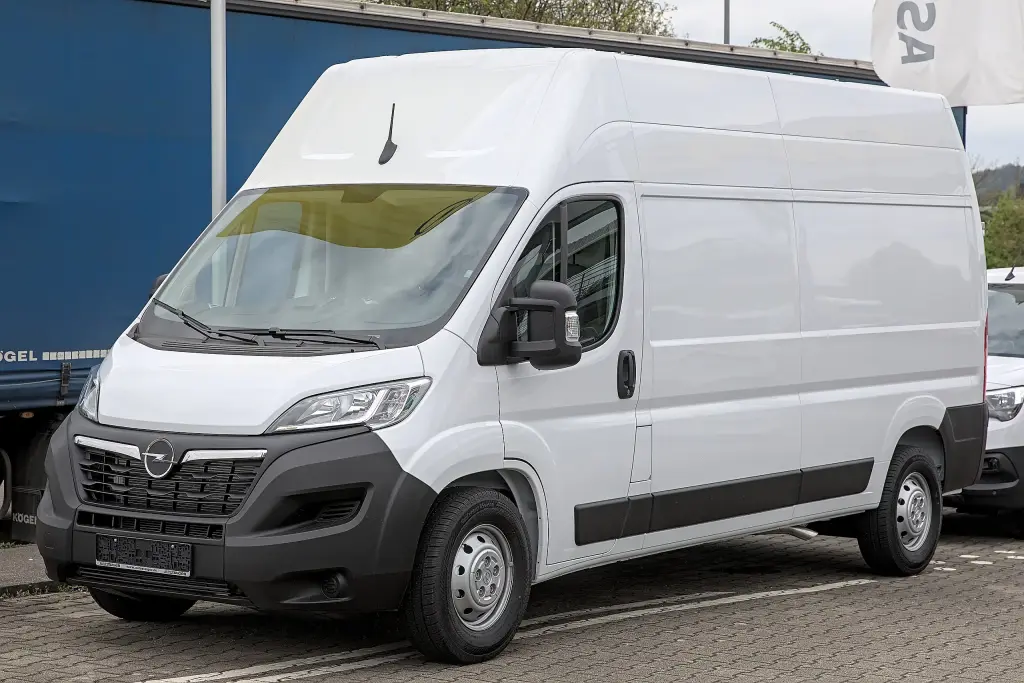
The Opel Movano is Opel’s large van. Its first two generations were a joint development with Renault and Nissan, built at the SOVAB factory in Batilly, France, alongside the Renault Master and the Nissan NV400; since Opel joined Stellantis the technical base has moved to Sevel Sud.
Opel Movano at a glance
| Maker | Opel |
|---|---|
| Production | since November 1998 |
| Class | large van |
| Developed with | Renault and Nissan (first two generations) |
| Built at | Batilly, France (SOVAB) |
| Sister models | Renault Master, Nissan NV400 / Interstar |
| Movano A | 1998–2009 |
| Movano B | 2010–2021 |
| Movano B lengths | L1 to L4, in three heights |
| British name | Vauxhall Movano |
Based on one source, the German Wikipedia article on the Opel Movano; the English Wikipedia has no page for this model. No free photograph was available, so the entry keeps its earlier picture.
History of the Opel Movano
Movano A
The first Movano went into production in November 1998, twenty-four years after the end of the Blitz range and eleven years after the Opel Bedford Blitz was withdrawn in Germany. Opel developed it together with Renault and Nissan, and the Movano A was identical to the second generation of the Renault Master; from early 2002 the Nissan Interstar was a further version of the same van. It was built in Batilly in the Meurthe-et-Moselle department of France, at the plant of the Société des Véhicules Automobiles de Batilly.
In October 2003 the Movano was restyled, with a completely new front and a slightly modified rear. The range gained two new common-rail turbodiesels, a 2.5-litre of 74 kW (101 PS) and a 3.0-litre of 100 kW (136 PS), while the 2.5 DTI of 84 kW (114 PS) stayed on as the CDTI. Alongside the five-speed manual there was now an automated manual gearbox called Tec-Shift. In autumn 2006 the 2.5 common-rail diesel was offered in two new ratings, 88 kW (120 PS) and 107 kW (146 PS); the 84 kW version was dropped and the 3.0 CDTI of 100 kW was replaced by a 2.5 CDTI of 107 kW (145 PS). Production ended in December 2009.
Movano B
The second generation was developed from scratch with Renault and Renault-Nissan and built as an Opel and Vauxhall from February 2010. Its Renault sister was the third-generation Master and the Nissan version became the NV400. The panel van came in four lengths and three heights, some with front-wheel drive and some with rear-wheel drive: front drive in L1H1, L1H2, L2H2, L2H3, L3H2 and L3H3, and rear drive in L3H2, L3H3, L4H2 and L4H3. Power came from a 2.3-litre common-rail turbodiesel in three ratings of 74 kW (100 PS), 92 kW (125 PS) and 110 kW (150 PS), the last having been 107 kW (147 PS) until March 2013.
Into Stellantis
When Opel became part of the Stellantis group, the technical base of the Movano was switched in 2021 to the Sevel Sud joint venture, which also supplies the Fiat Ducato, Peugeot Boxer and Citroën Jumper. In the United Kingdom the van has always been sold as the Vauxhall Movano.
Design and features
- Renault engineering: the first two generations were identical to the Renault Master.
- Built in France: Batilly in Meurthe-et-Moselle, at the SOVAB plant.
- Many sizes: four lengths and three heights, with front or rear-wheel drive.
- Turbo diesels: from the 2.5 and 3.0 common-rail units to the 2.3 of the Movano B.
Opel Movano versions
- Movano A (1998): the first generation, identical to the Renault Master II.
- Movano A restyling (2003): new front, 2.5 and 3.0 common-rail diesels, Tec-Shift gearbox.
- Movano B (2010): new van in four lengths and three heights.
- Nissan Interstar and NV400: the same vans under Nissan badges.
The Movano is the largest van in the Opel range, above the Vivaro, and it took the place of the old Blitz. More cars are in the Opel collection.
Sources
- Opel Movano, German Wikipedia: generations, plants, engines, sizes