Opel Blitz — Blitz is German for lightning — was the name Opel gave its light and medium trucks from 1930 to 1975. The three-tonne Blitz 3.6 became the standard German military lorry of the Second World War, and after it the name went on to post-war vans, fire engines and finally the Blitz B.
Opel Blitz at a glance
| Maker | Adam Opel AG, Rüsselsheim |
|---|---|
| Production | 1930–1975 |
| First model | presented November 1930 |
| Engines 1930 | 3.5-litre six of 61 PS; 2.6-litre four of 40 PS |
| Engine from 1937 | 75 hp overhead-valve six, also used in the Opel Admiral |
| Brandenburg plant | built from 1935; over 130,000 trucks and chassis by 1944 |
| Wartime model | Blitz 3.6, three tonnes |
| First post-war Blitz | 15 July 1946 |
| 1952 model | 1.75 tonnes, van and pickup |
| Blitz A | 1960, 1.9 tonnes, 2.6-litre six |
| Blitz B | 1965, the last of the line |
Based on one source, the English Wikipedia article on the Opel Blitz.
History of the Opel Blitz
The name
The name Blitz was chosen in a prize competition and first used on a new Opel truck presented in November 1930. In the years before the war Opel was Germany’s largest truck producer. The heavier models used a 3.5-litre flathead petrol six of 61 PS that came from the 1930 GM Marquette: after General Motors took over Opel in 1929 the Marquette’s production tools were shipped to Germany when that Buick sub-brand was closed. Opel’s own 2.6-litre four of 40 PS was also available. By 1934 there were four versions of the one-tonne model and fourteen versions of the larger two- and 2½-tonne trucks. In 1937 the Marquette engine was replaced by a modern overhead-valve 75 hp six that was also used in the Opel Admiral.
The two stripes that form a stretched letter Z in the original Blitz logo still appear in the Opel badge today.
The war years
From 1935 the Opelwerk Brandenburg was built as part of German rearmament, and by 1944 more than 130,000 Blitz trucks and chassis had been produced there. From 1939 the three-tonne Blitz 3.6 was used in large numbers by the Wehrmacht, in an elongated form and as the four-wheel-drive Blitz A. For the mud of the Eastern Front a half-tracked version, the Maultier (Sd.Kfz. 3), was built with tracks and suspension from Panzer I tanks. The light model was made in Rüsselsheim until 1942 and again from 1946 with the 55 hp engine of the Opel Super 6. On 6 August 1944 an RAF raid devastated the Brandenburg plant; about 2,500 more Blitz 3.6 trucks were then built at Daimler-Benz in Mannheim, whose own L3000 had to be dropped. After the war Daimler-Benz built the Blitz 3.6 as the L 701 until 1949, and the last 467 medium trucks were assembled by Opel in Rüsselsheim until 1954.
After the war
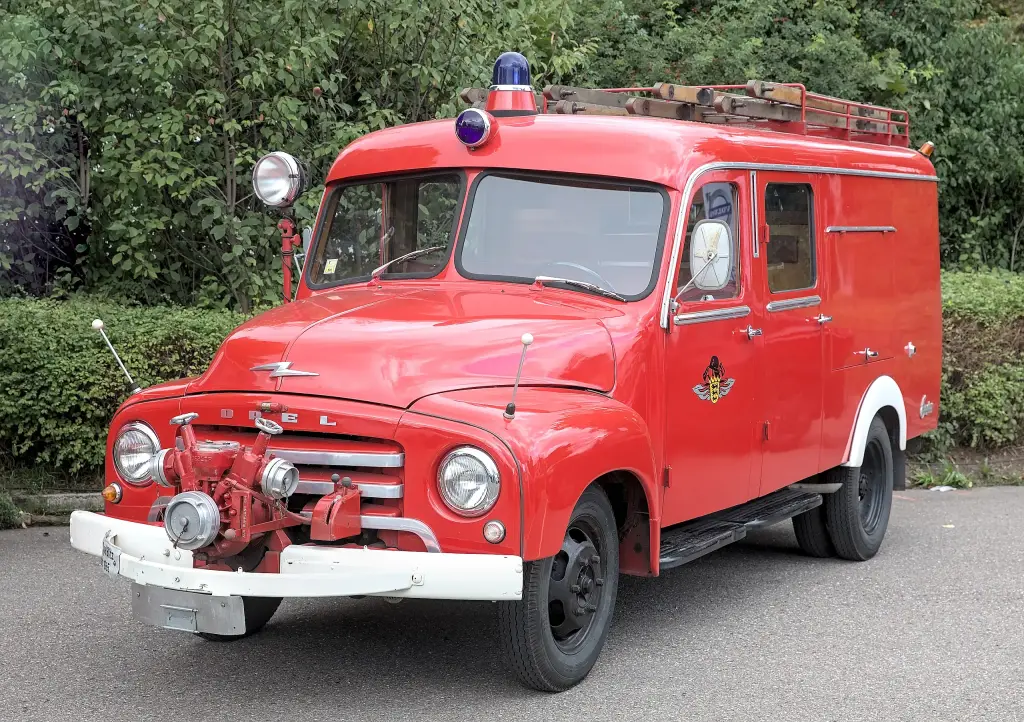
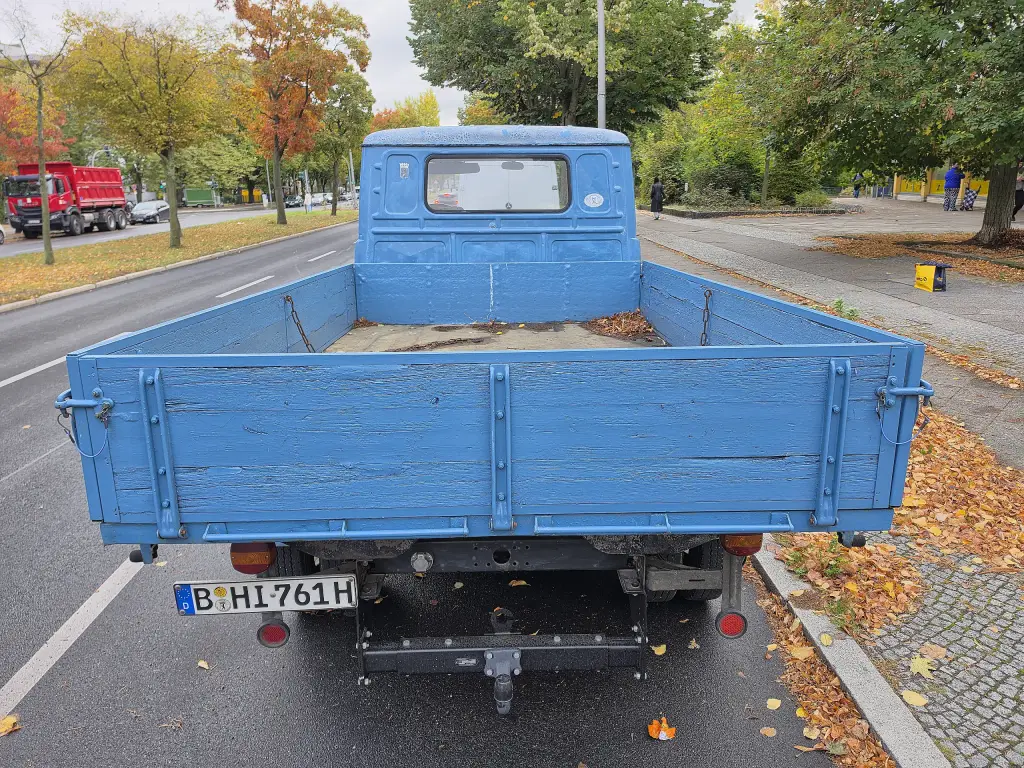
With Brandenburg dismantled and 47 per cent of the Rüsselsheim buildings destroyed, former Opel workers rebuilt the plant, and the first post-war Blitz was completed on 15 July 1946. The first post-war design, of 1952, used the cabin of the Chevrolet Advance Design with a different front end on the pre-war chassis and a more economical Opel engine; the 1.75-tonne truck came as a van and a pickup and remained the market leader among light trucks. A coach version was built by Kässbohrer from 1953 to 1956, and the Blitz was a popular basis for fire engines such as the LF8-TS. In 1960 the 1.9-tonne model with a 2.6-litre six replaced it; known later as the Blitz A, it had a cab-forward layout and more cargo space, but sales fell for want of an economical diesel. The Blitz B of 1965 was the last Opel Blitz. The name was later applied to the British-built Bedford CF in some markets.
Design and features
- Lightning name and logo: chosen in a competition, with two stripes forming a stretched Z.
- American engines: the 3.5-litre Marquette six and later a 75 hp overhead-valve unit shared with the Admiral.
- Military workhorse: the three-tonne Blitz 3.6 and the half-tracked Maultier.
- Fire engines: the LF8-TS conversion with a front-mounted pump was a familiar sight.
Opel Blitz versions
- One-tonne Blitz (1930): the original light truck.
- Two- and 2½-tonne trucks: fourteen versions by 1934.
- Blitz 3.6: the three-tonne lorry of 1939 and the standard Wehrmacht truck.
- Blitz A (4×4): four-wheel-drive military version.
- Maultier Sd.Kfz. 3: half-track with Panzer I running gear.
- Post-war 1.75-tonne (1952): van and pickup with a Chevrolet-style cab.
- Blitz A (1960) and Blitz B (1965): the last two civilian generations.
The Blitz shared its 75 hp six with the Opel Admiral and its 55 hp engine with the Opel Super 6. More Opel vehicles are in the Opel collection.
Sources
- Opel Blitz, English Wikipedia: engines, production, wartime and post-war models