The Nissan Presea was a compact car produced for the Asian market from 1990 to 2000. It competed with the entry-level luxury four-door hardtops popular in Japan in the 1990s, notably the Toyota Corolla Ceres, Toyota Sprinter Marino, Honda Integra and Mazda Lantis. Presea is Spanish for jewel or important.
Nissan Presea at a glance
| Production | 1990–2000 |
|---|---|
| Generations | R10 (1990–1995), R11 (1995–2000) |
| R10 base | Nissan Sunny B13 platform |
| R10 replaced | Nissan Laurel Spirit |
| Character | compact luxury four-door hardtop |
| R10 engines | shared with the Pulsar and NX coupés |
| R11 engines | GA15DE, SR18DE 125 hp, SR20DE |
| R11 dimensions | 4,425 mm long, 2,525 mm wheelbase, 1,695 mm wide, 1,325 mm tall |
| Sold at | Nissan Store |
based on one source: the English Wikipedia article on the Nissan Presea.
History of the Nissan Presea
R10 (1990–1995)
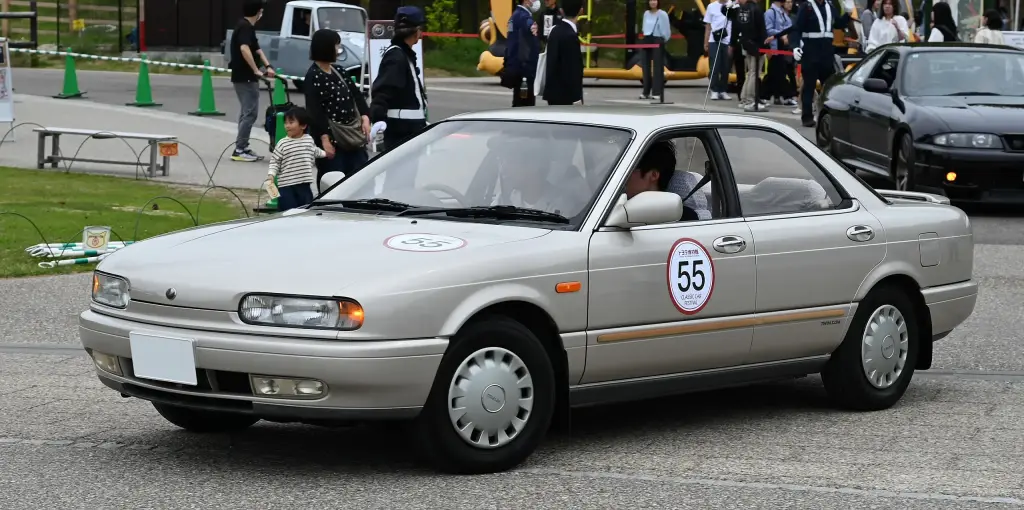
The original Presea was based on the B13 Sunny platform and replaced the Laurel Spirit, remaining a smaller companion to the Laurel with much of its styling and luxury in a smaller package. Its appearance was very similar to the much larger Nissan President. Body panels and interior were to a much higher specification than the Sunny’s: fabrics matched the Laurel, and standard equipment included automatic headlights, a lighted key slot, a rear-illuminated instrument cluster, an integrated sound system, automatic climate control with digital temperature control, height-adjustable seat belts with four-way adjustment, lumbar support for the driver, adjustable intermittent wipers, folding remote mirrors and, most notably, frameless windows like those of the NX coupé and Silvia. Many cars had four-wheel disc brakes with ABS and a rear wiper.
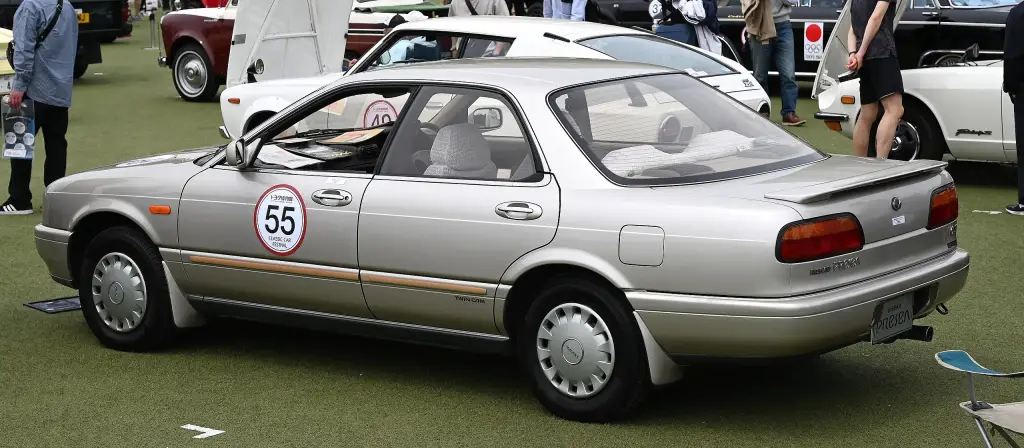
A glassy cabin
The A-pillar was thinner than on most compact cars, the B-pillar was almost invisible from outside and just wide enough inside for the seat-belt assembly, and the C-pillar wrapped around the rear window. Together these gave the driver more than 300 degrees of vision, like a fighter pilot. The rounded body left no visible straight edge and the grille-less front gave the car a sleek, futuristic look with some resemblance to the Infiniti Q45.
R11 (1995–2000)
The R11 Presea of 1995 was slightly longer. In Japan and some other countries the 125 hp SR18DE replaced the 110 hp SR18D, alongside the GA15DE and SR20DE, and it kept the drivetrain of the Sunny B14 and the same frameless door windows while growing to 4,425 mm long, 2,525 mm wheelbase, 1,695 mm wide and 1,325 mm tall. In Singapore, Thailand and New Zealand it mostly came with the older GA16DE. With almost every panel unchanged apart from fresher headlights and tail lights, it kept MacPherson struts at the front and multi-link rear geometry. Demand fell rapidly with Japan’s Lost Decade, and the Presea was cancelled after a review under the Nissan Revival Plan.
Design and features
- Frameless windows: the signature of both Presea generations.
- Glassy cabin: more than 300 degrees of vision for the driver.
- Laurel luxury: a compact car with executive equipment.
- Grille-less nose: a sleek front recalling the Infiniti Q45.
Nissan Presea versions
- Presea R10 (1990–1995): the first generation on the Sunny B13.
- Presea R11 (1995–2000): the longer second generation with the SR18DE.
The Presea was a smaller companion to the Laurel and sat above the Sunny. More cars are in the Nissan collection.
Sources
- Nissan Presea, English Wikipedia: R10 design and equipment, R11 changes and end of production