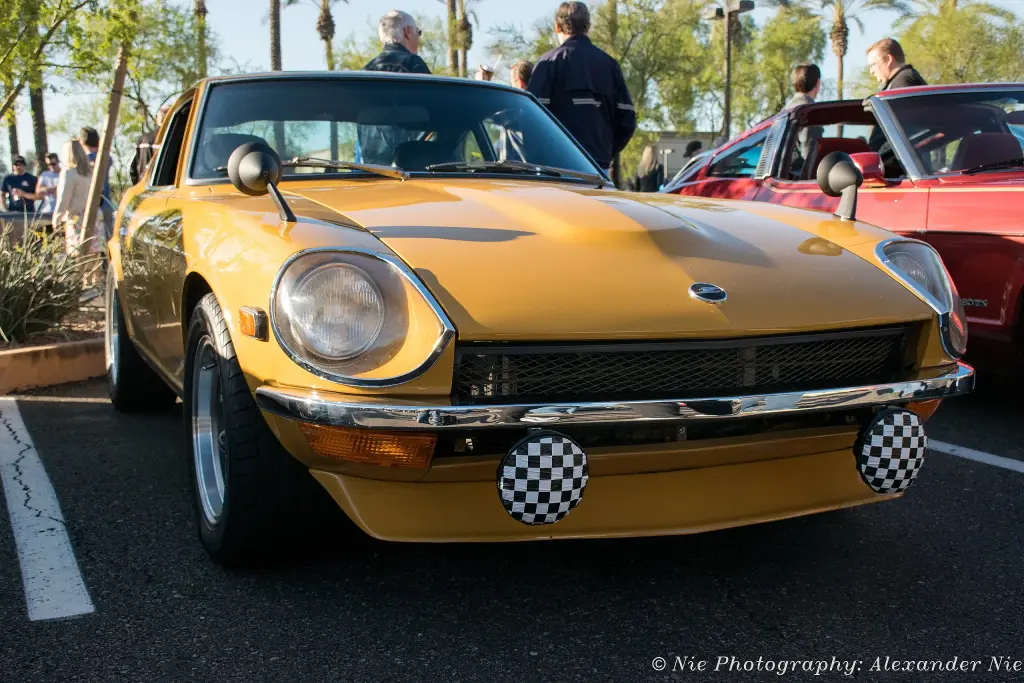
The Nissan S30, sold in Japan as the Fairlady Z and exported as the Datsun 240Z, 260Z and 280Z, was built from 1969 to 1978. It was conceived by Yutaka Katayama, then president of Nissan Motor Corporation U.S.A., and designed by a team led by Yoshihiko Matsuo. It is the first car in Nissan’s Z series.
Nissan Fairlady Z (S30) at a glance
| Production | 1969–1978 |
|---|---|
| Model codes | S30, HS30 (240Z), GS30 (2+2), S31 from 1976 |
| Japanese name | Nissan Fairlady Z |
| Export names | Datsun 240Z, 260Z, 280Z |
| Designers | Yutaka Katayama, Yoshihiko Matsuo |
| Japanese engine | L20 2.0-litre straight-six, 130 PS |
| Export engine | L24 2.4-litre six, 150 PS |
| Suspension | four-wheel independent |
| Bodies | two-seater and 2+2 |
| Special models | 240ZG, Z432 and Z432R |
based on one source: the English Wikipedia article on the Fairlady Z of the S30 generation.
History of the Nissan Fairlady Z (S30)
A sports car for the world
The S30 had four-wheel independent suspension and an overhead-camshaft straight-six, features then found on far more expensive European cars such as the Jaguar E-Type and BMW 2800 CS but missing from rivals like the Alfa Romeo Spider, MGB and Opel GT, which had four-cylinder engines and live rear axles. Its styling, engineering, low price and performance produced long waiting lists, and as a halo car it helped popularise Japanese makers beyond economy cars. Datsun’s growing dealer network played a large part, and the S30 was first sold alongside the smaller four-cylinder Datsun Sports until that car was dropped in 1970.
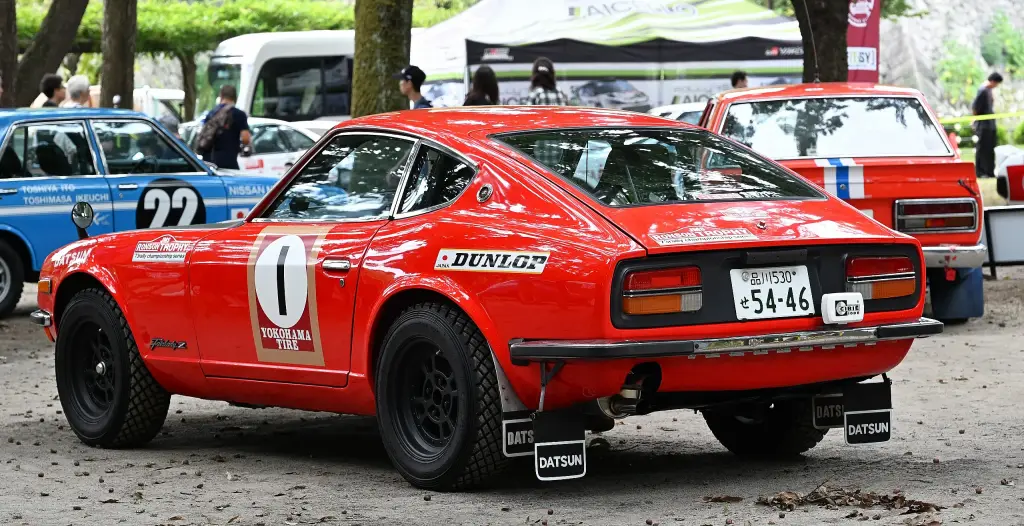
Fairlady Z at home
The Fairlady Z was introduced in late 1969 as a 1970 model with the L20 2.0-litre straight-six of 130 PS, rear-wheel drive and a coupé body, with four- or five-speed manual gearboxes. Power of the carburetted engine fell to 125 PS for 1973 to meet stricter rules. Japanese buyers could also order the L24-engined Fairlady 240Z (HS30) with 150 PS, though the larger engine put it in a higher tax class; it was dropped in 1973 after the fuel crisis, and until the August 1978 Fairlady 280Z only two-litre cars were sold at home. The 2+2 model arrived in January 1974 as the GS30, the L20 gained fuel injection in 1975 and the NAPS emission system in July 1976 brought the S31 code and the luxury Z-T equipment level.
240ZG, Z432 and Z432R
The Japan-only Fairlady 240ZG appeared in October 1971 to homologate the 240Z for Group 4 racing, with an extended glass-fibre “aero-dyna” nose, riveted over-fenders, a rear spoiler, acrylic headlight covers and fender-mounted mirrors; its better aerodynamics gave a 210 km/h top speed, five more than the standard 240Z. The Z432 used the twin-cam 2.0-litre S20 engine from the Skyline GT-R, with four valves per cylinder, three Mikuni carburettors and two camshafts, making 160 PS; about 420 were built. The Z432R was a lighter homologation special with thinner steel, a fibreglass bonnet, acrylic glass and a 100-litre fuel tank, some 100 kg lighter than the Z432 and painted orange with black wheels.
Design and features
- Six-cylinder engine: an overhead-cam straight-six in an affordable sports car.
- Independent suspension: all four wheels, unusual at the price.
- 240ZG aero nose: the racing homologation front, 210 km/h top speed.
- Z432: the Skyline GT-R engine in a Z, about 420 built.
Nissan Fairlady Z (S30) versions
- Fairlady Z (1969–1978): the Japanese 2.0-litre car.
- Datsun 240Z (HS30): the 2.4-litre export model.
- Datsun 260Z (1974): the larger 2.6-litre export engine.
- Datsun 280Z (to 1978): the final S30 export version.
- Fairlady 240ZG (1971): the aero-nose homologation car.
- Fairlady Z432 and Z432R: the S20-engined specials.
The S30 was followed by the 280ZX and 300ZX, and its spirit returned in the 350Z. More cars are in the Nissan collection.
Sources
- Nissan Fairlady Z (S30), English Wikipedia: design, engineering, Japanese models, ZG and Z432