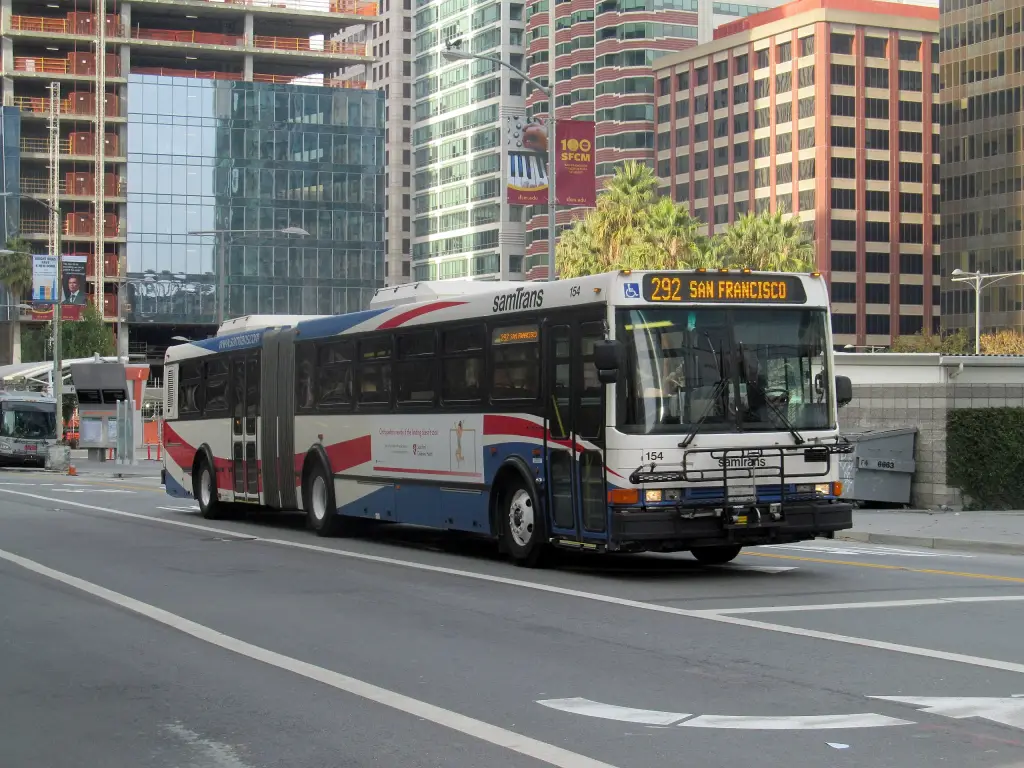
The NABI 436 is the 60-foot articulated bus of the SFW series, derived from the Hungarian Ikarus 435 and produced from 1991 until 2002. It carried high-floor construction into the era of low-floor buses and was withdrawn long before the rigid 416 it was developed alongside.
NABI 436 at a glance
| Maker | American Ikarus, then North American Bus Industries |
|---|---|
| Production | 1991–2002 |
| Class | articulated high-floor transit bus |
| Length | 60 ft nominal |
| Derived from | Ikarus 435 |
| Also called | 60-SFW |
| Engines | diesel and CNG; diesel-electric hybrid |
| Introduced | added to the line-up in 1991 |
| First order | Port Authority of Allegheny County, 1991 |
| Last order | SamTrans, 2002 |
| Orders | eleven numbered orders, 436.00 to 436.10, two cancelled |
Based on one source: the English Wikipedia article on the SFW series, which describes the 436 in sections covering the whole family.
History of the NABI 436
The 436 arrived in 1991, two years after the rigid 416, as the articulated member of the SFW family. Like the 416, it grew out of the Ikarus partnership: rolling shells were assembled in Hungary and finished in the United States to meet Buy America requirements for federally subsidised transit vehicles. Its Hungarian parent was the Ikarus 435, hence the larger model number.
The first 436 order was delivered to the Port Authority of Allegheny County in 1991. Production of the SFW line passed from Union City Body to American Ikarus after the Indiana company’s bankruptcy in 1992, and the business was renamed North American Bus Industries in 1997. In 1998 the stainless steel frame became an option across the SFW range.
By then the articulated bus was losing ground. NABI had introduced the low-floor LFW line in 1997 to supplement the older SFW buses, and the 436 was discontinued in 2002. The final order was produced for SamTrans, the transit district of San Mateo County in California.
Only eleven 436 orders were ever numbered, from 436.00 to 436.10, and two of those were cancelled — a modest total set against sixteen orders for the rigid 416. Under NABI’s alternative length-based scheme the articulated bus was also known as the 60-SFW.
Design and features
- Articulated layout: two body sections joined by a flexible joint for high-capacity routes.
- Ikarus 435 basis: the Hungarian articulated design adapted for American buyers.
- High floor: the bus belonged to the older SFW family rather than NABI’s low-floor generation.
- Buy America assembly: Hungarian shells completed in Anniston, Alabama.
- Short production life: withdrawn in 2002 as low-floor buses took over.
NABI 436 versions
- Ikarus USA 436 (1991–1992): the first buses, assembled by Union City Body.
- American Ikarus 436 (1992–1997): production after the bankruptcy.
- NABI 436 (1997–2002): the final years under the NABI name.
- 60-SFW: the alternative length-based designation for the same bus.
The 436 was the articulated stablemate of the NABI 416, and its low-floor replacement in the range was the NABI 40-LFW. More buses are in the NABI collection.
Video: RTC Transit 1997 NABI 436 on Maryland Parkway
Video on YouTube.
Sources
- NABI SFW, English Wikipedia: history, numbering, production dates