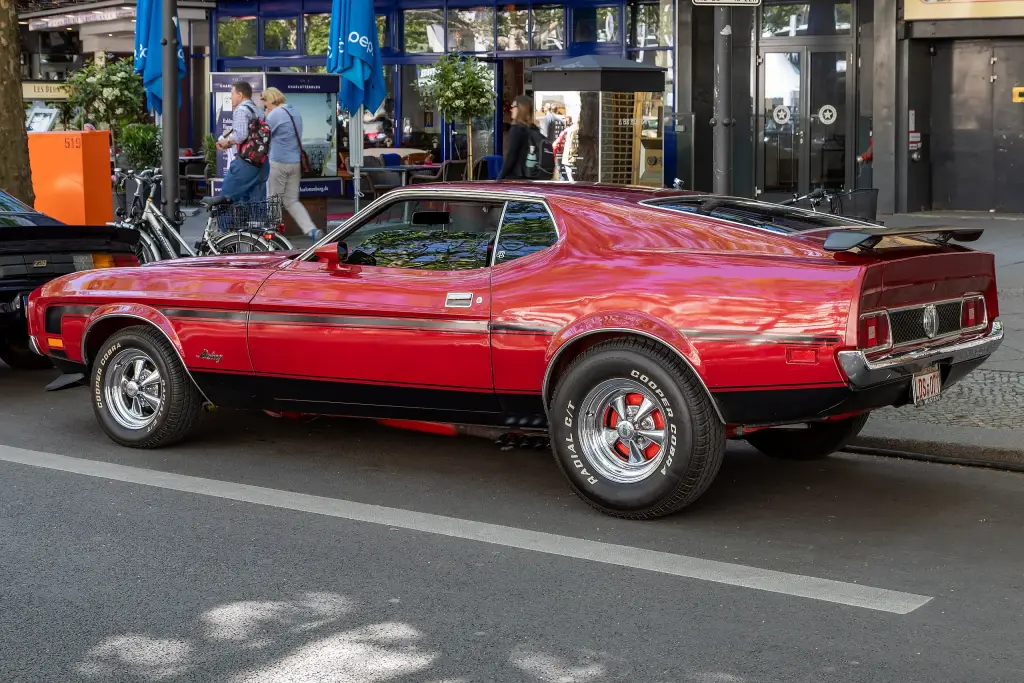
The Ford Mustang is an American automobile manufactured and marketed by Ford since 1964, and the longest-running Ford nameplate in continuous production. It gave its name to the pony car class, and it was developed as a highly styled line of sporty coupes and convertibles with long-hood, short-deck proportions.
Ford Mustang at a glance
| Maker | Ford Motor Company |
|---|---|
| Production | since 17 April 1964 |
| Class | pony car |
| Predicted sales | 100,000 a year |
| First-year sales | over 400,000 |
| Millionth car | within two years of launch |
| Ten-millionth car | August 2018, a 2019 Wimbledon White convertible |
| Chassis links | Falcon until 1973, Pinto 1974–1978, Fox 1979–2004 |
| Own platform | D2C, from 2005 |
| Name in Germany | T-5 until December 1978 |
| Defining features | long hood, short deck; GT, Mach 1, Boss, Cobra, Bullitt |
This page is based on English Wikipedia only.
History of the Ford Mustang
Where the name came from
Executive stylist John Najjar, a fan of the P-51 Mustang fighter, is credited by Ford with suggesting the name, and he co-designed the first Mustang I prototype of 1961 with Philip T. Clark; that car made its formal debut at the Watkins Glen United States Grand Prix on 7 October 1962, demonstrated by Dan Gurney. An alternative account has market research manager Robert J. Eggert, a breeder of quarter horses, adding Mustang to the list after receiving J. Frank Dobie’s book The Mustangs as a birthday present in 1960; it won the focus groups by a wide margin. The designer had preferred Cougar or Torino and Henry Ford II wanted T-bird II. The name could not be used in Germany, where Krupp owned it and Ford refused to pay about US$10,000 for it, so Mustangs were sold there as T-5s until December 1978.
The launch that broke records
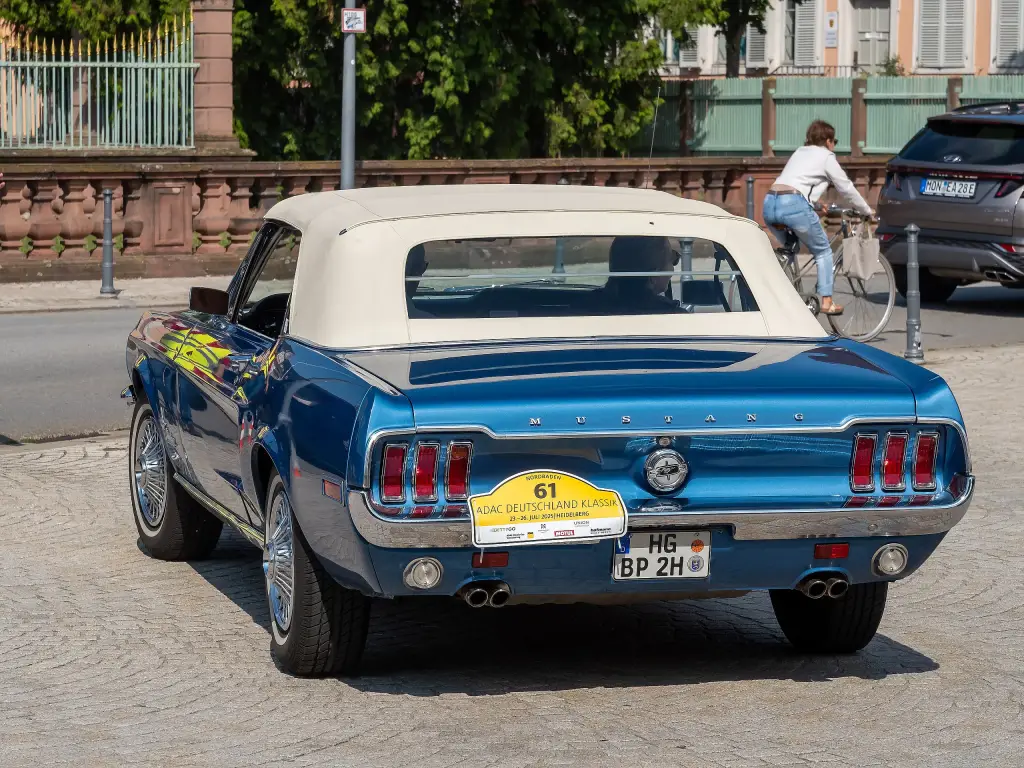
Ford expected to sell 100,000 Mustangs a year, but the 1965 car became the most successful vehicle launch since the 1927 Model A. Introduced on 17 April 1964, sixteen days after the Plymouth Barracuda, it sold over 400,000 units in its first year, and the one-millionth Mustang was sold within two years. In August 2018 Ford built the ten-millionth, a 2019 Wimbledon White convertible with a V8, matching the first 1965 car.
A car other makers answered
The Mustang’s success brought competitors from every American maker, among them the Chevrolet Camaro and Pontiac Firebird of 1967, the AMC Javelin of 1968 and the Dodge Challenger of 1970, and it influenced coupé design worldwide, leading to cars such as the Toyota Celica and the Ford Capri. From 1965 until 2004 the Mustang shared its chassis with other Fords, staying rear-wheel drive throughout: it was derived from the 1960 Falcon until 1973, was a long-wheelbase Pinto as the Mustang II from 1974 to 1978, and used the Fox platform from 1979 to 2004, the last car to do so. Since 2005 it has had the D2C platform to itself, and the range has carried badges such as GT, Mach 1, Boss 302 and 429, Cobra, Bullitt and 5.0.
Design and features
- Pony car proportions: a long hood and a short deck derived from existing Ford lines.
- Record launch: over 400,000 cars sold in the first year.
- Long nameplate: the longest-running Ford model in continuous production.
- Performance badges: GT, Mach 1, Boss, Cobra and Bullitt versions.
Ford Mustang versions
- Mustang I concept (1962): the first car to carry the name.
- 1965 Mustang: the launch model based on the Falcon.
- Mustang II (1974–1978): the Pinto-based generation.
- Fox-platform Mustang (1979–2004): the long-running generation.
- D2C Mustang (from 2005): the first with its own platform.
- GT, Mach 1, Boss and Bullitt: the best-known performance versions.
The Mustang was the model the Capri was meant to repeat in Europe, and its early cars used the Falcon chassis. More Ford vehicles are in the Ford collection.
Sources
- Ford Mustang, English Wikipedia: launch, sales, naming, platforms