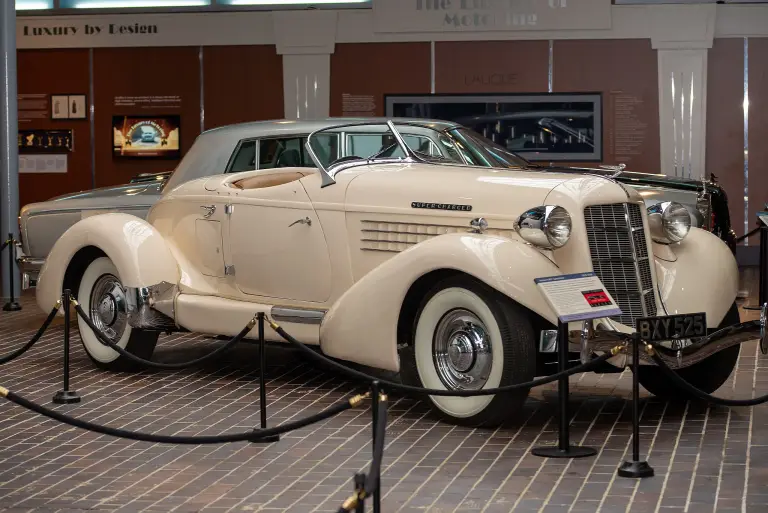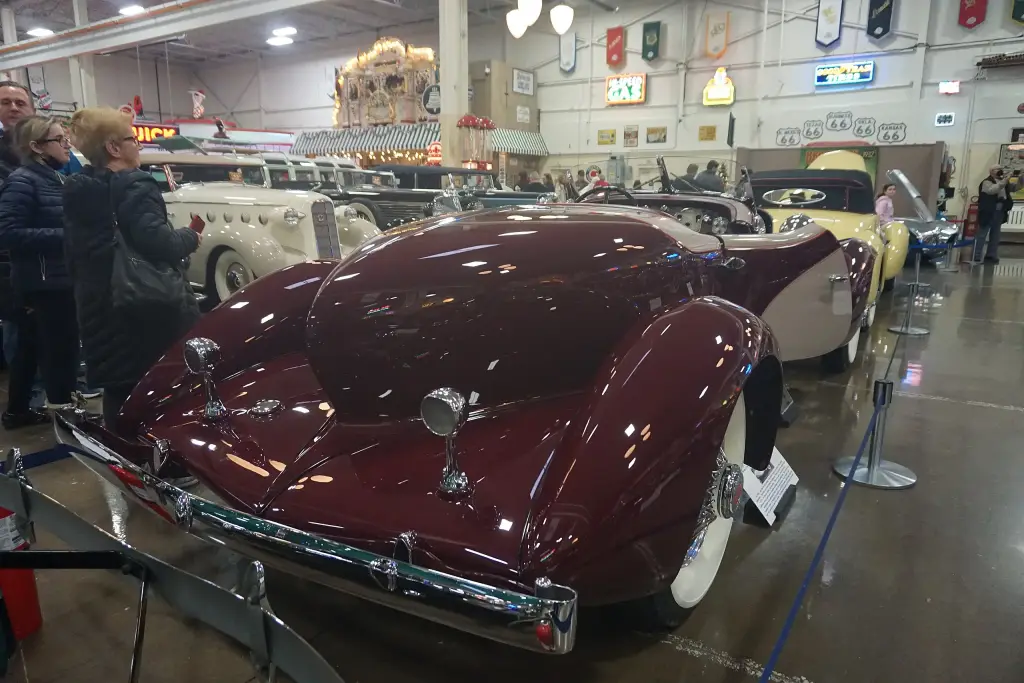
The Cord L-29 was a luxury car built by Cord, the Auburn Automobile Company’s prestige marque, from 1929 to 1932. It was the first American front-wheel-drive car offered to the public, beating the Ruxton by several months, and its low chassis and de Dion front axle came straight from Indianapolis racing practice.
Cord L-29 at a glance
| Maker | Cord, Auburn Automobile Company |
|---|---|
| Production | 1929–1932 |
| Engineering | Cornelius Van Ranst, a former Miller engineer |
| Engine | 4,934 cc (301 cu in) Lycoming L-head straight-eight, 125 hp |
| Transmission | three-speed |
| Drive | front-wheel drive, de Dion front axle, inboard brakes |
| Wheelbase | 137.5 in (3,490 mm) |
| Height | 61 in for the sedan |
| Weight | 4,700 lb (2,100 kg) |
| Top speed | just over 80 mph (130 km/h) |
| Price | around $3,000 |
| Built | about 4,400 |
English Wikipedia has no separate article on the L-29; this page uses the L-29 section of its Cord marque article together with the French article on the model.
History of the Cord L-29
Origins
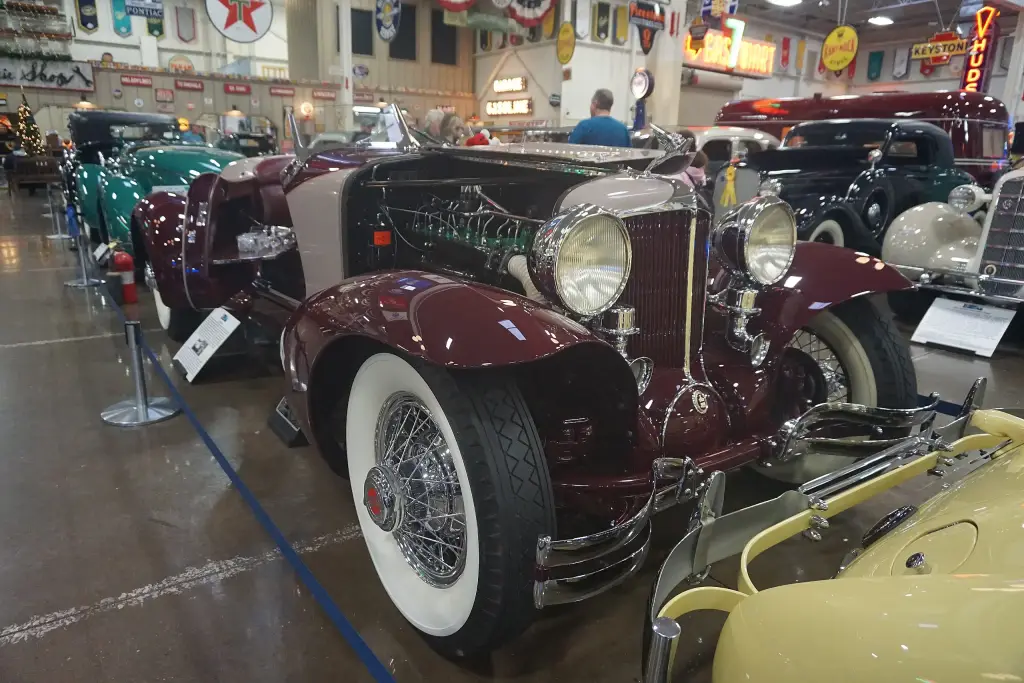
Cord was founded in 1929 by E. L. Cord as a prestige marque between his Auburn and Duesenberg cars. The L-29 followed the L-27 prototype of 1927 and was shown at the New York Auto Show in November 1929, ten days after the Wall Street crash. It was the work of Cornelius Van Ranst, a former Miller engineer, and borrowed from the Indianapolis 500-winning racers: a de Dion front axle with inboard brakes and hydraulic Lockheed drum brakes on all four wheels. It was also the first American front-wheel-drive car to use constant-velocity joints, in the form of double Hooke’s joints rather than the Rzeppa joints adopted by Ruxton.
Front-wheel drive and a frame without the rear kick-up needed to clear a rear axle allowed the L-29 to sit much lower than its rivals, whose bodies were on average about six feet high. The styling was widely admired, and both stock cars and special bodies built on the Cord chassis by American and European coachbuilders won prizes in concours d’élégance around the world. The 1930 Chrysler Imperial and Chrysler Eight copied several of its styling elements.
Engine and road behaviour
Power came from a Lycoming 4,934 cc L-head straight-eight of 125 hp, taken from the Auburn 120, with the crankshaft pushed out through the front of the block and the flywheel mounted there, driving a three-speed gearbox. Gearing in both the gearbox and the front axle was inadequate for a car weighing 4,700 lb, and the L-29 was underpowered: its top speed was only a little over 80 mph, below what the cheaper Auburn could manage. The 137.5 in wheelbase and steering that needed four turns from lock to lock did not promise much either, yet handling was reported to be superb. The sedan stood just 61 in tall.
The car came with full instrumentation: a temperature gauge, oil pressure gauge and speedometer on the left of the steering wheel, and a fuel gauge, oil level gauge and ammeter on the right.
Bodies and the end
The L-29 was offered as a sedan, a Brougham saloon, a coupé cabriolet and a phaeton sedan cabriolet, or as a chassis and engine for independent coachbuilders. At around $3,000 it stood in the upper tier of American luxury cars, alongside Cadillac, Marmon, Lincoln, Packard, Franklin and Stutz and below only Duesenberg. The Great Depression could not be overcome: production stopped in 1932 with about 4,400 cars built. A V12-engined L-30 planned for 1930 was cancelled after the crash, and the Cord name did not return until the 810 of 1936.
Design and features
- First American front-wheel drive: offered to the public months before the Ruxton, and before the Citroën Traction Avant of 1934.
- Racing-derived front end: a de Dion axle with inboard brakes, from the Indianapolis 500 cars of the Miller team.
- Constant-velocity joints: double Hooke’s joints, the first use on an American front-wheel-drive car.
- Low body: a frame without a rear kick-up let the sedan stand only 61 in tall.
- Full instrumentation: gauges arranged on both sides of the steering wheel.
- Coachbuilt bodies: chassis supplied to independent coachbuilders, with concours wins in America and Europe.
Cord L-29 versions
- Sedan: the standard four-door saloon.
- Brougham: the more formal closed saloon.
- Coupé cabriolet: the two-door convertible.
- Phaeton sedan cabriolet: the four-door convertible.
- Chassis and engine: sold to independent coachbuilders for special bodies.
The L-29 was succeeded in 1936 by the Cord 810/812. More cars of the marque are in the Cord collection.
Video: Brooks Stevens L-29 Cord: we go for a ride
Video on YouTube.
Sources
- Cord (automobile), English Wikipedia: engineering, engine, price, production
- Cord L-29, French Wikipedia: origins, body styles, coachbuilders