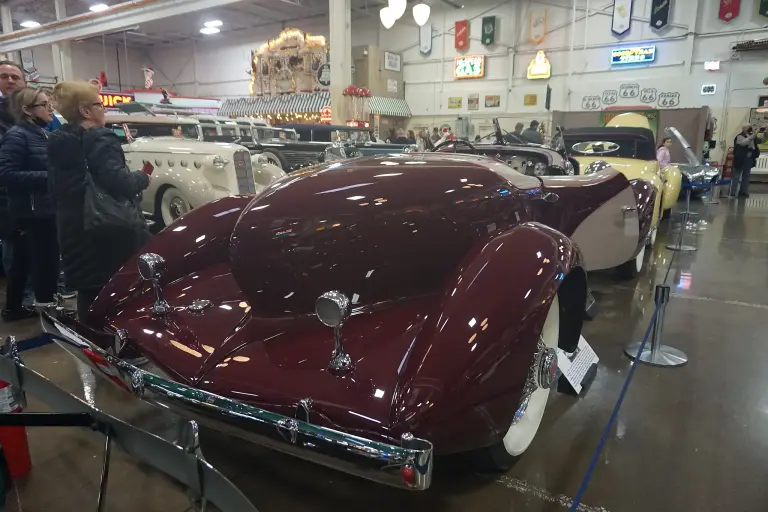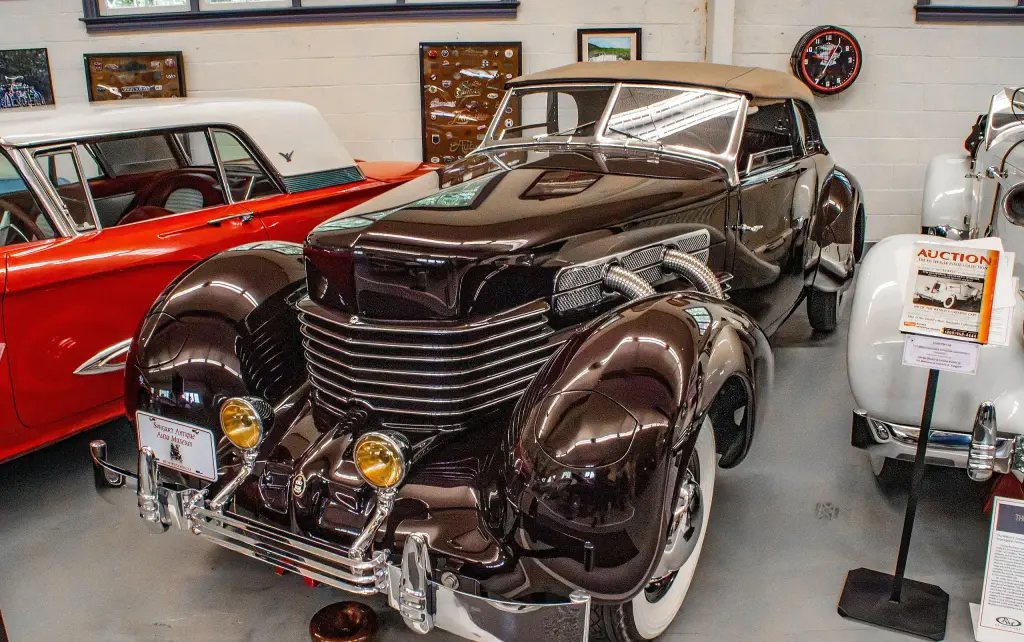
The Cord 810 of 1936 and its 1937 successor, the Cord 812, were luxury cars built by the Cord Automobile division of the Auburn Automobile Company. The 810 was the first American-designed and built front-wheel-drive car with independent front suspension, and the first production car to have hidden, pop-up headlamps; its louvered wraparound nose earned it the nickname ‘coffin nose’.
Cord 810/812 at a glance
| Maker | Cord Automobile, Auburn Automobile Company |
|---|---|
| Production | 1936–1937 |
| 1936 range | sedan, Beverly sedan, Sportsman, Phaeton |
| 1937 additions | Custom Beverly and Custom Berline (Westchester) on a 132 in wheelbase |
| Engine | 4,739 cc (289 cu in) Lycoming V8, 125 hp |
| Supercharged | 170 hp; 810S in 1936, 812S in 1937 |
| Transmission | four-speed semi-automatic, mounted ahead of the engine |
| Drive | front-wheel drive with independent front suspension |
| Wheelbase | 125 in (3,175 mm); 132 in (3,400 mm) for the Customs |
| Prices | $1,995–$2,195 in 1936; $2,445–$2,645 in 1937 |
| Headlamps | hidden, raised by hand cranks on the dashboard |
| Built | 2,972, including 205 cabriolets |
History of the Cord 810/812
The 810 of 1936
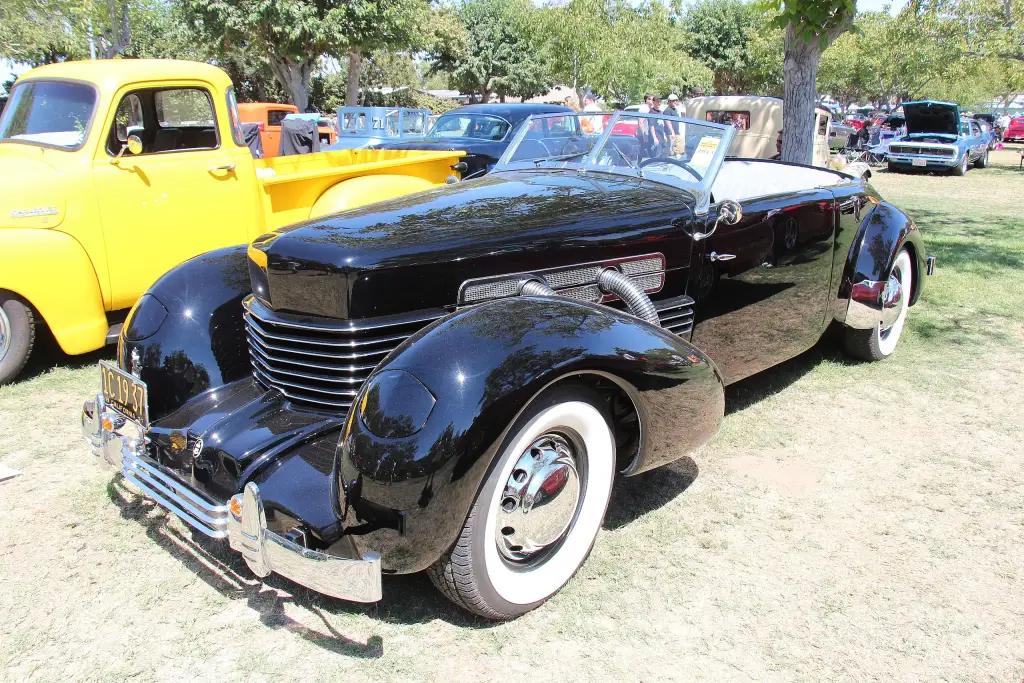
The 810 was styled by Gordon M. Buehrig and his team, which included the young Vince Gardner and Alex Tremulis. Power came from a 4,739 cc Lycoming V8 of 125 hp, the same output as the straight-eight of the earlier Cord L-29. The semi-automatic four-speed transmission sat in front of the engine, as on the L-29, which allowed Buehrig to do away with the driveshaft and the transmission tunnel and gave the car its low, sleek look; running boards went too. The wheelbase was 125 in, and the 1936 range had four models: an entry-level sedan at $1,995, the Beverly sedan at $2,095, the Sportsman at $2,145 and the Phaeton at $2,195.
The car was reportedly conceived as a Duesenberg and was almost free of chrome. It had hidden door hinges and a rear-hinged hood, pontoon fenders with headlamps hidden behind panels — modified Stinson landing lights, from a company in which E. L. Cord held a majority — that were raised by hand cranks on the dashboard. There was a concealed lockable fuel filler, variable-speed windscreen wipers and an engine-turned dashboard with full instrumentation, a tachometer and a radio as standard.
It caused a sensation at the New York Auto Show in November 1935, where the crowds were so dense that people stood on the bumpers of nearby cars to see it. Cord had rushed to build the 100 cars needed for the show, but the transmission was not ready. Orders were taken with a promise of Christmas delivery and production of 1,000 cars a month was expected, yet the semi-automatic gearbox proved troublesome: the first cars reached New York only in April 1936, and just 1,174 of the new 810 were sold in the first model year.
The 812 of 1937
For 1937 the car was renamed 812, with detail changes and the same four models, now priced from $2,445 to $2,645. Two more were added on a 132 in wheelbase: the $2,960 Custom Beverly and the $3,060 Custom Berline, called the Westchester. Left-over and in-process 1936 810s were renumbered and sold as 1937 812s. Reliability problems such as slipping out of gear and vapour lock cooled early enthusiasm, and the dealer base shrank quickly.
The supercharged S models
A mechanically driven Schwitzer-Cummins supercharger was offered: supercharged 1936 cars were called 810S and 1937 cars 812S, and were easily recognised by the chrome-plated external exhaust pipes mounted on each side of the hood and grille. With the blower, power rose to 170 hp.
The end and the 814 prototype
Production ended in 1937 after 2,972 cars in total, including 205 cabriolets and the one-off 1938 Custom Cabriolet prototype. Cord had planned mechanical and cosmetic updates for a 1938 model, probably to be called 814; a single prototype was built and kept in storage for many years, surfacing in 1989, when its owner used factory archive photographs and drawings to confirm what it was. The 810/812 was the last American front-wheel-drive car for almost thirty years, until the Oldsmobile Toronado of 1966; the Toronado and the Cadillac Eldorado of 1967 both paid homage to its hidden headlamps.
Design and features
- Coffin nose: a horizontally louvered grille wrapping around the sides of the nose instead of a vertical radiator.
- Hidden headlamps: modified Stinson landing lights folded into the fenders and raised by hand cranks — a first for a production car.
- Front-wheel drive: independent front suspension and the gearbox ahead of the engine, so there was no driveshaft or transmission tunnel.
- Buehrig styling: no running boards, hidden hinges, a rear-hinged hood and a concealed fuel filler.
- Equipment: variable-speed wipers, an engine-turned dashboard, a tachometer and a radio as standard.
- Supercharged S: 170 hp and external chrome exhaust pipes along the hood.
Cord 810/812 versions
- 810 sedan (1936): the entry-level model at $1,995.
- Beverly sedan (1936): the better-equipped four-door at $2,095.
- Sportsman (1936): the open model at $2,145.
- Phaeton (1936): the four-door convertible at $2,195.
- 810S and 812S: supercharged versions with 170 hp and external exhaust pipes.
- 812 Custom Beverly and Custom Berline (1937): long-wheelbase models at $2,960 and $3,060.
- 814 prototype: a single 1938 prototype, discovered in 1989.
The 810/812 succeeded the front-wheel-drive Cord L-29 of 1929. More cars of the marque are in the Cord collection.
Video: 1936 Cord 810/812: The Beautiful Baby Duesenberg That Never Caught On
Video by Jay Leno’s Garage on YouTube.
Sources
- Cord 810/812, English Wikipedia: styling, engineering, prices, production
- Cord 810/812, French Wikipedia: body styles, gearbox, performance