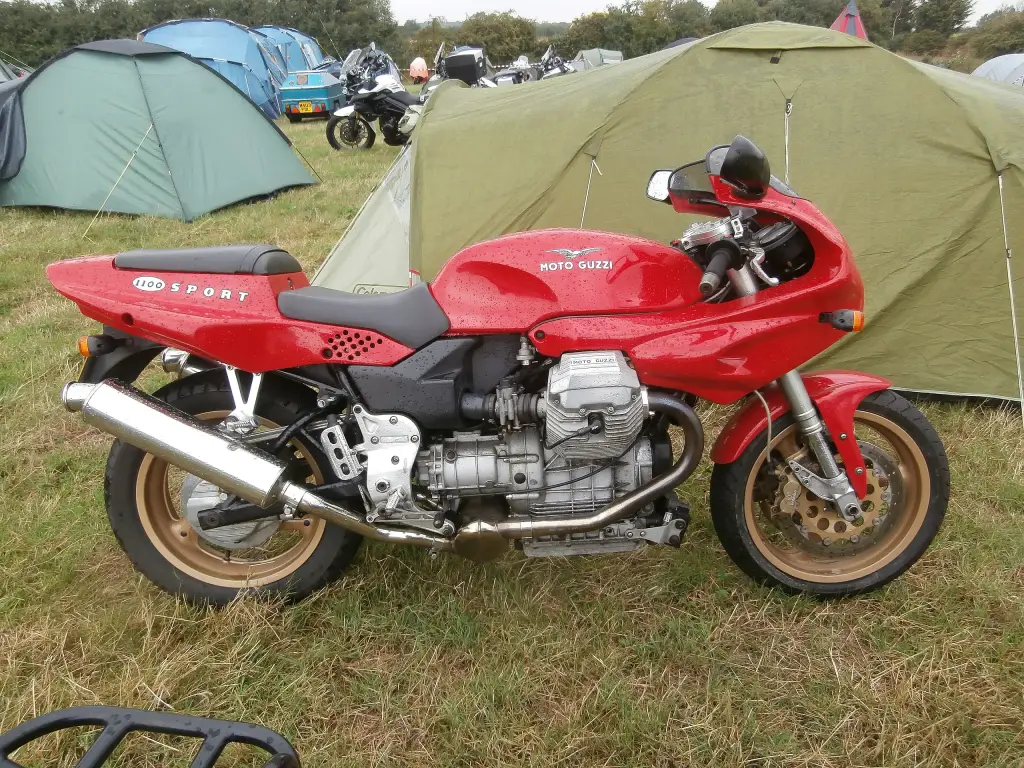
The Moto Guzzi 1100 Sport was a sports motorcycle built by Moto Guzzi from 1994 to 2000. It was intended as the company’s second sports bike, with simpler equipment than the Daytona from which it was derived.
Moto Guzzi 1100 Sport at a glance
| Maker | Moto Guzzi, Mandello del Lario |
|---|---|
| Production | 1994–2000 |
| Derived from | Moto Guzzi Daytona |
| Engine | 1,064 cc V-twin, two valves per cylinder, pushrods |
| First version | two Dell’Orto 40 mm carburettors |
| From 1996 | Weber-Marelli sequential electronic injection, 45 mm throttle bodies |
| Power | about 90 hp in both versions |
| Compression | 10.5:1 carburettor version, 9.5:1 injection version |
| Frame | John Wittner spine beam from the Daytona |
| Front suspension | Marzocchi 41.7 mm fork, then White Power upside-down fork |
| Brakes | Brembo four-piston calipers, twin front discs |
The English Wikipedia has no article on the 1100 Sport; this page is based on the Italian article and is therefore based on one source.
History of the Moto Guzzi 1100 Sport
The 1100 Sport was meant to be Moto Guzzi’s second sports offering, with simpler equipment than the Daytona from which it descended. The difference between the two models was not so marked, and basically not technical either, so the two ended up cannibalising each other and neither of them broke through.
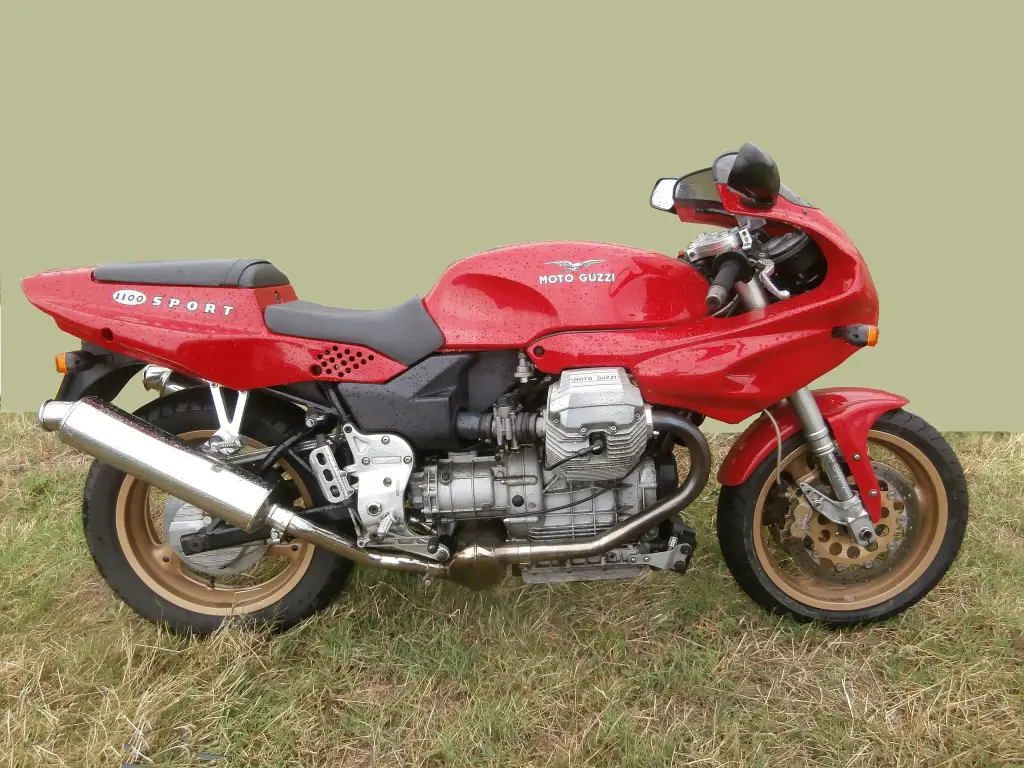
Mechanically the 1100 Sport had the 1,064 cc V-twin with two valves per cylinder and pushrod distribution, while the Daytona had the 992 cc unit with overhead cams, rockers and four valves per cylinder. From the Daytona the 1100 Sport also took the frame designed and developed by John Wittner, the American dentist known as Dr. John: a descending rectangular-section spine beam that joined the steering head directly to the rear swingarm.
Two versions
The first version of the 1100 Sport had carburettor fuelling, two Dell’Orto of 40 mm; the second, on the market from 1996, had Weber-Marelli sequential electronic injection with 45 mm throttle bodies. Both versions had about 90 hp, although with different compression ratios, a higher 10.5:1 for the carburettor version and a milder 9.5:1 for the injected one.
Its performance, despite a good frame and an engine not excessive in maximum power but with high torque from low revs as usual with the Guzzi V-twin, was held back by anachronistic tyres, with a 17-inch front wheel and an 18-inch rear. The rapid development of tyres in those years, especially for the driven wheel, made much wider rubber available able to put far more power on the road, but the swingarm layout with a floating shaft drive, and above all the limited financial resources, did not allow the rear end to be redesigned for such tyres, which limited the performance of the 1100 Sport.
Chassis differences
The first version had a Marzocchi fork of 41.7 mm at the front, replaced on the second version by a fully adjustable White Power upside-down fork of 40 mm taken from the Daytona RS, with a fully adjustable White Power monoshock at the rear. Braking was the usual Brembo with four-piston calipers, twin discs at the front and a single disc at the rear. Between the two versions there were also other differences: the oil radiator was absent on the first version; the wheels were split three-spoke on the first and single three-spoke Marchesini aluminium on the second, with an 18-inch rear wheel on the first and 17-inch on the second; the frame side plates were drilled on the first version and solid on the second, with a label bearing the Mandello eagle; the steering plates and front mudguard changed to suit the different forks; and the 1100 Sport lettering on the tail was in italics on the first version and in block capitals, with the 1100 in an oval, on the second.
Design and features
- Daytona-derived: the Wittner spine frame and sports layout in a simpler, cheaper package.
- Two-valve 1,064 cc V-twin: about 90 hp with strong low-down torque.
- Carburettors to injection: Dell’Orto 40 mm in 1994, Weber-Marelli injection from 1996.
- White Power suspension: the second version used the Daytona RS fork and monoshock.
- Racing version: the 1100 Sport Corsa of 1998–1999.
Moto Guzzi 1100 Sport versions
- 1100 Sport (1994–1997): carburettor version with Marzocchi fork and 18-inch rear wheel.
- 1100 Sport IE (1996–2000): injected version with White Power fork and 17-inch rear wheel.
- 1100 Sport Corsa (1998–1999): the racing variant of the model.
The 1100 Sport was the simpler sister of the Daytona, and its engine later went into the California 1100. More machines are in the Moto Guzzi collection.
Video: Moto Guzzi 1100 Sport onboard (2nd edit)
Video by Danspics on YouTube.
Sources
- Moto Guzzi 1100 Sport, Italian Wikipedia: versions, engine, frame, suspension, differences, versions list