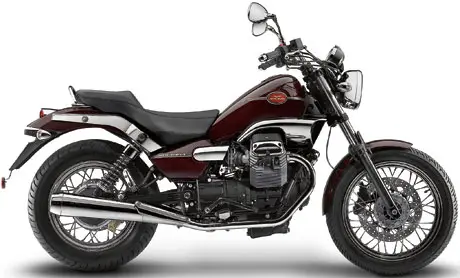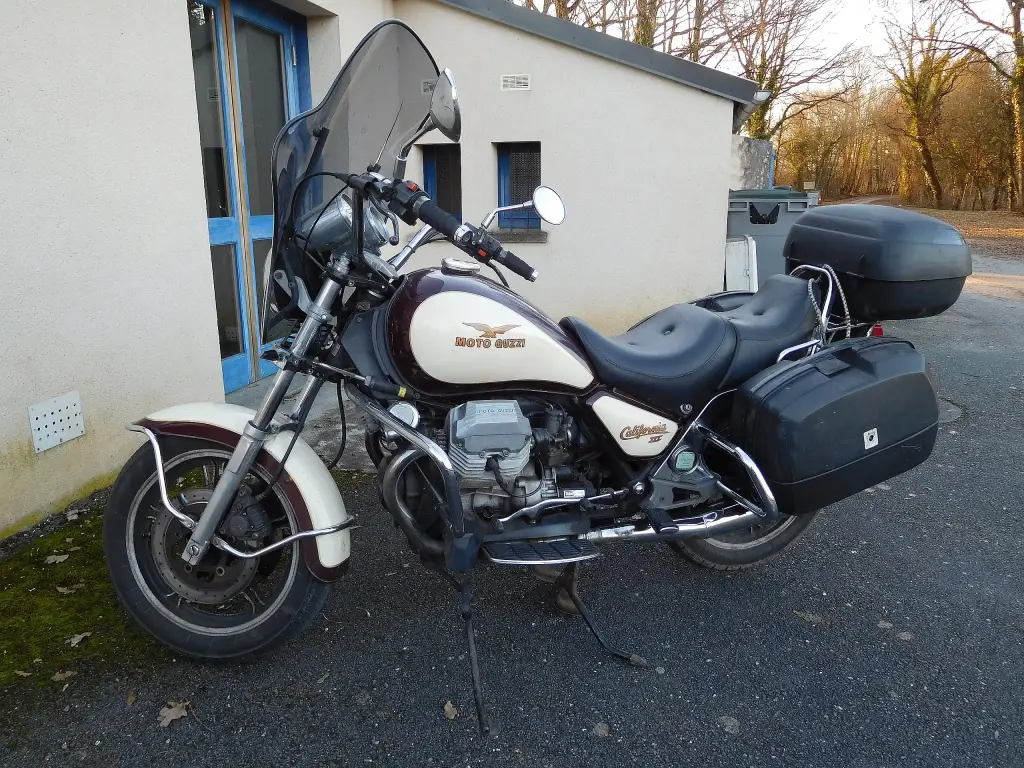
The Moto Guzzi California is a cruiser that Moto Guzzi has made since 1971, with a standard seating position, footboards, a heel-and-toe gearshift and linked Brembo brakes. It began as a police motorcycle and became one of the longest-running models in the company’s history.
Moto Guzzi California at a glance
| Maker | Moto Guzzi, Mandello del Lario |
|---|---|
| In production | since 1971, until the end of 2020 |
| Origin | Moto Guzzi Ambassador and V7, for the Los Angeles Police Department |
| First California | 1971, V7 750 engine |
| 850 from | 1972; 850 GT California in 1974 |
| Generations | V7 850 GT California, 850 T3 California, California II, California III, California 1100, California 1400 |
| California II | 1981, 948 cc engine from the Le Mans 1000 |
| California III | 1987, same 948 cc engine at first |
| California 1100 | 1994, 1,064 cc engine |
| California 1400 | 1,380 cc, the last generation |
| Equipment | footboards, heel-and-toe shift, linked Brembo brakes, Lexan screen on the first police bikes |
History of the Moto Guzzi California
The first California was designed in consultation with the Traffic Division of the Los Angeles Police Department to modify the Moto Guzzi Ambassador, which had won the tender for supplying vehicles to the L.A.P.D. The original idea was to develop a motorcycle for a tender called by the Italian police forces at the request of the President of the Republic, but the 700 cc V7 engine was a little undersized for the heavy bodywork required. The commercial evolutions of the V7 that arrived at the end of the 1960s, the 757 cc V7 Special and the 850 cc V 850 GT, gave the basis for trying again, and Moto Guzzi, urged on by its local importer, won the Los Angeles tender.
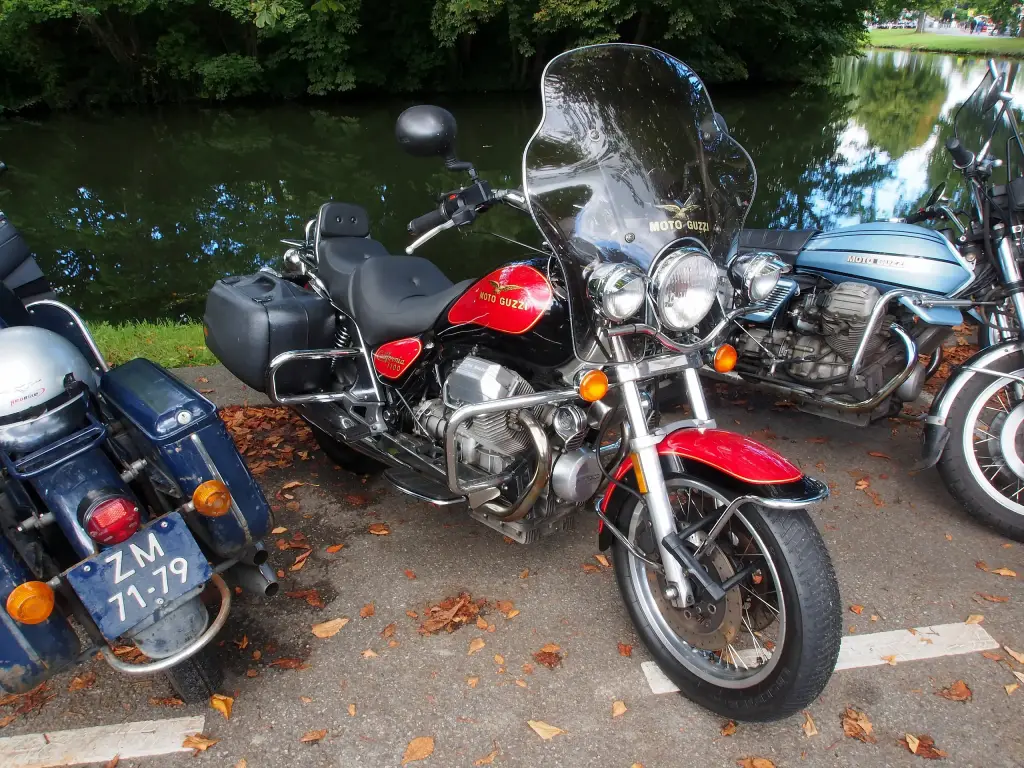
The first California had a left-foot gearshift, a bulletproof Lexan windscreen, a sprung side stand, a siren, radio and extra police lights, and a standing quarter mile of under 16 seconds. Other departments used it too, including the California Highway Patrol. In 1971 the California V7 was born for Europe with American styling; after a limited number of 750 models on the V7 Special chassis, from 1972 it was offered as an 850. The 750 and the first batch of 850s had a double-cam front brake and white painted mudguards, later chromed mudguards and a four-cam front brake.
Six generations
The last version to lose the V7 name was the 850 GT California of 1974, with a single Brembo front disc. In 1973 Moto Guzzi launched the 850 T, followed in 1975 by the 850 T3 with the integral braking system patented by Moto Guzzi and Brembo and the new closed double cradle frame by Lino Tonti, and a California version was derived from the 850 T3 by changing the bodywork. In 1981, under Alejandro De Tomaso, the California became a model of its own with the California II and its 948 cc engine from the Le Mans 1000, which stayed on sale until 1987.
The California II was replaced in 1987 by the California III, at first with the same 948 cc engine and a more cruiser-like style; from 1990 the standard model was joined by the Classic without screen and the fully faired FF, and the engine could be had with carburettors or injection, with a catalytic exhaust available from 1991. In 1994 came the California 1100 and California 1100 i.e., with the 1,064 cc engine developed originally for the 1100 Sport and updates to more than 200 components, and for a long time it was the fastest cruiser in the world. The touring version was renamed the California EV in 1997, and in 1999 a simpler, cheaper model joined the range to widen its appeal, followed by versions such as the Jackal, Special, Special Sport, Titanium, Aluminium, Stone, Metal, Aquila Nera, Classic, EV Touring and Vintage. The last generation was the California 1400, in Custom and Touring forms, and production ended at the end of 2020.
Design and features
- Police roots: developed for the Los Angeles Police Department from the Ambassador and V7.
- Cruiser layout: footboards, heel-and-toe gearshift, wide bars and American-influenced styling.
- Guzzi V-twin: air-cooled 90° V-twin mounted longitudinally, with shaft drive.
- Integral braking: the system patented by Moto Guzzi and Brembo arrived with the 850 T3.
- Long life: six generations from 1971 to the end of 2020, from 750 to 1,380 cc.
Moto Guzzi California versions
- V7 850 GT California (1971–1974): the first generation, from 750 to 850 cc.
- 850 T3 California (1975): Tonti frame and integral braking.
- California II (1981–1987): 948 cc engine, a model of its own.
- California III (1987 onwards): Classic without screen and fully faired FF from 1990.
- California 1100 (1994): 1,064 cc engine, carburettor and injection versions.
- California EV and the 1990s family: touring version renamed EV in 1997, plus Jackal, Special, Stone, Titanium and others.
- California 1400: the final generation in Custom and Touring forms.
The California grew out of the V7 and shared its big-block engine with the faired 1000 SP. The small-block V35 was the other side of the Guzzi range at the time. More machines are in the Moto Guzzi collection.
Video: Test-Video | Moto Guzzi California 1400 Touring | Actionaufnahmen & Onboard
Video by 1000PS – die starke Motorradseite im Internet on YouTube.
Sources
- Moto Guzzi California, English Wikipedia: LAPD origin, generations, 1400 model
- Moto Guzzi California, Italian Wikipedia: generation history, engines, versions, end of production