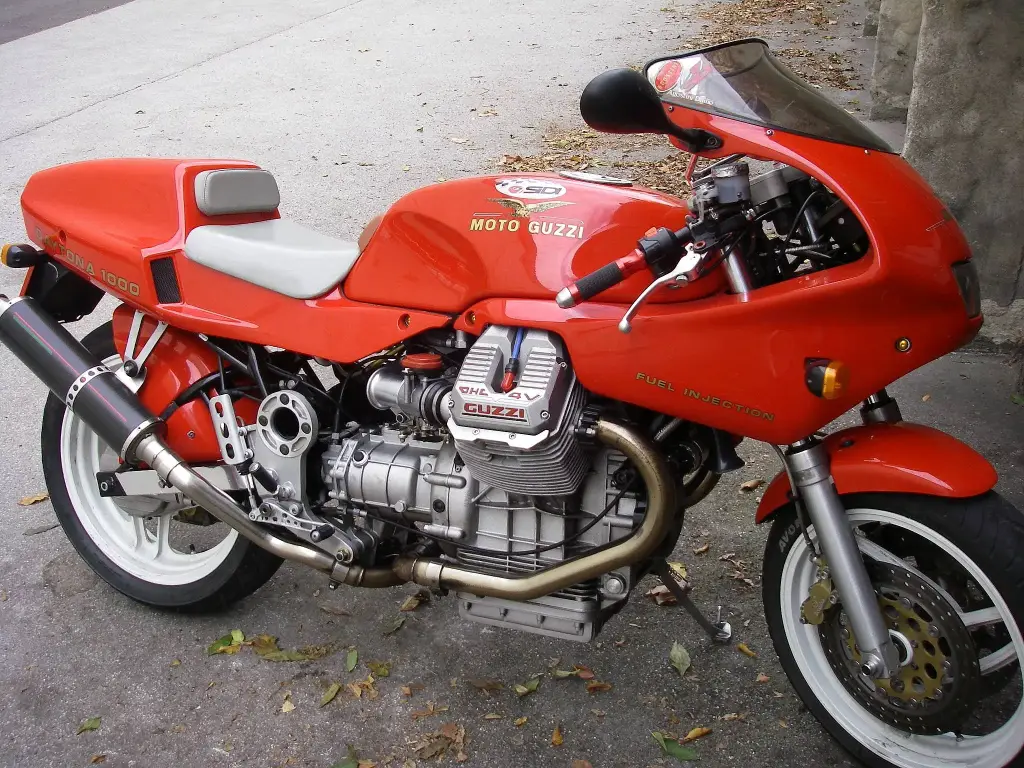
The Moto Guzzi Daytona 1000 IE was a sports motorcycle built between 1992 and 1999. It was first shown at the Milan show in 1989 in carburettor form as a replica of the racing motorcycle that competed in production-derived classes, and it went on sale from 1992.
Moto Guzzi Daytona at a glance
| Maker | Moto Guzzi, Mandello del Lario |
|---|---|
| Production | 1992–1999 |
| Shown | Milan show, 1989, in carburettor form |
| Name | 1000 for the engine size, IE for iniezione elettronica |
| Engine | V-twin with four valves per cylinder |
| Developed with | John Wittner, the American tuner known as Dr. John |
| Frame | rectangular-section spine beam running diagonally through the V of the cylinders |
| Rear suspension | Cantilever swingarm with a single shock |
| Racing origin | BOTT and AMA Pro-Twins wins at Daytona in 1987 |
The English Wikipedia has no article on the Daytona; this page is based on the Italian article and is therefore based on one source.
History of the Moto Guzzi Daytona
The Daytona was born from a need to turn racing success into sales. In the United States the tuner John Wittner, a former dentist known to enthusiasts as Dr. John, was reviving the glories of the Italian company, which had withdrawn from competition in the 1950s. Moto Guzzi had been part of De Tomaso Industries since the 1970s, alongside Benelli, under Alejandro De Tomaso, and by the end of the 1980s its range still included an old-design machine like the Le Mans 1000 but no pure sports bike for the production-derived championships.
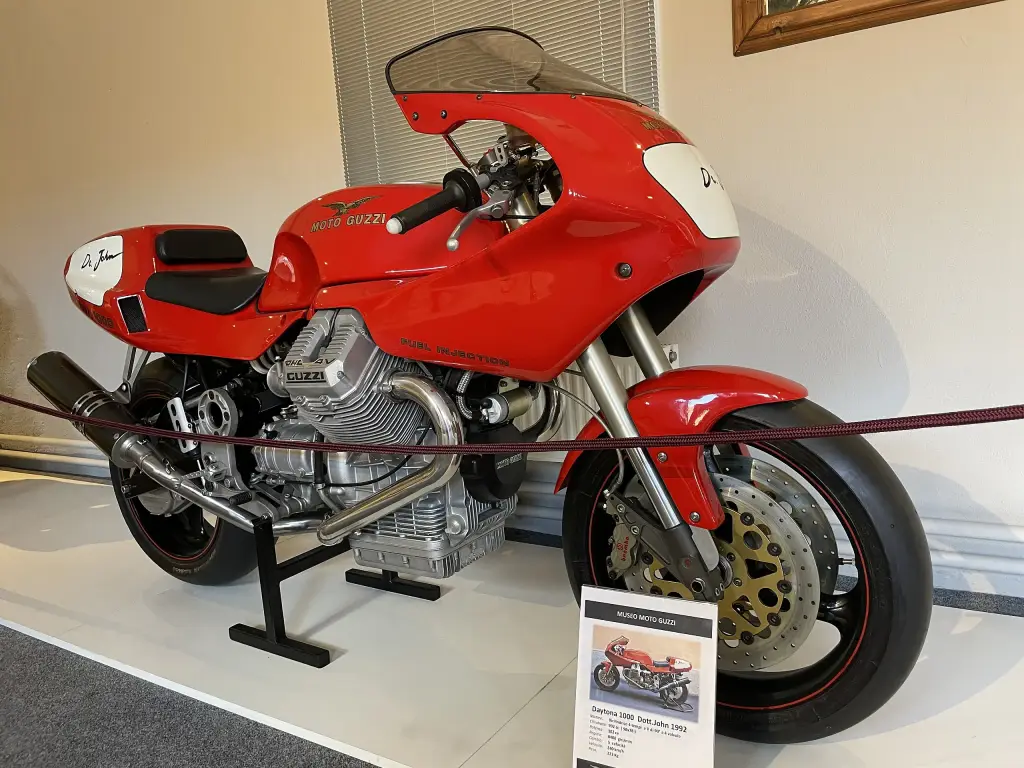
During the 1980s racing for production-derived machines had become popular again, starting in the United States: Superbike, the BOTT, Battle of the Twins, for twins and the SOS, Sound of the Singles, for singles. Moto Guzzi and Ducati V-twins were widely used in the BOTT. In 1987 Dr. John built one by hand on a Le Mans basis for the American BOTT races and, with the rider Doug Brauneck, won during the race week at Daytona and the AMA Pro-Twins championship. Those results impressed De Tomaso, who in 1988 gave him the development of the four-valve-per-cylinder V-twin that Umberto Todero had designed but never developed for lack of funds.
The Wittner frame
Wittner started from the prototype and built a new frame around it. He had replaced the double cradle of the Le Mans series and, using the space between the cylinders of the V, designed a descending rectangular-section spine beam that ran diagonally through the middle of the V and was connected to a Cantilever two-arm swingarm with a single shock through two light alloy plates bolted to a short transverse tube above the traditional longitudinal gearbox. With the new eight-valve engine this let the bike continue its winning run in the American BOTT, and it won again at Daytona, the most prestigious race of the series and the one that gave the model its name.
Monza and the road bike
In 1989 De Tomaso invited Dr. John to Mandello and convinced him to race in Europe. He, his small team and the unknown Brauneck made their debut at the Due Giorni Internazionale at Monza against the former world champion Marco Lucchinelli and his works Ducati 851. The white and red Moto Guzzi set the second best qualifying time, a few hundredths from the Ducati and with a gap to the rest, and although a broken plug lead stopped Brauneck while he was leading, the Daytona was awarded the prize for the best technical and performance novelty at Monza. The company could not follow up the exploit because its financial problems were unresolved, and that was the end of the racing version but the beginning of a road-going Daytona, sold from 1992 with electronic injection, rare at the time.
Design and features
- Four-valve V-twin: the Todero engine developed by John Wittner into an eight-valve unit.
- Spine frame: a rectangular beam running diagonally through the V of the cylinders, with a Cantilever rear end.
- Electronic injection: the IE of the name, unusual on motorcycles of the period.
- Racing pedigree: a road replica of the bike that won at Daytona and shone at Monza.
- Dr. John: developed by the American tuner John Wittner, dentist turned racing engineer.
Moto Guzzi Daytona versions
- Daytona 1000 (1989): the carburettor version shown at the Milan show.
- Daytona 1000 IE (1992–1999): the production model with electronic injection.
- Racing Daytona (1987–1989): the Wittner machines raced in the United States and at Monza.
The Daytona was developed from the Le Mans, whose double cradle frame it replaced, and it was the sports machine that the Griso later echoed. More machines are in the Moto Guzzi collection.
Video: Moto Guzzi Daytona 1000
Video by znuto on YouTube.
Sources
- Moto Guzzi Daytona 1000 IE, Italian Wikipedia: origins, Wittner, frame, racing history, production years