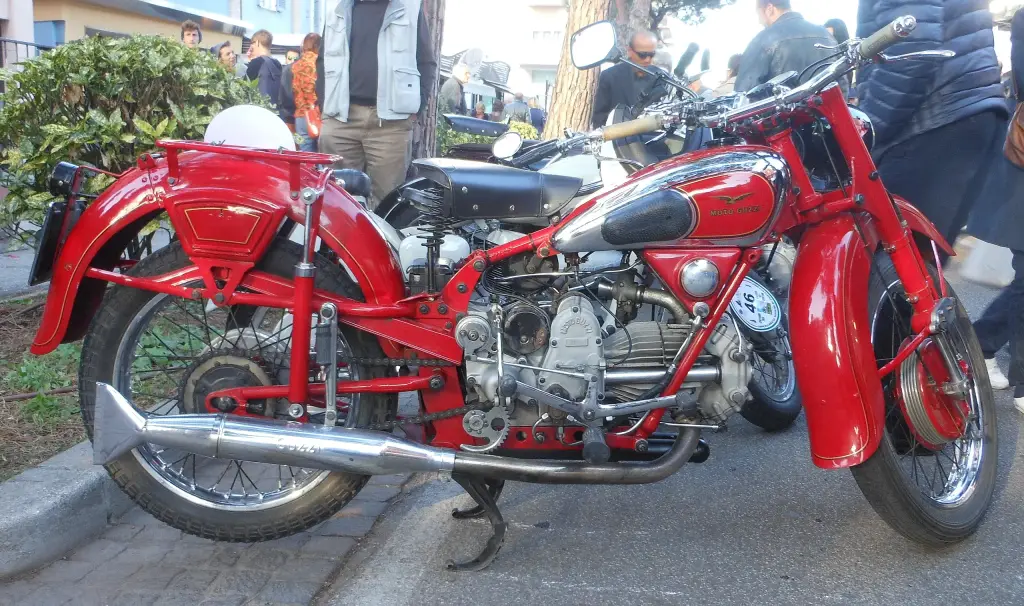
The Moto Guzzi Astore was built between 1949 and 1953. It was the touring 500 developed from the G.T.V. of 1934, and it was presented at the Milan show in 1949 before giving way to the Falcone Turismo four years later.
Moto Guzzi Astore at a glance
| Maker | Moto Guzzi, Mandello del Lario |
|---|---|
| Production | 1949–1953 |
| Developed from | Moto Guzzi G.T.V. of 1934 |
| Shown | Milan motorcycle show, 1949 |
| Engine | 500 cc single, four-stroke, horizontal cylinder |
| Bore and stroke | 88 mm × 82 mm |
| Valve gear | pushrod and rockers, springs enclosed in an oil bath |
| Cylinder and head | aluminium instead of cast iron |
| Frame | closed tubular double cradle |
| Gearbox | four speeds, foot change |
| Rear suspension | swingarm with a spring under the engine and two hydraulic dampers |
The English Wikipedia has no article on the Astore; this page is based on the Italian article and is therefore based on one source.
History of the Moto Guzzi Astore
The Astore was an evolution of the G.T.V., the touring model that Moto Guzzi had introduced in 1934, and it was presented at the Milan show in 1949. Its engine descended from the unit that had appeared in 1921 with the Normale: a horizontal pushrod single of 500 cc, with the traditional Mandello bore and stroke of 88 by 82 mm. Compared with the earlier G.T.V. the big change was in the cylinder head, where the valve springs and rockers were now enclosed and ran in an oil bath, a system already used on the Airone in 1948; the head and cylinder were also in aluminium rather than cast iron.
The chassis followed that of the last G.T.V.s: a closed tubular double cradle frame, a telescopic fork at the front and at the rear the classic arrangement introduced in 1928 with the Norge, a swingarm with a spring under the engine, this time helped, as on the last G.T.V. and G.T.W. and on the 1947–48 Airone, by two hydraulic dampers. The gearbox had four speeds with a foot change.
Looks and the end of the line
The styling of the Astore was practically identical to its G.T.V. ancestor, with a tapered chromed tank and very protective leg shields. In 1952, because chrome was hard to obtain, the tank was painted red and black while other details were painted or nickel plated. The following year a new tank with a more modern line, similar to that of its bigger brother the Falcone, was introduced, and in the same year production ended to make room for the Falcone Turismo, which was almost identical apart from the rear suspension, where the hydraulic dampers gave way to two cheaper compass-type units.
Design and features
- Enclosed valve gear: the rockers and springs ran in an oil bath, following the Airone of 1948.
- Alloy top end: aluminium head and cylinder instead of cast iron.
- Traditional 500: the 88 by 82 mm horizontal single derived from the 1921 Normale.
- Comfortable tourer: telescopic fork, sprung swingarm with hydraulic dampers and very protective leg shields.
- Short life: replaced after four years by the nearly identical Falcone Turismo.
Moto Guzzi Astore versions
- Astore (1949–1953): the standard touring model with a chromed tank.
- 1952 models: red and black painted tank because chrome was difficult to find.
- 1953 models: new, more modern tank in the style of the Falcone, the last of the line.
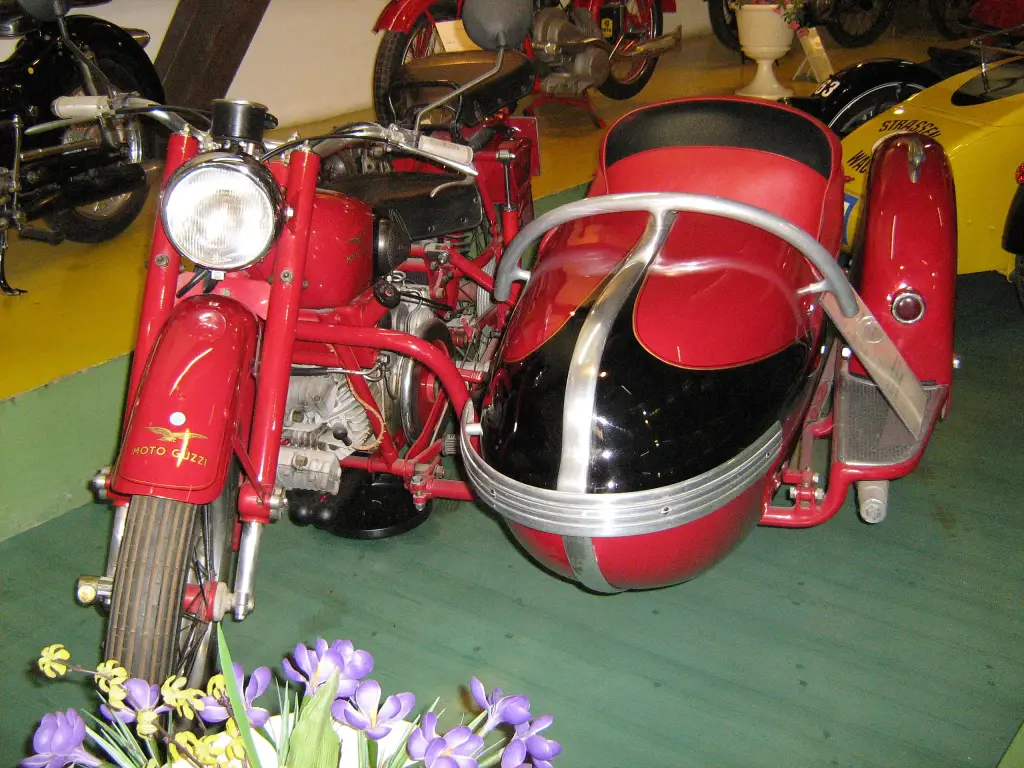
- Sidecar outfits: the Astore was also used with a sidecar, as period photographs show.
The Astore was the touring brother of the Falcone that replaced it, and it came from the GT series. The military Alce used the same 500 cc layout. More machines are in the Moto Guzzi collection.
Video: moto guzzi astore 500 1949
Video by motoitaliane on YouTube.
Sources
- Moto Guzzi Astore, Italian Wikipedia: production, engine, chassis, 1952 and 1953 changes