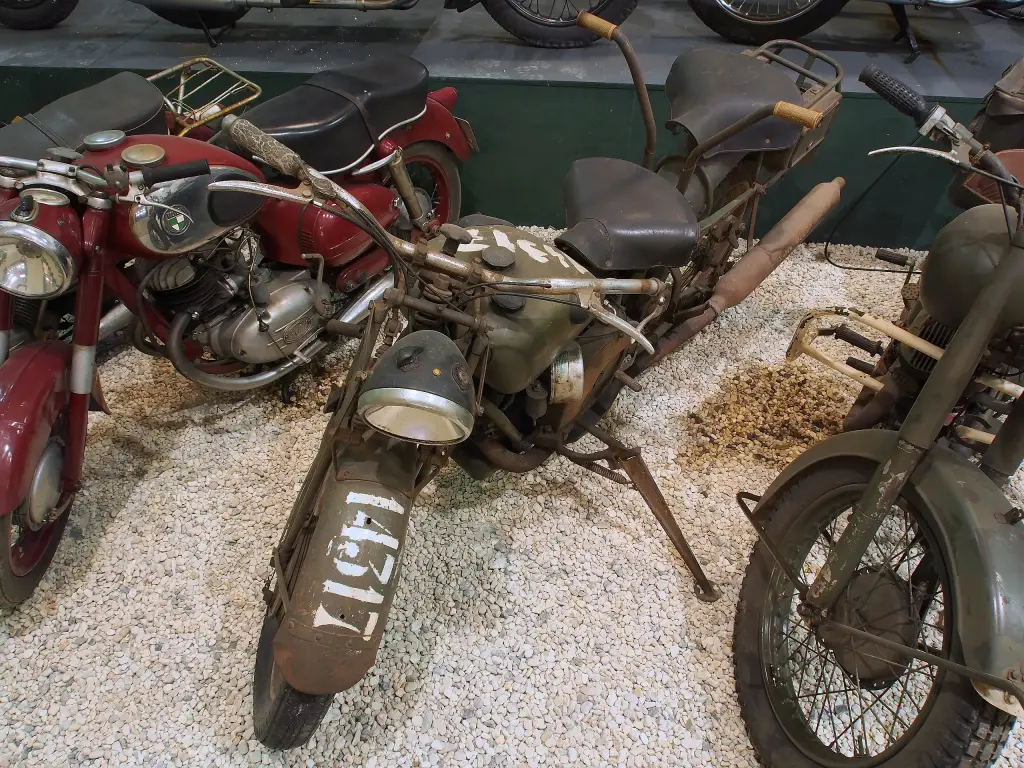
The Moto Guzzi 500 Alce was an Italian military motorcycle built by Moto Guzzi between 1938 and 1948, mainly for the armed forces and the police. It replaced the GT 20 and became the standard mount of the Italian army’s motorcycle units during the Second World War.
Moto Guzzi Alce at a glance
| Maker | Moto Guzzi, Mandello del Lario |
|---|---|
| Production | 1938–1948 |
| Replaced | Moto Guzzi GT 20 |
| Engine | 498.4 cc single, four-stroke, horizontal cylinder |
| Power | 14 hp at 4,000 rpm |
| Carburettor | Dell’Orto MC 26 F, gravity feed |
| Gearbox | four speeds, chain final drive |
| Frame | tubular double cradle |
| Wheelbase | 1,455 mm |
| Dry weight | 179 kg |
| Top speed | 90 km/h, range 300 km |
| Built | 6,390 solo and two-seat, plus 669 sidecar outfits |
The English Wikipedia has no article on the Alce; this page is based on the Italian article and is therefore based on one source.
History of the Moto Guzzi Alce
The Alce was born in 1939 to replace the Moto Guzzi GT 20, itself derived in 1938 from the GT 17, which had been in production since 1932. It stayed in production until 1945. Between 1946 and 1948 an unrecorded number of the transitional Alce V was also built, with features halfway between the two models and the change to overhead valves, followed by the Superalce. Engine numbers carried the prefixes AV, Alce Veloce, and then SA, Superalce.
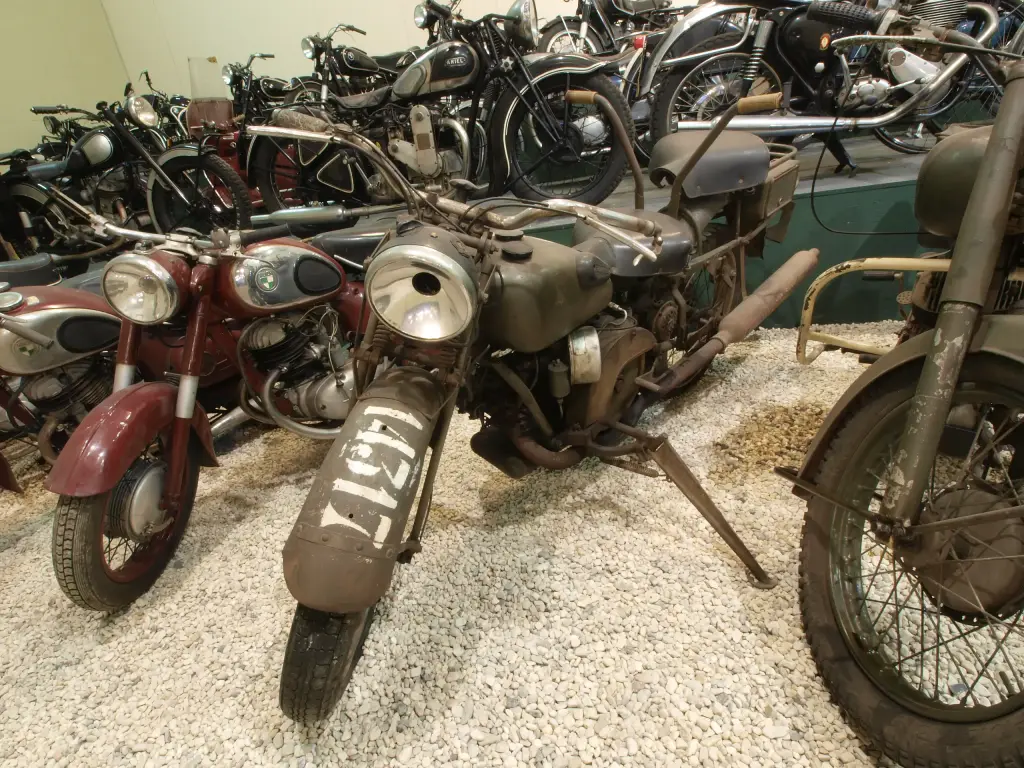
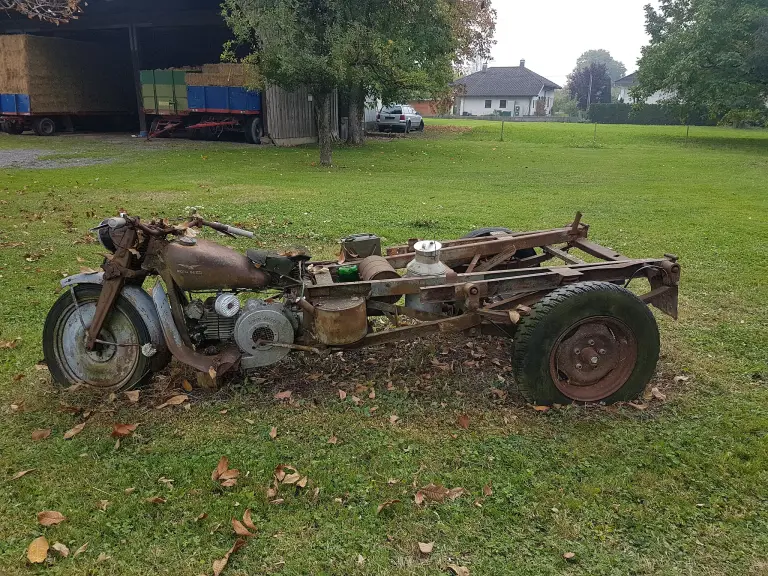
The Alce was taken up by the Milizia della Strada and the Polizia dell’Africa Italiana and was used extensively by the Regio Esercito on all fronts in three versions, single-seat, two-seat and equipped, the last being a sidecar outfit. In total 6,390 solo and two-seat machines were built and 669 sidecars. Between 1940 and 1943 the Alce mechanics were developed into a military three-wheeler, the TriAlce, of which 1,741 were made.
In service
In the Italian army the Alce was issued to every regiment as a reconnaissance and column-leader machine, and it equipped entire Bersaglieri motorcycle regiments. A particular version was the machine-gun carrier, with a Breda Mod. 30 light machine gun on a rotating mount on the front fork pivot; the weapon could not be fired on the move, and the motorcycle served as a firing platform when stopped. After the war the Alce remained in service with the Italian army and the traffic police until it was replaced in 1948 by the Superalce.
Engineering
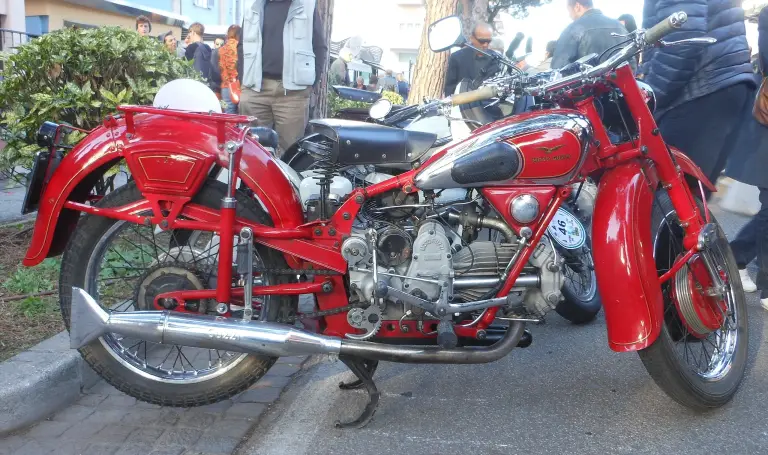
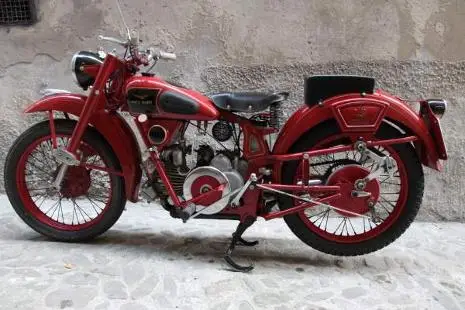
From the GT 20 the Alce took, with some improvements, the 498.4 cc four-stroke single with a horizontal cast iron cylinder and an external flywheel, air cooled and giving 14 hp at 4,000 rpm. Fuel feed was by gravity through a Dell’Orto MC 26 F carburettor, the primary transmission used helical gears, the secondary a roller chain, and there was a four-speed gearbox with a multi-plate clutch lubricated by oil mist. Outside, it differed from its ancestor in the leg shields, the exhaust line, the position of the tool box and a stronger stand. The tubular double cradle frame proved very robust in battlefield use, with a parallelogram front suspension and a rear swingarm with coil springs mounted horizontally under the engine and adjustable friction dampers.
Design and features
- Military specification: built for the Italian army and police, with single-seat, two-seat and sidecar versions.
- Horizontal 500 single: 498.4 cc, 14 hp and a top speed of 90 km/h with a 300 km range.
- Robust frame: a tubular double cradle that proved very strong in the field.
- Machine-gun carrier: a Breda Mod. 30 could be mounted on the front fork pivot for firing when stopped.
- TriAlce: a military three-wheeler developed from the Alce, 1,741 built between 1940 and 1943.
Moto Guzzi Alce versions
- Alce Monoposto: single-seat military version.
- Alce Biposto: two-seat version with a handlebar for the passenger between the saddles.
- Alce Attrezzata: sidecar outfit carrying three soldiers, with racks for kit and a rifle.
- Alce V (1946–1948): transitional version with overhead valves.
- Superalce: the post-war successor that replaced the Alce in service in 1948.
The Alce’s civilian relatives are the GT series and the Astore, while the three-wheeled Moto Guzzi triporteurs came from the same military thinking. More machines are in the Moto Guzzi collection.
Video: Moto Guzzi Alce 500 kick start
Video by Rene Wollin on YouTube.
Sources
- Moto Guzzi Alce, Italian Wikipedia: history, military use, production numbers, technical data