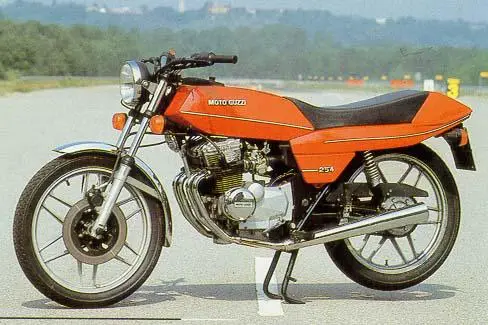
The Moto Guzzi 254 was produced from 1977 to 1981 as the touring version of the Benelli 250 Quatro. Its 231 cc inline four was the smallest production four-cylinder engine of its day, and the model was built in fewer than 1,000 examples.
Moto Guzzi 254 at a glance
| Maker | Moto Guzzi and Benelli, under Alejandro de Tomaso |
|---|---|
| Production | 1977–1981 for the Guzzi version |
| Shown | Milan motorcycle show, 1975 |
| Engine | 231 cc inline four, four-stroke, single overhead cam |
| Power | 27.8 hp at 10,500 rpm |
| Top speed | 150 km/h |
| Bore and stroke | 44 mm × 38 mm |
| Carburettors | four Dell’Orto PHBG 18B |
| Gearbox | five speeds, chain drive |
| Weight | 117 kg |
| Wheelbase | 1,290 mm |
| Price in 1979 | 1,767,000 lire |
The 254 is described in the Wikipedia articles on the Benelli 254, of which it was the Moto Guzzi-badged version; this page covers only the Guzzi model.
History of the Moto Guzzi 254
The 254 came out of Alejandro de Tomaso’s plan to sell a modern small flagship in Italy and in Europe, especially in markets such as France, Spain and Britain where machines up to 250 cc enjoyed tax and insurance concessions. The design was shown at the Milan show in 1975 in two versions, a Benelli called 250 Quattro for a more sporting clientele and a Moto Guzzi called 254 intended for touring, with different tanks and seat humps, three-spoke cast wheels on the Benelli and six-spoke on the Guzzi. Two years passed before production began.
Engineering was by Lino Tonti and the styling by Paolo Martin. Plastic and aluminium were used extensively to keep the weight at 117 kg, and Martin’s clean lines put the instruments and brake master cylinder in the tank, which cut capacity to 8.5 litres and gave a range of only 121 to 137 km; the British Moto Guzzi importers declined the model because of it. The four weighed only 35 kg without its carburettors, used a chain-driven single overhead cam and revved to 11,800 rpm.
Slow sales
The small Benelli and Guzzi fours did not bring De Tomaso the success he expected. In 1979 the model cost 1,767,000 lire, against 1,368,000 for a Benelli 250 2C and 2,199,000 for a Moto Guzzi V35, and buyers disliked the styling; in Italy learners could ride up to 350 cc, so a 250 carried no advantage at home, while abroad the cheaper Japanese bikes were strong competition. Moto Guzzi stopped making the 254 in 1981, though it stayed in showrooms for a couple of years, and fewer than 1,000 of the Guzzi version were built. Benelli took over the styling, added a screen and kept the model until 1984.
Design and features
- Smallest production four: a 231 cc inline four with a chain-driven overhead cam.
- Light build: 117 kg thanks to extensive use of plastic and aluminium.
- Tank-mounted instruments: a styling idea by Paolo Martin that cut fuel capacity to 8.5 litres.
- Guzzi specification: six-spoke cast wheels and a more touring-oriented riding position than the Benelli.
- Rare model: fewer than 1,000 Moto Guzzi 254s were built.
Moto Guzzi 254 versions
- Moto Guzzi 254 (1977–1981): the touring version with six-spoke wheels and its own tank and seat hump.
- Benelli 250 Quatro (1977–1984): the sporting version with three-spoke wheels and a different rear seat hump.
- Benelli 304 (1983–1986): restyled development with a twin downtube frame and 29 hp.
- 125 twin: a small two-cylinder derived from the 254, built from 1979 to 1981 under both badges.
The 254 shared the De Tomaso era with the two-stroke 250 TS. Its direct rival at Mandello was the V35, and the four-cylinder idea returned much later in the MGS-01. More machines are in the Moto Guzzi collection.
Video: Moto Guzzi 254 Quattor, mit Feuer 0
Video by ClassicMotorcyclesTi on YouTube.
Sources
- Benelli 254, English Wikipedia: design, engine details, production numbers, range
- Benelli 254, Italian Wikipedia: presentation, specifications, price, market response