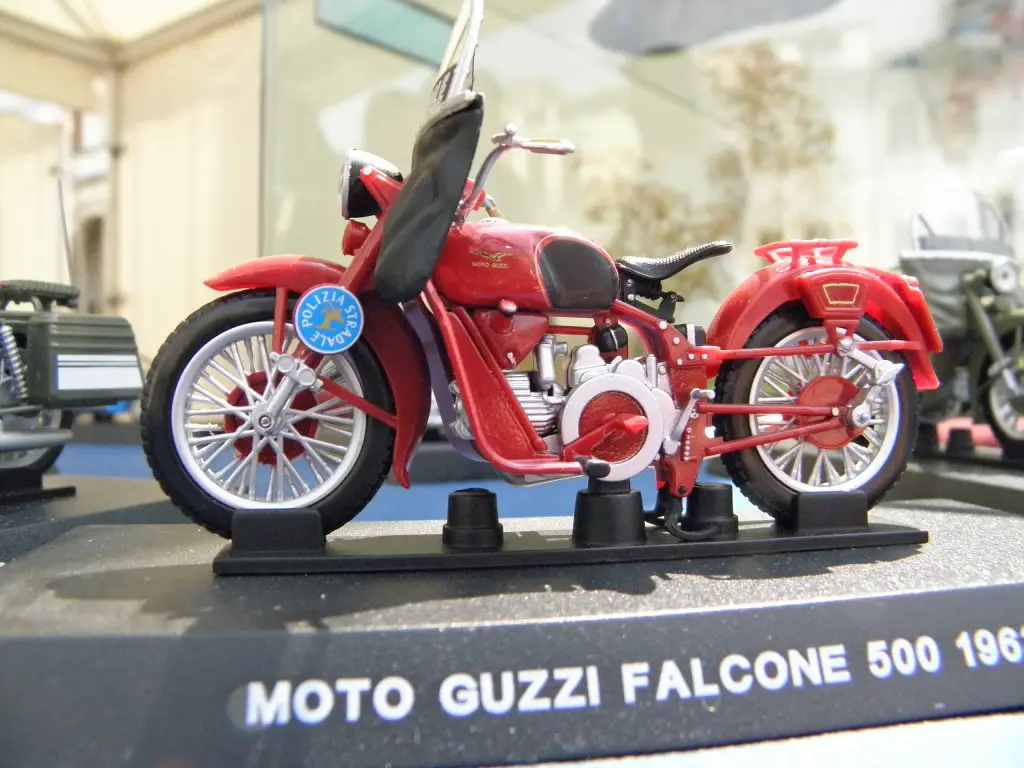
The Moto Guzzi Falcone was built between 1950 and 1967. It was created to replace the G.T.W. of 1934, was presented at the Geneva show in 1950, and was the last Guzzi with the classic 500 cc horizontal four-stroke single.
Moto Guzzi Falcone at a glance
| Maker | Moto Guzzi, Mandello del Lario |
|---|---|
| Production | 1950–1967 |
| Replaced | Moto Guzzi G.T.W. |
| Shown | Geneva motorcycle show, 1950 |
| Engine | 500 cc horizontal single, four-stroke |
| Bore and stroke | 88 mm × 82 mm |
| Frame | closed tubular double cradle |
| Front suspension | telescopic fork |
| Rear suspension | swingarm with a spring under the engine and two compass dampers |
| Gearbox | four speeds, foot change |
| Versions from 1953 | Sport and Turismo |
| Successor | Moto Guzzi Nuovo Falcone, from 1969 |
The English Wikipedia has no article on the Falcone; this page is based on the Italian article and is therefore based on one source.
History of the Moto Guzzi Falcone
The Falcone was born to replace the G.T.W., a model that dated back to 1934, and it was presented at the Geneva show in 1950. It was the last of the Guzzis with the classic horizontal four-stroke single of 500 cc. Its engine descended from the unit born in 1921 with the Normale, a horizontal pushrod single of 500 cc with the classic Mandello bore and stroke of 88 by 82 mm.
The frame was a closed tubular double cradle. At the front there was a telescopic fork, and at the rear the classic arrangement introduced in 1928 with the Norge: a swingarm with a spring under the engine, helped by two compass-type dampers. The gearbox had four speeds with a foot change. The Falcone was offered in a single version alongside the Astore, already in the catalogue since 1949, as the more sporting model. Its first version had a fully chromed tank with the exception of a red painted band; in 1952, because chrome was hard to obtain, some parts were blued or painted.
Sport and Turismo
From 1953 the Falcone split in two: the existing version, renamed Sport, was joined by the Turismo, which was in effect the heir of the Astore. The two differed in external details, the leg shields being fitted only to the Turismo and the tank returning to chrome on the Sport, and in mechanical parts, including the cylinder head, exhaust valve, connecting rod, piston, camshaft and carburettor.
Police and fire service
By the mid-1950s the popularity of the Falcone, like that of its great rival the Gilera Saturno, declined, as its performance was matched by more modern and smaller machines. Appreciation by the traffic police, whose official motorcycle it was until the 1970s, and by the Guardia di Finanza never stopped, so that changes made to the Mandello single were almost exclusively due to its military and public uses. Among the public-service versions, one was prepared for the Corazzieri in 1957 with improved finish and electric starting, and some Falcone 500 Turismo were used by the national fire brigade. Production ended in 1967 with the arrival of the V7, and two years later came its successor, the Nuovo Falcone, which differed greatly from the original, notably in the flywheel covered by a casing.
Design and features
- Last big single: the final Guzzi with the 500 cc horizontal pushrod engine.
- Two characters: the Sport with a chromed tank and the Turismo, heir of the Astore, with leg shields.
- Police favourite: official motorcycle of the Italian traffic police until the 1970s.
- Public service versions: including a Corazzieri machine of 1957 with electric starting.
- Long production: seventeen years, from 1950 to 1967.
Moto Guzzi Falcone versions
- Falcone (1950–1953): the single original version with a chromed tank and red band.
- Falcone Sport (1953–1967): the more sporting version, tank chromed again.
- Falcone Turismo (1953–1967): touring version with leg shields, heir of the Astore.
- Corazzieri version (1957): improved finish and electric starting for the presidential guard.
- Nuovo Falcone (from 1969): the successor, with a flywheel covered by a casing.
The Falcone replaced the Astore in the touring role and came from the same 500 cc line as the GT series. Its successor in the range was the V7. More machines are in the Moto Guzzi collection.
Video: Moto Guzzi Falcone Testfahrt
Video by ingo oldbike on YouTube.
Sources
- Moto Guzzi Falcone, Italian Wikipedia: history, engine, chassis, versions, public service, end of production