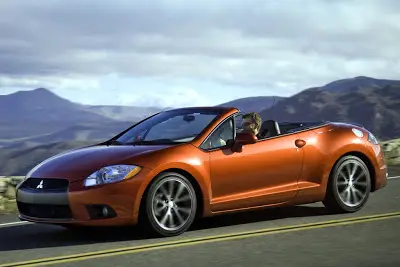
The Mitsubishi Eclipse is a sport compact car sold over four generations in the 1990 to 2012 model years. The first two generations were developed together with Chrysler and also sold as the Eagle Talon, the first generation additionally as the Plymouth Laser, and a convertible joined the range in 1996.
Mitsubishi Eclipse at a glance
| Maker | Mitsubishi Motors, built in Normal, Illinois |
|---|---|
| Production | 1990–2012, four generations |
| Also sold as | Eagle Talon (first two generations), Plymouth Laser (first generation) |
| Partnership | Diamond-Star Motors, a Mitsubishi and Chrysler venture |
| Body | three-door coupé; convertible from 1996 |
| First generation | D21A, D22A, D27A, from 1990 |
| Base engine | 1.8-litre 4G37, 92 hp |
| Turbo engine | 2.0-litre 4G63T, 180–195 hp |
| Top model | GSX with all-wheel drive |
| Third generation | 2000–2005, Chrysler platform |
| Fourth generation | 2005–2012, PS platform |
| Name | after an unbeaten 18th-century English racehorse |
Based on one source: the English Wikipedia article on the Mitsubishi Eclipse, which describes the first generation in much more detail than the later ones. This page follows that balance.
History of the Mitsubishi Eclipse
A child of the Chrysler alliance
The Eclipse was developed for North America, where sales began in the autumn of 1989; Japanese sales of cars imported from Illinois started in 1990, and limited European sales followed in late 1991, at first only in Austria, Sweden and Switzerland. The first two generations were sold alongside the Eagle Talon, and the first generation also as the Plymouth Laser, all products of Diamond-Star Motors, the joint venture between Mitsubishi and Chrysler.
Mitsubishi says the car was named after an unbeaten 18th-century English racehorse that won 18 races in a row and then retired. In Japan the first two generations were sold through the Car Plaza chain.
First generation
The profile was low and sleek, with a bonnet line so low that it needed a bump to clear the engine’s cam cover. Cars built before the facelift had pop-up headlights, while the 1992 to 1994 models had exposed aerodynamic headlamps and more rounded sheet metal. Five trim levels were offered, all front-wheel drive except the GSX.
The entry Eclipse had a 92 hp 1.8-litre 8-valve 4G37 engine. The GS DOHC used a 135 hp 2.0-litre 16-valve 4G63, and a 150 hp naturally aspirated all-wheel-drive version was sold in Europe only, with a five-speed manual and no rear limited-slip differential. The GS Turbo and GSX shared a turbocharged 4G63T of 180 to 195 hp: the 1990 manual GS Turbo was rated at 190 hp and the GSX at 195 hp to offset the extra weight of its all-wheel-drive system, about 2,930 lb against 2,570 lb, and from 1991 both used the 195 hp version. Automatic cars had 180 hp because of smaller injectors and turbocharger.
The basic layout put a transverse 4G37 or 4G63 on the left-hand side of the car driving a gearbox on the right. All-wheel-drive cars had a different transmission with a limited-slip centre differential and a transfer case driving the rear differential and half-shafts. The 4G63 had an iron block, an aluminium head and two balance shafts, while the turbo version ran a lower 7.8:1 compression ratio and oil squirters under the pistons. Engines built from 1989 to April 1992 used a six-bolt crankshaft, and from May 1992 a seven-bolt design. In Europe only one trim was offered, with the 2.0-litre double-overhead-camshaft engine of 150 PS and optional four-wheel drive.
Recalls and later generations
In March 1998 Mitsubishi recalled all 1990 to 1998 Eclipse GSXs because of a transfer case that could lock up through insufficient lubrication and cause a loss of control, and dealers checked the transfer case lubrication. The second generation arrived for 1995 and added a convertible during the 1996 model year. The third generation of 2000 to 2005 used an extended-wheelbase version of the platform shared with the Chrysler Sebring and Dodge Stratus, and the fourth generation of May 2005 returned to Mitsubishi’s own PS platform.
The final Eclipse was built at the end of August 2011 and auctioned for charity, closing the line after four generations. In 2017 Mitsubishi brought the name back on a compact crossover called the Eclipse Cross.
Design and features
- Diamond-Star origins: built with Chrysler and sold as the Eagle Talon and Plymouth Laser.
- GSX: the 195 hp turbocharged all-wheel-drive model at the top of the first range.
- Pop-up to exposed lights: the 1992 facelift changed the nose and sheet metal.
- Two engine families: the 1.8-litre 4G37 and the 2.0-litre 4G63 and 4G63T.
- Four generations: 1990 to 2012, with a convertible from 1996.
Mitsubishi Eclipse versions
- Eclipse (1990): 92 hp 1.8-litre base model.
- GS and GS DOHC: 2.0-litre cars with 135 hp.
- GS Turbo: 180–195 hp front-wheel drive.
- GSX: turbocharged all-wheel drive with limited-slip differentials.
- European model: 150 PS 2.0 with optional four-wheel drive.
- Second to fourth generations: 1995, 2000 and 2005.
The Eclipse came from the same Mitsubishi and Chrysler partnership that produced the 3000GT and its Dodge Stealth twin. Its platform relative is the Galant, and more cars are in the Mitsubishi collection.
Sources
- Mitsubishi Eclipse, English Wikipedia: generations, engines, trims, recall