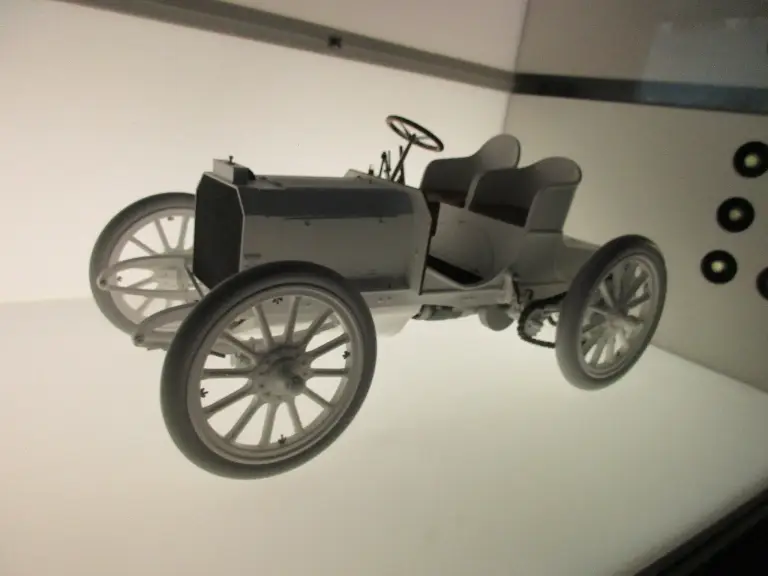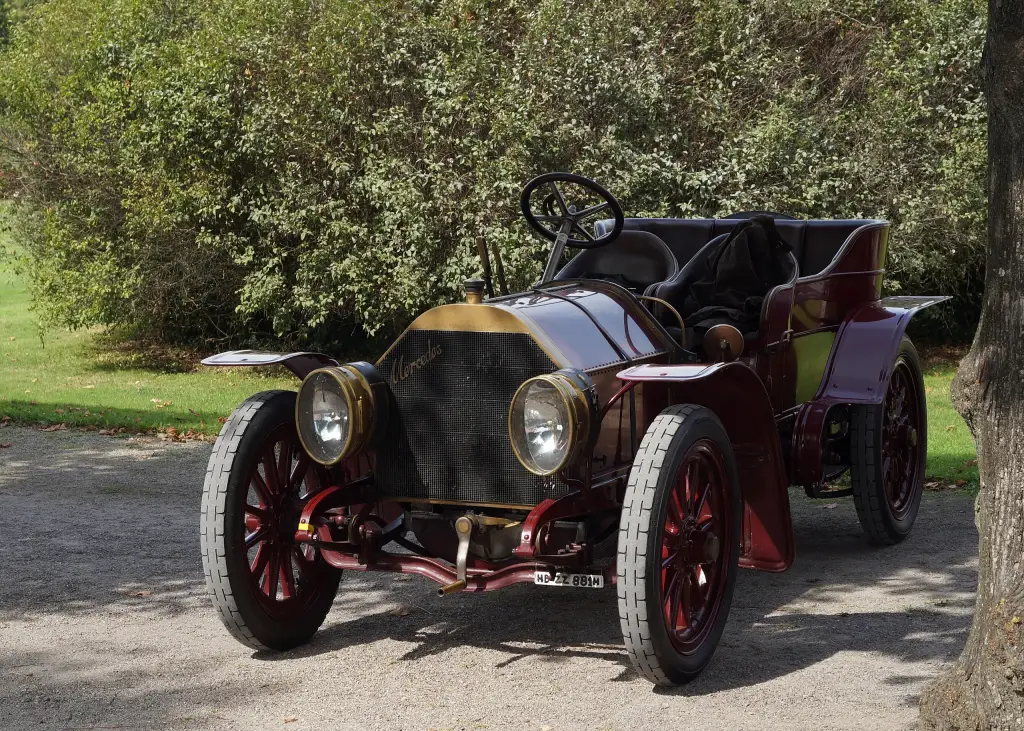
The Mercedes-Simplex was the Daimler-Motoren-Gesellschaft’s luxury car of 1902 to 1909, designed by Wilhelm Maybach as a simpler, easier-to-drive successor to the Mercedes 35 hp. Its name came from “comfort by means of simplicity”, and its 60 hp version is usually credited with creating the super-luxury car class.
Mercedes-Simplex at a glance
| Maker | Daimler-Motoren-Gesellschaft, Cannstatt, later Untertürkheim |
|---|---|
| Production | 1902–1909 (German sources: 1902–1910) |
| Designer | Wilhelm Maybach |
| Engine | four-cylinder, 6,786 cc |
| Power | 40 to 60 hp, depending on version |
| Wheelbase | 2,450 mm |
| Weight | 942 kg |
| Gearbox | four-speed and reverse, chain drive |
| Wheels | wooden, twelve non-removable spokes; cast steel from 1905 |
| Brakes | hand brake on rear drums, foot brake on the intermediate shaft, water-cooled |
| Name | from “comfort by means of simplicity” |
| Successor | Mercedes 28/50 PS |
English sources give production as 1902–1909, German ones as 1902–1910; records titled “Mercedes 60” and “Mercedes 70” are treated here as Simplex variants.
History of the Mercedes-Simplex
A simpler Mercedes
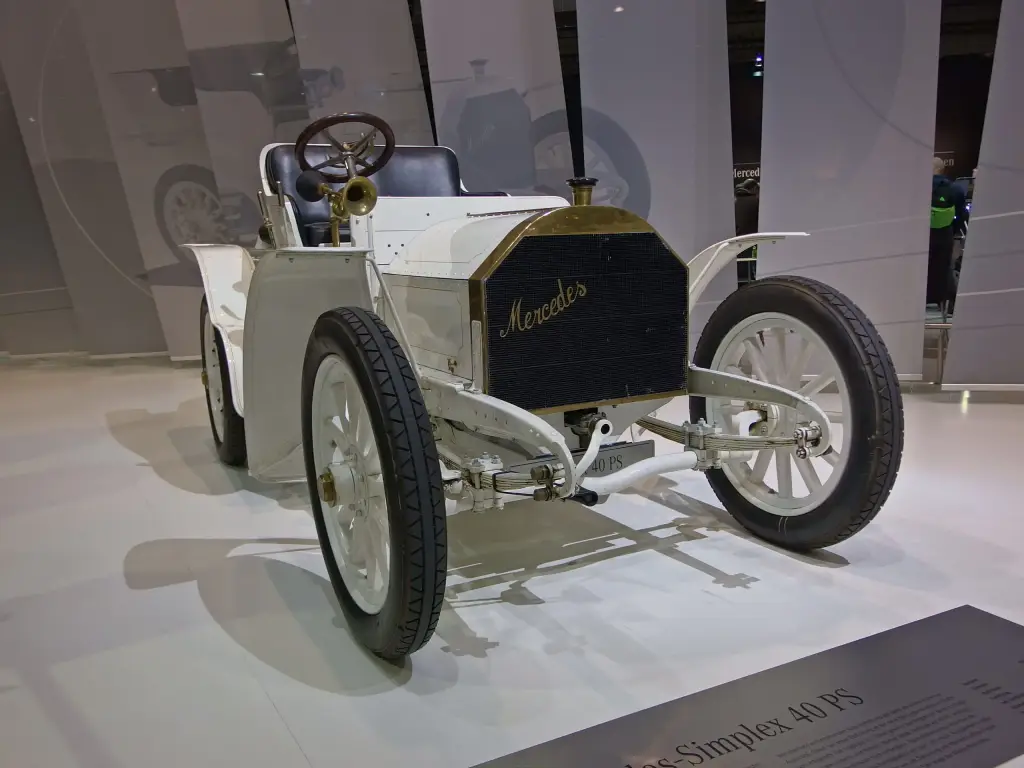
The Simplex continued the line begun by the Mercedes 35 hp of 1901. Maybach and the Daimler-Motoren-Gesellschaft set out to improve that car by offering “comfort by means of simplicity”, and the new name reflected controls that were considered very easy to use for 1902: a single gear lever declutched and braked the car at the same time. The first Mercedes-Simplex 40 PS was sent to Emil Jellinek in Nice on 1 March 1902.
The new top model kept the engine dimensions of its predecessor but changed bore and stroke to give 6,786 cc and 45 PS. The camshafts were enclosed, a single carburettor with pre-heating replaced the earlier arrangement, and cooling was improved by guide vanes on the large flywheel, which removed the need for a radiator fan. The underside was panelled in, an idea that influenced engine design elsewhere, and water consumption fell to seven litres.
Racing success
At the Nice race week in March 1902 the 45 PS car won the Nice–La Turbie hill climb in a record time, just as the 35 hp had done a year earlier. Albert Lemaìtre finished second in the same event in a Simplex, and in the United States a Simplex won a five-mile track race at Grosse Pointe, Detroit. William Kissam Vanderbilt II received the fifth 40 PS car on 14 March 1902 and immediately drove 600 km to Paris; on 3 May he set a record over one kilometre from Ablis to Chartres with a flying start, reaching 111.8 km/h. That car is the oldest surviving Mercedes.
The 60 hp and the luxury class
In 1903 Maybach designed a second Simplex version of 60 hp. With its large, wide body, low centre of gravity and imposing touring saloon coachwork, it laid the foundation of the super-luxury segment that the company would occupy for the next seventy years, through the 630, the 770 “Großer Mercedes”, the 300 “Adenauer” and finally the 600. Buyers came from royalty and the aristocracy, and Kaiser Wilhelm II admired the car at the Berlin exhibition of 1903, remarking to Maybach: “A truly beautiful engine you have here! But it’s not as simple as that, you know.”
The end of the name
The Simplex name was used until 1905, so the last models of the line never carried it. The model designations changed several times: 40/45 PS in 1904, when the first figure gave nominal and the second effective output, then 45 PS from 1905 and 26/45 PS from 1909, when the tax class was put first. The successor was the Mercedes 28/50 PS, available with cardan or chain drive.
Design and features
- Low centre of gravity: a long, wide chassis with a carefully designed pressed-steel frame gave stability at speed.
- Simplified controls: one lever both declutched and braked the transmission, which earned the car its name.
- Improved cooling: guide vanes on the flywheel fed air to the radiator and engine bay, and the undertray was closed with panels.
- Water-cooled brakes: all four brakes were cooled by water dripping from a reservoir onto the friction surfaces.
- Pressed-steel frame: the engine was bolted directly to it, keeping the unit low and saving weight.
Mercedes-Simplex versions
- Mercedes-Simplex 40 PS (1902–1903): the first version, 6,786 cc and 45 PS.
- Mercedes-Simplex 28 PS (1902–1903): a smaller car on a 2,500 mm wheelbase with a 5,320 cc engine.
- Mercedes-Simplex 60 PS (1903): Maybach’s second version and the foundation of the luxury class.
- 40/45 PS (1904), 45 PS (1905–1909), 26/45 PS (1909–1910): the same line under changing designations.
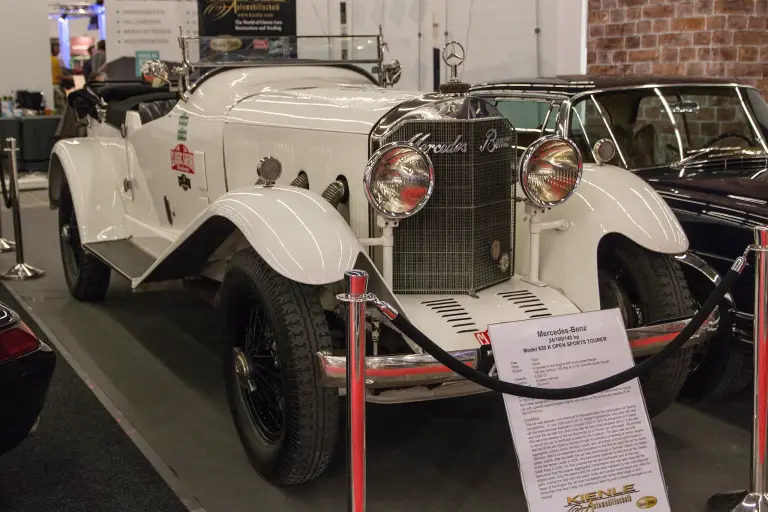
The Simplex followed the Mercedes 35 hp of 1901, and its luxury tradition was continued by the supercharged Mercedes 24/100/140 PS. More cars are in the Mercedes collection.
Video: Mercedes Simplex at Brokstedt
Video by dwerke on YouTube.
Sources
- Mercedes Simplex, English Wikipedia: history, racing, luxury class, dimensions
- Mercedes-Simplex, German Wikipedia: versions, designations, technical details