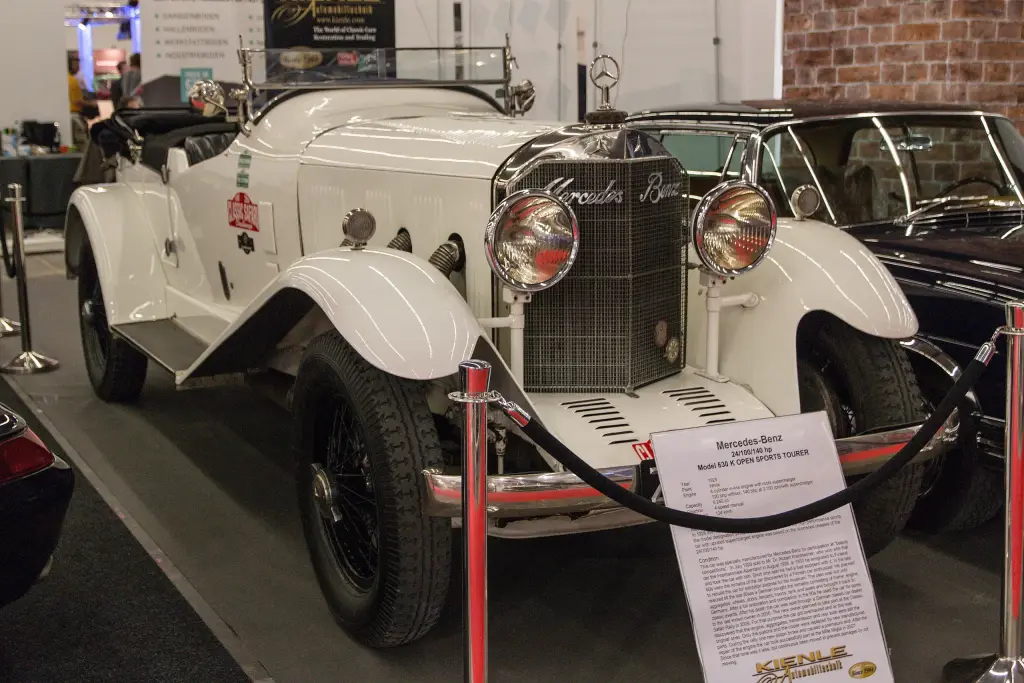
The Mercedes 24/100/140 PS was a large luxury car introduced by Daimler of Untertürkheim in 1924 and built until 1929. Developed under Ferdinand Porsche, it used a 6,240 cc straight-six with a switchable supercharger, and after the Daimler-Benz merger it became the Mercedes-Benz Typ 630.
Mercedes 24/100/140 PS at a glance
| Maker | Daimler-Motoren-Gesellschaft, then Mercedes-Benz from 1926 |
|---|---|
| Production | 1924–1929 |
| Development | completed by Ferdinand Porsche from April 1923 |
| Engine | six-cylinder in-line, 6,240 cc, overhead camshaft |
| Power | 100 PS (74 kW) normal, 140 PS (103 kW) with Kompressor |
| Top speed | 115 or 120 km/h, depending on final drive |
| Wheelbase | 3,750 mm; Modell K: 3,400 mm |
| Gearbox | four-speed manual, multi-plate dry clutch |
| Suspension | rigid axles on semi-elliptic leaf springs |
| Brakes | cable-operated on all four wheels, vacuum assisted from 1928 |
| Later name | Mercedes-Benz Typ 630 |
| K model | 24/110/160 PS from 1928, 145 km/h |
The car is described as the Mercedes 24/100/140 PS before the 1926 merger and as the Mercedes-Benz Typ 630 afterwards; both names appear in the sources.
History of the Mercedes 24/100/140 PS
Origins
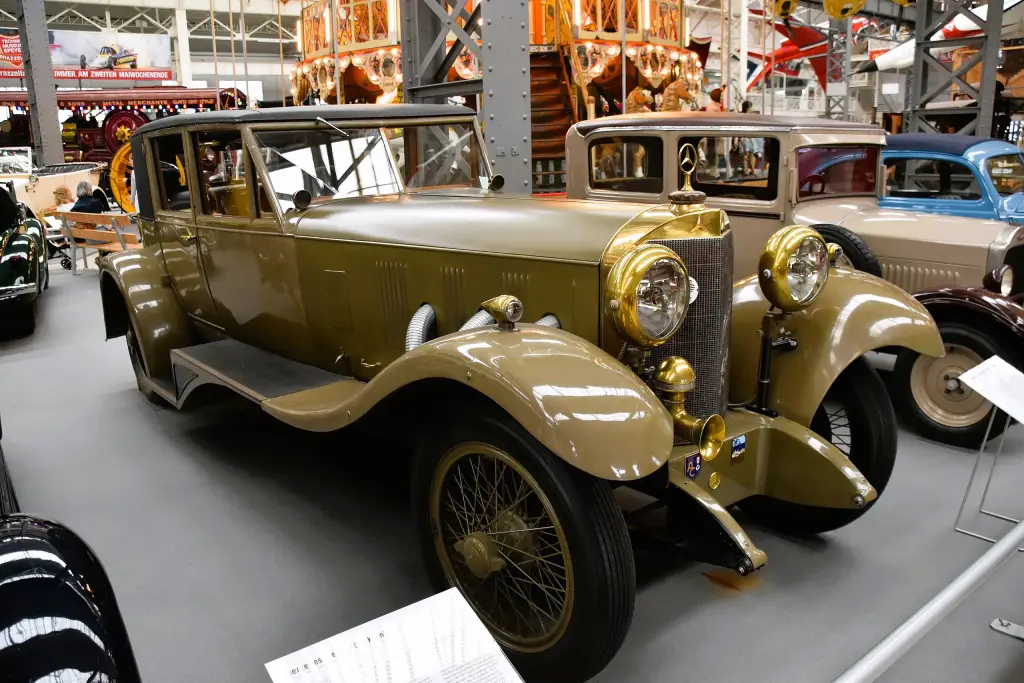
Plans for the car were drawn up by Paul Daimler, the company’s technical director and son of the founder. After a disagreement about model policy he left in 1922 for Horch, and the new technical director Ferdinand Porsche, who arrived from Austria in April 1923, completed the development and handled the launch. The idea was to use knowledge from the company’s racing cars to build a large, fast and expensive road car.
Naming and the Kompressor
Under the German naming conventions of the time, the first figure was the tax horsepower used to calculate annual car tax, and the following figures the maker’s claims for actual output. Two output figures were unusual and came from the switchable Roots supercharger: without it the engine gave 100 PS at 3,100 rpm, with it 140 PS. The same engine had an overhead camshaft driven by a bevel shaft, an unusual feature then. Power went to the rear wheels through a multi-plate dry clutch and a four-speed gearbox; the gear lever was at first outside the driver’s door on the right, later moved to the floor.
Bodies and buyers
Many buyers took the car as a bare chassis and had bodywork fitted by an independent coachbuilder. The factory list included a four- or six-seater Torpedo touring car, a six-seater Pullman limousine, a six-seater Landaulet, a six-seater coupé-limousine and a four-door four-seater cabriolet. Among early owners was Reichspräsident Paul von Hindenburg, whose 1929 Type 630 carried a Pullman-Landaulet body by Jos. Neuss of Berlin.
Typ 630 and the K model
The 24/100/140 PS was one of two Daimler models to survive the merger with Benz & Cie, which took effect in 1926. The car was renamed Mercedes-Benz Typ 630 without mechanical change; in 1927 an underslung chassis lowered the centre of gravity, and in 1928 the cable brakes gained vacuum assistance. From 1928 the Typ 630 could be ordered with the more powerful K engine for 2,000 marks extra, about eight per cent of the total price.
The Mercedes-Benz Modell K of 1926–1928 used the same engine on a shortened 3,400 mm chassis. It came as a four-seater sports saloon or a two-seater roadster, with three external metal pipes on the right side of the engine cover to lead away exhaust gases, a detail that became typical of later Mercedes-Benz Kompressor cars, and it reached 145 km/h. From 1928 the K was enlarged to 24/110/160 PS with no change in performance. In 1930 the limousines were replaced by the Typ 770 and the sports cars by the SS and SSK.
Design and features
- Switchable Kompressor: a Roots blower raised output from 100 to 140 PS, taken from the company’s racing cars.
- Overhead camshaft: driven by a bevel shaft, an advanced arrangement for a luxury car of 1924.
- Coachbuilt bodies: many cars left the factory as chassis only, to be bodied to the owner’s taste.
- Underslung chassis: from 1927 the axles sat above the frame members, lowering the centre of gravity.
- Vacuum-assisted brakes: added in 1928 to improve the cable-operated system.
Mercedes 24/100/140 PS versions
- Mercedes 24/100/140 PS (1924–1926): the original model.
- Mercedes-Benz Typ 630 (1926–1929): the same car after the Daimler-Benz merger.
- Typ 630 with K engine (1928–1929): the sports engine offered as an option.
- Mercedes-Benz Modell K (1926–1928): short-chassis sports car, 145 km/h.
- Modell K 24/110/160 PS (1928–1929): the more powerful final version.
The supercharged six continued the luxury tradition begun by the Mercedes-Simplex, and the same switchable Kompressor technology went into the Mercedes-Benz Grand Prix cars. More cars are in the Mercedes collection.
Sources
- Mercedes 24/100/140 PS, English Wikipedia: origins, naming, bodies, engine, evolution
- Mercedes 24/100/140 PS, German Wikipedia: versions, Typ 630, Modell K