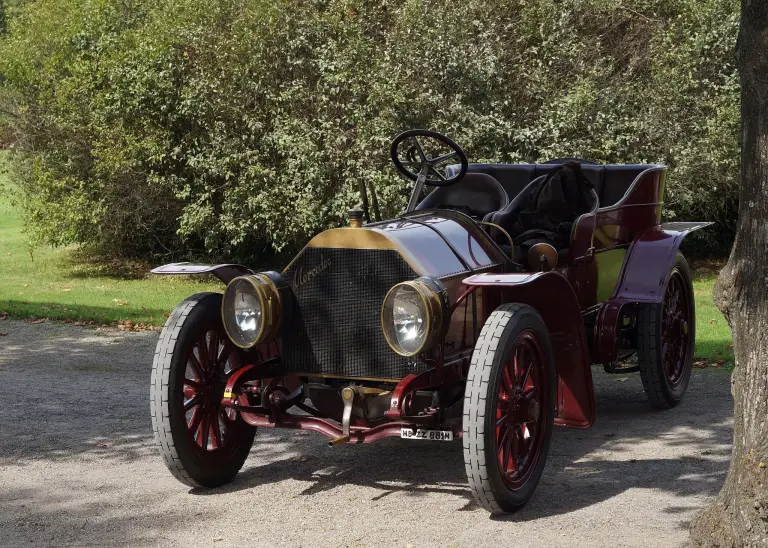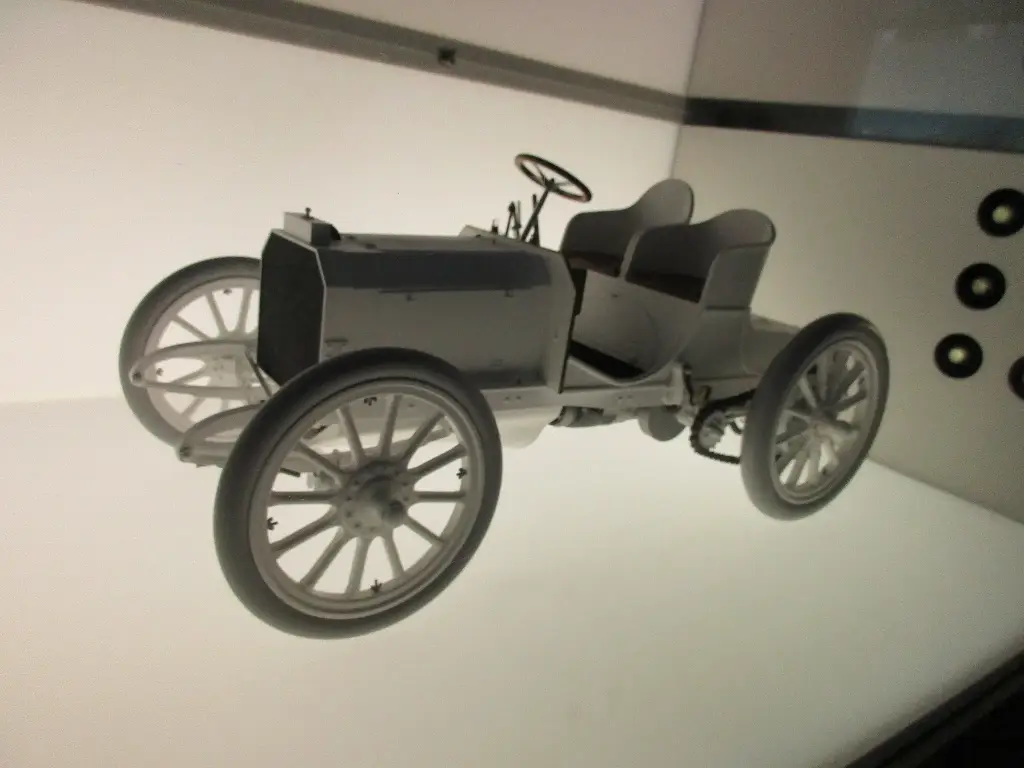
The Mercedes 35 hp, known in German as the Mercedes 35 PS, was designed in 1901 by Wilhelm Maybach and Paul Daimler for Emil Jellinek and built by Daimler-Motoren-Gesellschaft in Stuttgart. Regarded as the first modern car, it began the Mercedes line and gave the brand the name of Jellinek’s daughter.
Mercedes 35 hp at a glance
| Maker | Daimler-Motoren-Gesellschaft, Stuttgart |
|---|---|
| Production | from 1901 |
| Designers | Wilhelm Maybach and Paul Daimler |
| Built for | Emil Jellinek, Nice |
| Engine | four-cylinder in-line, 5,913 cc |
| Bore × stroke | 116 × 140 mm |
| Power | 35 PS (26 kW) |
| Wheelbase | 2,345 mm (German sources: 2,245 mm) |
| Track | 1,400 mm |
| Weight | 1,200 kg; engine about 230 kg |
| Top speed | 70–75 km/h on the road, over 85 km/h racing |
| Gearbox | four speeds and reverse, chain drive |
English and German sources give slightly different wheelbase figures (2,345 and 2,245 mm); both are shown in the table.
History of the Mercedes 35 hp
The name Mercedes
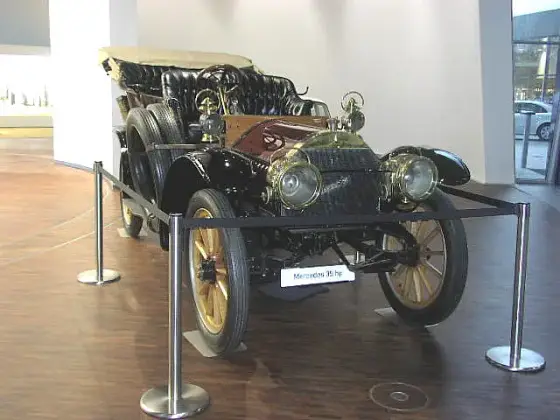
Emil Jellinek was a wealthy Austrian businessman and Austro-Hungarian diplomat who lived in Nice and sold Daimler cars in France, Italy and Switzerland. His daughter Adriana Manuela Ramona was nicknamed “Mercédès”, and Jellinek named his houses, racing team and cars after her; he raced as “Monsieur Mercedes”. After the death of the Daimler mechanic Wilhelm Bauer in the 1900 Nice–La Turbie race, the company withdrew from motorsport, but Jellinek persuaded it to build a new model and insisted that the name Mercedes appear on the radiator.
Development
Jellinek demanded a car unlike the motorised coaches of the day: longer, wider, with a lower centre of gravity, a light steel body and a strong chassis with the engine fixed low. He ordered 36 cars for 500,000 marks. Maybach tested the first car on 22 November 1900 and Jellinek received his first delivery on 22 December. The engine was a four-cylinder with an aluminium crankcase, paired cast-iron cylinders with integrated heads, and camshaft-driven inlet valves instead of the earlier sniffing valves. Maybach bolted the engine directly to the pressed-steel side members of the frame rather than to a subframe, which saved weight and lowered the centre of gravity.
The car introduced the honeycomb radiator: 8,070 square tubes of six by six millimetres soldered into a rectangular block. Its greater open area cut the water requirement from 18 to nine litres, and a small fan behind the radiator helped at low speed. The four-speed gearbox was combined with the differential and drove the rear wheels through open chains; the steering box was moved further back and inclined, with the steering axles at the wheel hubs to reduce shocks reaching the driver’s hands.
Racing and reception
In January 1901 six cars ran in the Pau Grand Prix with disappointing results, but at Nice–La Turbie in March the five Mercedes 35 hp cars of Jellinek’s team, with the German driver Wilhelm Werner, dominated from start to finish. They set a record average speed of 51.4 km/h against the previous 31.3 km/h and reached 86 km/h, and Paul Meyan of the French Automobile Club declared: “We have entered the Mercedes era.” In Stuttgart the company added two rear seats to make a family car, and in 1901 it also built the smaller Mercedes 12/16 hp and 8/11 hp. The Mercedes trademark was registered on 26 September 1902, and in June 1903 Jellinek changed his own name to Jellinek-Mercedes.
Design and features
- Low centre of gravity: the engine sat directly over the front axle on a pressed-steel frame, giving stability unknown in motorised coaches.
- Honeycomb radiator: Maybach’s block of square tubes halved the cooling water needed and became a standard for the industry.
- Modern engine: aluminium crankcase, mechanically timed inlet valves, one carburettor per pair of cylinders and a stable 300 rpm idle.
- Friction-band clutch: a small coil-spring clutch inside the flywheel, automatically readjusting and new at the time.
- Balanced chassis: a long wheelbase and a 1,400 mm track made the car far more stable than its rivals.
Mercedes 35 hp versions
- Racing version: stripped for competition and capable of more than 85 km/h.
- Road car: typical speeds of 70–75 km/h.
- Family car: two additional rear seats fitted in Stuttgart.
- Mercedes 12/16 hp and 8/11 hp: smaller sister models of 1901.
- Mercedes-Simplex 40 PS: the 1902 successor.
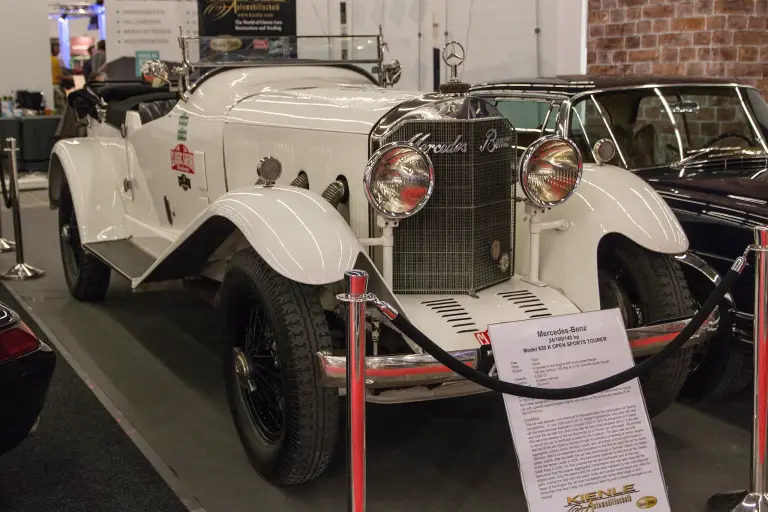
The 35 hp was replaced by the Mercedes-Simplex of 1902. The same company later built the supercharged Mercedes 24/100/140 PS, and more cars are in the Mercedes collection.
Sources
- Mercedes 35 hp, English Wikipedia: history, racing, dimensions, technical description
- Mercedes 35 PS, German Wikipedia: engine details, radiator, chassis