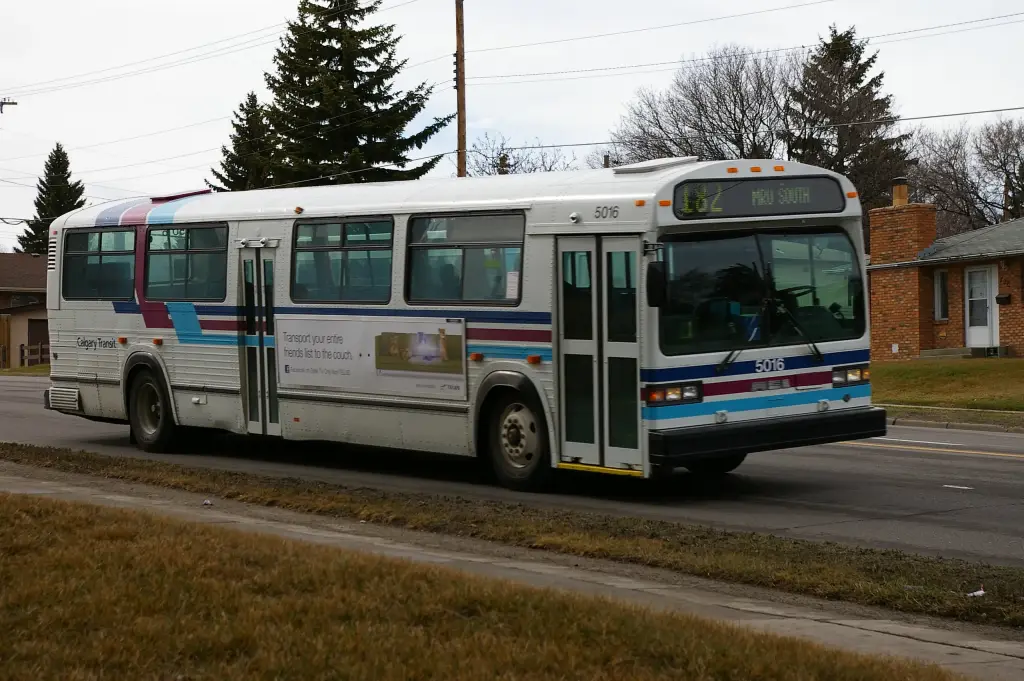
The Classic is a single-deck transit bus that General Motors Diesel developed from its previous New Look design. MCI acquired the design with GM’s transit bus division in 1987 and built the bus until the division, and the Classic with it, passed to Nova Bus in 1993.
MCI Classic at a glance
| Type | single-deck transit bus |
|---|---|
| Developed by | General Motors Diesel, from the New Look |
| Compared with New Look | nearly identical from the belt rail up; new front allowing a wider front door |
| Main version | 40 ft long, 102 in wide |
| Articulated version | 60 ft, 16 built |
| MCI took over | 1987, when GM sold its transit bus division |
| Passed to Nova Bus | 1993 |
| Last Classics built | 1997, for the Société de transport de l’Outaouais |
| Model designations | TC40-102A, TC40-102N, TA60-102N |
This page is based on the English Wikipedia article on the Classic, so it relies on one source.
History of the MCI Classic
From General Motors
When GMC in the United States replaced the New Look with the RTS II series in 1977, it hoped to win operators in both the United States and Canada. The futuristic RTS turned off most Canadian operators, and in 1979 GM Canada’s transit division decided to keep building New Looks until 1982, when it unveiled the Classic. The bus was nearly identical to the New Look from the belt rail up but had a new front that allowed a wider front door. It was intended for the Canadian market as an alternative to the RTS, but it sold widely in the United States as well: the Utah Transit Authority was the first American operator, ordering 39 buses in 1983, followed by 63 in 1984 and 66 in 1990, and Detroit, Grand Rapids, Connecticut Transit, Santa Monica’s Big Blue Bus and the New York commuter operators followed.
Under MCI
In 1987 GM sold its transit bus division to Motor Coach Industries. The Classic continued to be built at the former GM plant in Saint-Eustache, Quebec, while the 60-foot articulated version was added in 1992, after MCI had bought the design; only 16 were ever built, 14 for Halifax Transit and two for Quebec City. The model designations were the TC40-102A, TC40-102N and the TA60-102N, all with an automatic transmission.
The end of the line
By 1993 the bus division had changed hands again, this time to Nova Bus. Nova Bus assembled Classics in the United States in 1995 and 1996 at a plant in New York state, delivering them to Buffalo, Connecticut, Rochester, Pace in the Chicago suburbs and Pittsburgh, the last American agency to receive them. Production ended in 1997 with a final batch for the STO of Gatineau, Quebec, as most agencies preferred the new low-floor LFS. Some Classics stayed in service for another two decades, and several have been preserved by bus groups and private owners.
Design and features
- New Look underneath: the same body as the previous GM bus from the belt rail up.
- Wider front door: the new front end was the main visual change.
- Two lengths: the 40-foot standard bus and a 60-foot articulated version.
- Long service life: some Classics ran into the 2010s and several are preserved.
MCI Classic versions
- TC40-102A: the standard 40-foot bus.
- TC40-102N: the later 40-foot version.
- TA60-102N: the 60-foot articulated bus, 16 built.
- Nova Bus Classics: built after 1993, including the American-assembled buses of 1995–1996.
MCI’s intercity coaches of the same years are in MCI 102 and MCI D4500. More buses are in the MCI collection.
Video: 1988 MCI Classic transit bus
Video on YouTube.
Sources
- Classic (transit bus), English Wikipedia: history, models, production, operators