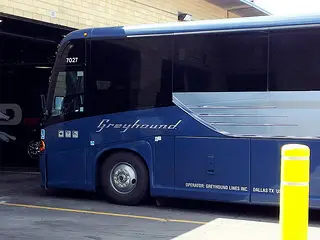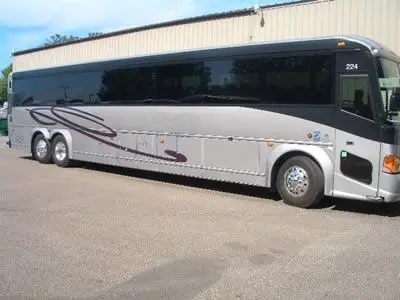
The coach that became the MCI D4500 was introduced in February 1992 as the 102-DL3, less than three months after American law was changed to allow 45-foot buses. It was MCI’s first 45-foot motorcoach and was renamed D4500 in 2001; the first-generation D-Series remained in production until 2005.
MCI D4500 at a glance
| Introduced as | 102-DL3, February 1992 at the UBOA Bus Expo |
|---|---|
| Production | 1992–2005 |
| Renamed | D4500 in 2001 |
| Length | 45 ft, the first MCI coach of that length |
| Width | 102 in |
| Axles | three |
| Name decoded | 102 = width in inches, D = model, L = long, 3 = three axles |
| 40-foot sister | 102-D3, introduced in January 1994, renamed D4000 in 2001 |
| Options | wheelchair lift, accessible lavatory, stainless steel front and sides |
| Wheelchair version | 102-DLW3 |
History of the MCI D4500
The 45-foot law
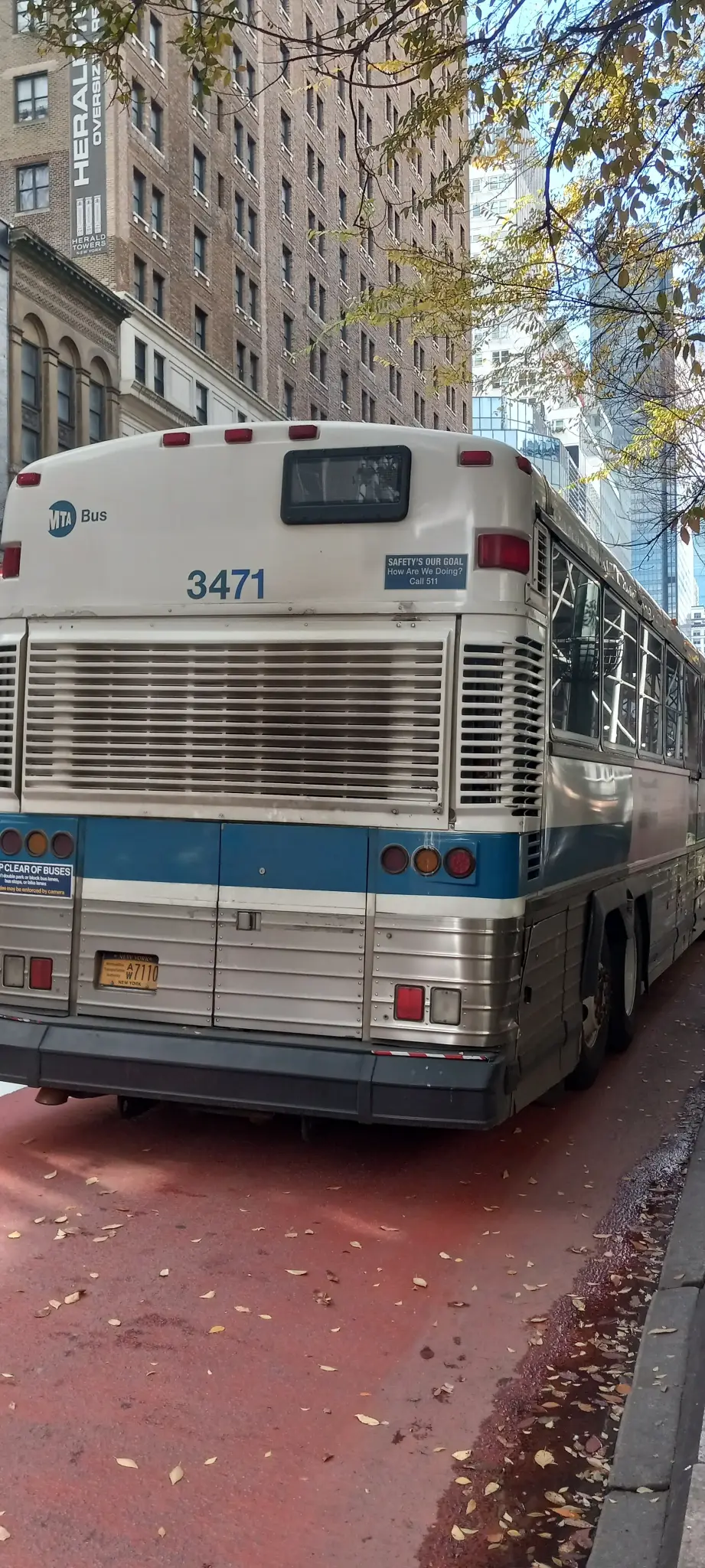
Three changes pushed MCI towards a new coach in the late 1980s: growing calls to allow 45-foot coaches, which American law then prohibited; the company’s wish to offer the new four-stroke Detroit Diesel Series 60 instead of two-stroke engines; and a 1988 request from the Canadian government for a wheelchair-accessible intercity bus. MCI built two prototypes: in 1989 it stretched an existing 102-C3 to 45 feet, and in May 1990, with the Canadian government, it built a wheelchair-accessible bus with a lift and an accessible bathroom. On 18 December 1991 the Intermodal Surface Transportation Efficiency Act was signed, allowing 45-foot coaches, and MCI was ready: the 102-DL3 appeared at the February 1992 UBOA Bus Expo and production began late that year.
The D-series
The 102-DL3 was joined in January 1994 by a 40-foot version, the 102-D3, which replaced the B- and C-Series coaches in the range. Both used a large air intake behind a big grille, a two-piece engine door, small headlights and a black roof cap, with fender skirts and a rear-mounted radiator fan beside the intercooler fan. Stainless steel front and sides and a rubber front bumper were optional. In 2001 the 102-D3 was renamed D4000 and the 102-DL3 became the D4500.
Transit and prison versions
The D-Series was quickly adopted by companies running scheduled service, Greyhound among them, and by commuter operators. As transit agencies began using the coaches on long express routes, MCI offered destination signs and two-piece sliding doors better suited to curbside loading. A prisoner transport version, the Inmate Security Transportation Vehicle, was introduced at about the same time as the 102-D3; it carries up to 69 inmates, has containment cells and a rear officer position, and is built only in the 40-foot length to fit existing prison sally ports. The first-generation coaches were replaced by updated models in 2005.
Design and features
- First 45-footer: the model that answered the 1991 change in American length rules.
- New engines: designed around four-stroke engines such as the Detroit Diesel Series 60.
- Accessibility: wheelchair lift and accessible lavatory were offered from the start.
- Long life: a simple, durable body that transit agencies used on express routes.
- Prison version: the ISTV with cells for up to 69 inmates.
MCI D4500 versions
- 102-DL3 / D4500 (1992–2005): the 45-foot coach.
- 102-DLW3: the 45-foot coach with a wheelchair lift.
- 102-D3 / D4000 (1994–2005): the 40-foot version.
- D4000H: hybrid-electric 40-foot model.
- D4000N (2002–2004): 96-inch wide version, 12 built.
- ISTV: the 40-foot prisoner transport coach.
The facelifted coach that followed is in MCI D4505, and the naming system in MCI 102. More coaches are in the MCI collection.
Video: 2001 MCI D4500 coach
Video on YouTube.
Sources
- MCI D-Series, English Wikipedia: history, models, dimensions, versions
- Motor Coach Industries, English Wikipedia: production years and model table