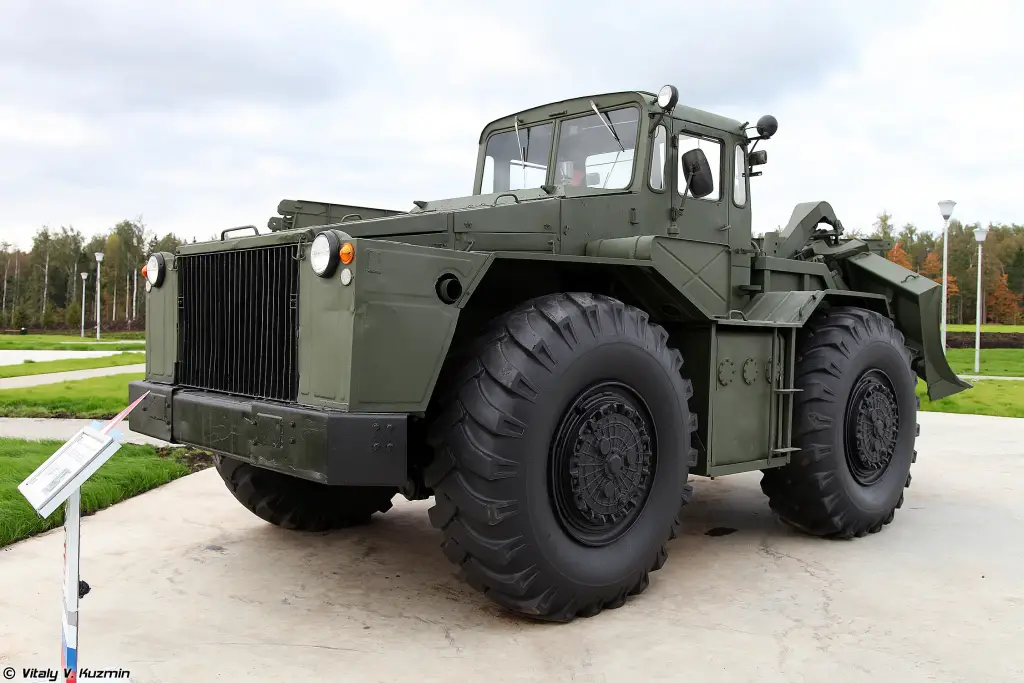
The MAZ-538 was a heavy four-wheeled bulldozer designed and built at the Minsk Automobile Plant for the Soviet armed forces. It was made from 1964 to 1990 and came in many versions, some of which are still in use today.
MAZ-538 at a glance
| Maker | Minsk Automobile Plant (MAZ), Belarus |
|---|---|
| Production | 1964–1990 |
| Predecessor | prototype MAZ-528, built and tested from 1955 |
| Role | heavy wheeled bulldozer for the Soviet armed forces |
| Drive | 4×4, four equal wheels with low-pressure tyres |
| Steering | rear wheels steer, in the manner of a forklift truck |
| Engine | D12A-375 V12 diesel of 38.88 litres, 375 hp |
| Top speed | 45 km/h |
| Fuel | about 100 litres per 100 km, from two 240 litre tanks |
| Dimensions | 5,870 mm long, 3,100 mm wide, 3,120 mm high |
| Weights | kerb 16.5 tonnes, gross up to 19.5 tonnes |
| Other names | versions known as BKT and PKT wheeled tractors |
The MAZ-538 has an article only in English Wikipedia; this page is based on one source.
History of the MAZ-538
From the MAZ-528
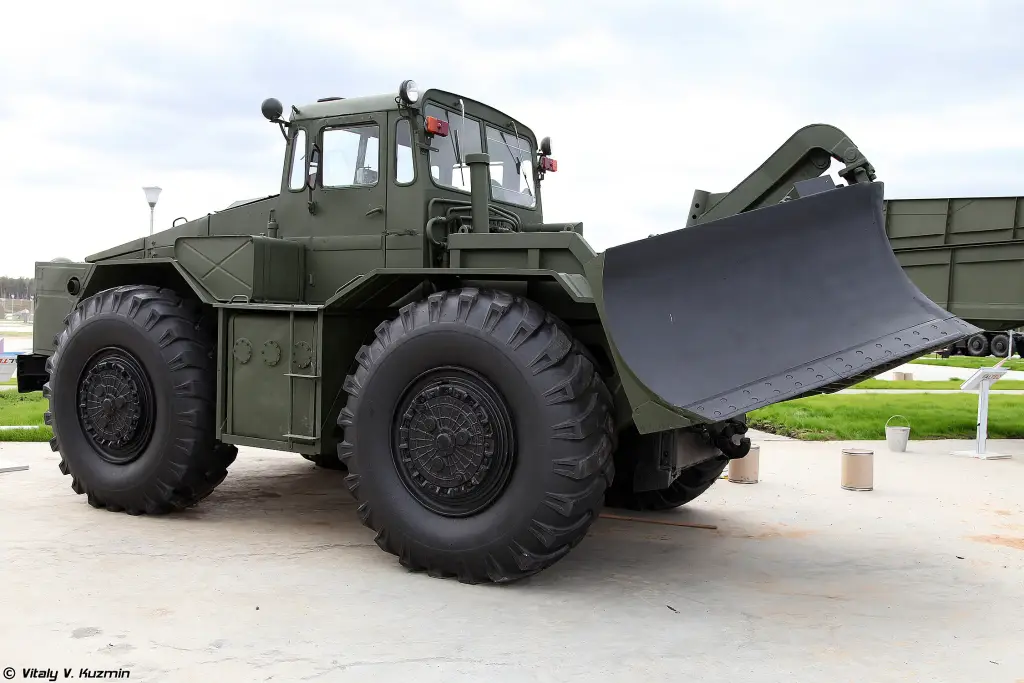
As early as 1955 a series of prototypes of a heavy wheeled bulldozer were built and tested under the name MAZ-528. It is not clear exactly when or why the designation changed to MAZ-538, but the machines were built in series under that name from 1964. From 1965 other factories began producing different versions, partly outside the MAZ plant, at armament works such as MZKT or KZKT that officially did not exist. Versions made until the 1990s were often named with three letters such as BKT or PKT instead of MAZ-538: the KT stood for wheeled tractor and the first letter for the particular use, depending on the attachments.
How it worked
The machine stood on four equal-sized wheels with low-pressure tyres, and the rear wheels steered in a way similar to a forklift truck. The bulldozer blade of the early machines had a characteristic V shape, gradually replaced by a flat design. Later, extra equipment was fitted at the rear, such as pulling devices, rippers to loosen the ground or large trenching machines. Depending on the version the machine was operated by one or two people.
Engines and growth
Power for the machine and its equipment came from the V12 D12A-375 diesel of 38.8 litres and 375 hp, an engine originally designed for tanks in the Second World War. During the production run there were attempts to raise output with a 525 hp version, which for unknown reasons was not pursued. All versions had four-wheel drive and were built for long life. Over time the machines grew bigger and heavier: in 1965 the wheelbase of the KZKT-538DP was extended by more than a metre, and later models gained almost 10 tonnes of kerb weight. Output rose too, from 60 to 100 m³ of soil an hour to as much as 160 m³ an hour in the last generation. The bulldozers spread widely in the Soviet army and in the successor republics; some are now in museums or still at work in civilian hands.
Design and features
- Steering rear wheels: the layout gave the machine the manoeuvrability of a forklift truck.
- Tank diesel: the V12 D12A-375 of 375 hp came from wartime tank design.
- Growing machines: wheelbase and weight rose through the years, and output reached 160 m³ an hour.
- Many names: the versions were known as BKT and PKT wheeled tractors according to their equipment.
MAZ-538 versions
- MAZ-528 (from 1955): the prototypes of the heavy wheeled bulldozer.
- MAZ-538 (from 1964): the series bulldozer.
- BKT and PKT versions: wheeled tractors with different attachments, built by other plants from 1965.
- KZKT-538DP (1965): version with the wheelbase extended by more than a metre.
The MAZ-538 used the same family of V12 tank diesels as the MAZ-537 and the MAZ-7310. More are in the MAZ collection.
Sources
- MAZ-538, English Wikipedia: history, description, technical data, versions