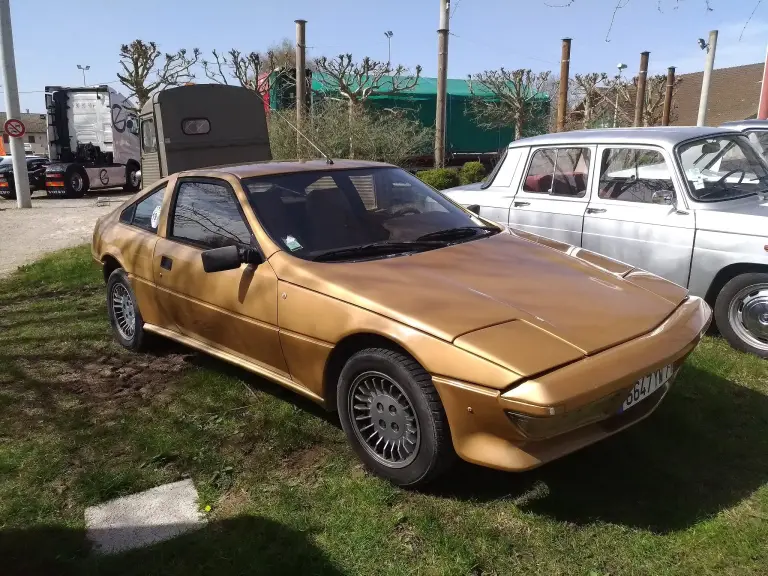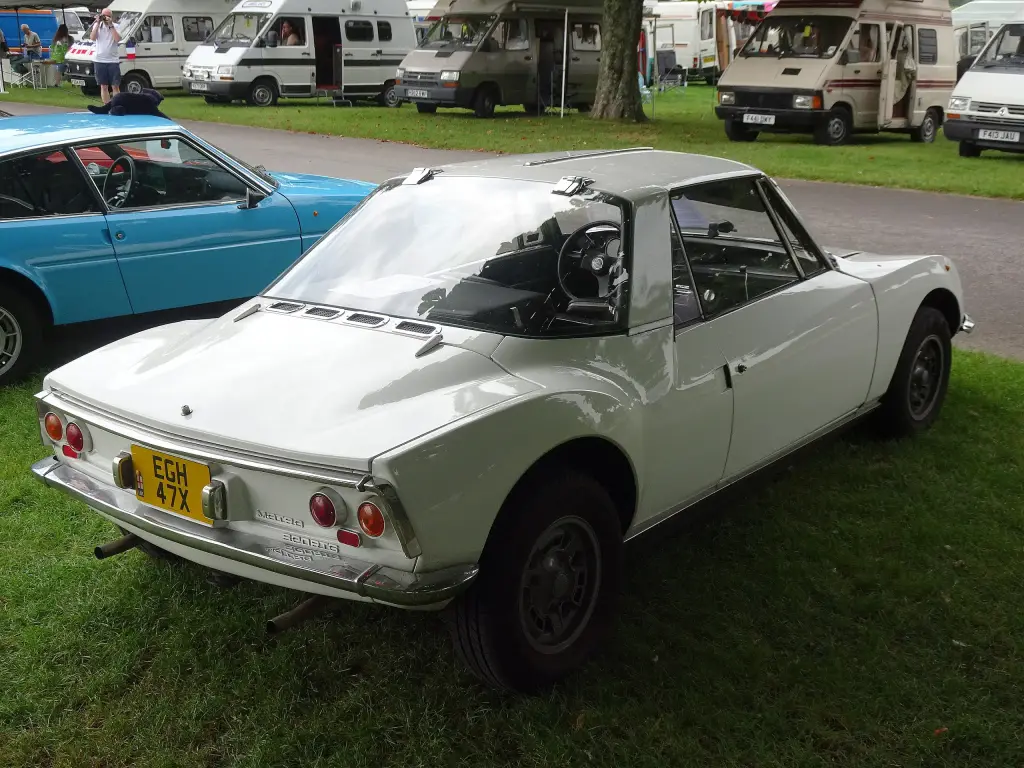
The Matra Sports M530 was Matra’s first “true” sports car: the Djet had been a René Bonnet design, while the M530 was developed in-house as a more practical mid-engined 2+2. It was built from 1967 to 1973 and named after Matra’s R.530 missile.
Matra 530 at a glance
| Maker | Matra Sports, France |
|---|---|
| Production | 1967–1973 |
| Designed by | Philippe Guédon; body styled by Jacques Nochet |
| Layout | mid-engine, rear-wheel drive, 2+2 |
| Engine | 1,699 cc Ford Taunus V4 |
| Power | 70 DIN hp at launch; 75 CV (55 kW) from 1969 |
| Top speed | 175 km/h (109 mph) claimed |
| Body | glass-reinforced plastic on a steel platform chassis |
| Roof | targa top |
| Built | 9,609 (2,062 M530, 1,669 M530 A, 4,731 M530 LX, 1,146 M530 SX) |
Based on the English Wikipedia article on the Matra 530.
History of the Matra 530
Development
In 1965 Matra’s chief executive Jean-Luc Lagardère decided to develop a successor to the Djet that would appeal to the non-racing public — a voiture des copains, a car for friends. The result, designed by former Simca designer Philippe Guédon with bodywork styled by Jacques Nochet, was the first Matra sports car developed entirely by the company itself. It was named after the R.530 missile the company built.
Engineering
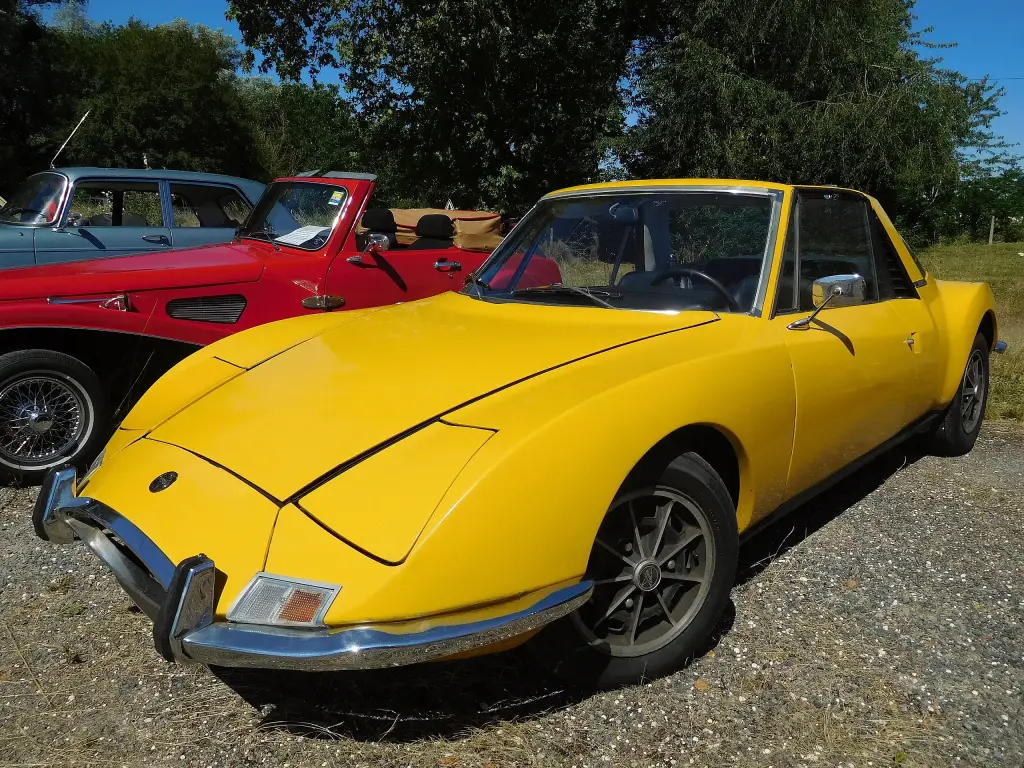
The Djet had used a steel backbone chassis; the M530 was built on a steel platform chassis, perforated to save weight. Both cars had glass-reinforced plastic bodies and mid-mounted engines. To fit a mid engine while keeping 2+2 seating and a useful boot, Matra chose the compact “high compression” 1,699 cc Ford Taunus V4 and transaxle from the Taunus 15M TS, whose running gear traced back to the Ford Mustang I prototype by way of Ford Germany. The targa roof and hidden headlamps were among the most notable features of its avant-garde design.
M530 and M530 A
The M530 debuted on 7 March 1967 at the Geneva Motor Show with 70 DIN hp and a claimed 175 km/h. Production began in April with a chrome bumper bar protecting the front grille, a reshaped dashboard for more knee room and a repositioned ignition key. For the first two years chassis were built by Carrier in Alençon and final assembly was done by Brissonneau et Lotz at Creil; the engine bay of early cars was reached by removing the acrylic rear window.
1969 brought several changes: a different carburettor raised output to 75 CV, Matra agreed with Chrysler Europe to sell through the Simca network from 1970, assembly moved entirely to Romorantin, and the car was badged M530 A. Autocar tested one in March 1969: 95 mph, 0–60 mph in 15.6 seconds and 26.9 mpg, slower than a Lotus Elan +2 but praised for refinement, handling and construction.
M530 LX and SX
The M530 LX appeared at Geneva in 1970, a minor redesign by Michelotti with a new glass rear hatch held open by struts and a new front bumper. In October 1971 came the budget M530 SX, priced under 20,000 francs, with a fixed roof, four fixed headlamps on the nose instead of hidden ones, black bumpers and only yellow or white paint.
The end
Production ended in 1973 after 9,609 cars: 2,062 M530, 1,669 M530 A, 4,731 M530 LX and 1,146 M530 SX. No right-hand-drive cars were built. A handful of specials were made, including a body by Vignale, a gull-wing “Laser” study by Michelotti and a V6-engined car prepared by Weslake, while the artist Sonia Delaunay painted a pre-production car in 1968.
Design and features
- Targa roof: an open-air roof panel over a mid-engined 2+2 body.
- Hidden headlamps: a clean nose that became a Matra signature.
- Practical packaging: the compact Ford V4 sat between the rear seats and the boot.
- Plastic body on a steel platform: light panels over a perforated steel chassis.
Matra 530 versions
- M530 (1967–1969): 70 hp, early cars with the acrylic rear window.
- M530 A (1969–1971): 75 CV, built entirely at Romorantin.
- M530 LX (1970–1973): Michelotti restyle with glass rear hatch.
- M530 SX (1971–1973): fixed roof, exposed headlamps, black bumpers.
The 530 replaced the Matra Djet and was itself replaced by the Matra Bagheera. More cars are in the Matra collection.
Sources
- Matra 530, English Wikipedia: development, versions, production, road test