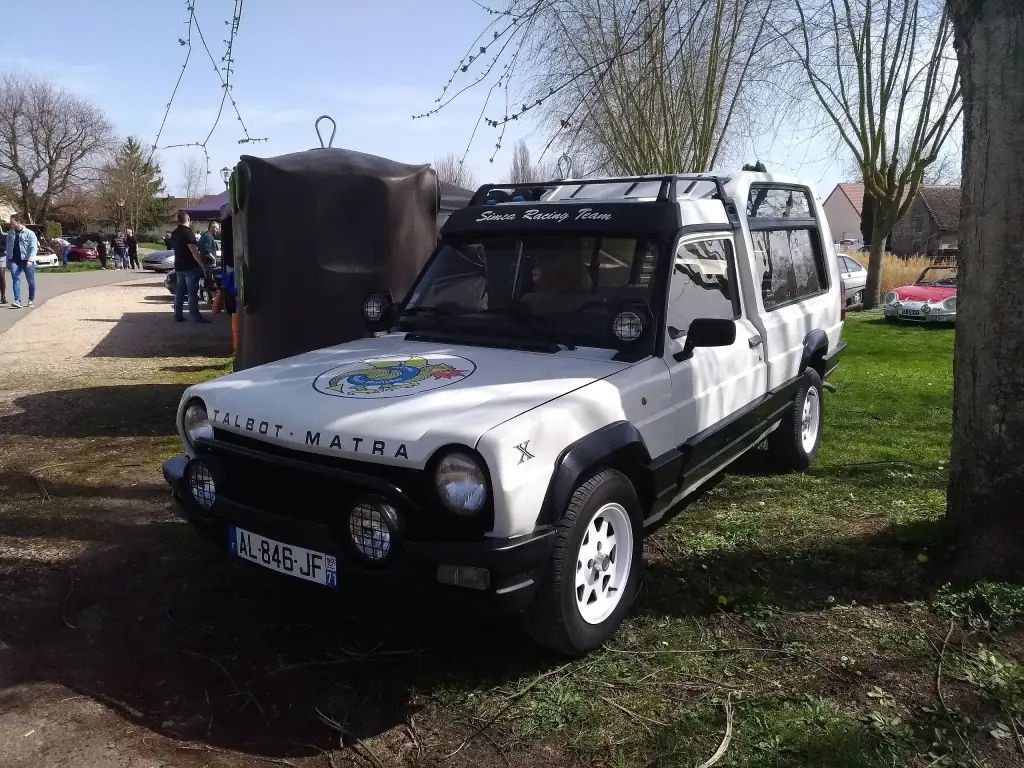
The Matra Rancho was a leisure activity vehicle created by Matra in cooperation with Simca to capitalise on the off-road trend started by the Range Rover. It offered an off-road look at a much lower price, without four-wheel drive.
Matra Rancho at a glance
| Maker | Matra, with Simca; later Talbot |
|---|---|
| Production | 1977–1984; on sale until January 1985 |
| Designed by | Antonis Volanis |
| Based on | Simca 1100 pick-up |
| Engine | 1,442 cc Poissy four-cylinder |
| Power | 80 hp (59 kW) |
| Drive | front-wheel drive, no all-wheel drive |
| Body | fibreglass and polyester over a stretched chassis |
| Ground clearance | increased |
| Built | 57,792 |
Based on the English Wikipedia article on the Matra Rancho.
History of the Matra Rancho
Launch
The Rancho was launched in 1977 and became a popular model, but it did not solve the larger problems of Chrysler Europe, Simca’s parent company. Chrysler sold its European arm to PSA in 1978, and it was rebranded as Talbot in 1979; the Matra-Simca Rancho became the Talbot Matra Rancho. Production continued until 1984, the car remained on sale until January 1985, and 57,792 were built in total.

Construction
Designed by Antonis Volanis, the Rancho was based on the pick-up version of Simca’s supermini, the Simca 1100, using its front structure and a stretched chassis. The rest of the body was made by Matra from fibreglass and polyester, including the mouldings that adorned the body and made it look sturdier — the technology later used on the Renault Espace. Ground clearance was increased, but unlike most off-roaders the Rancho had no all-wheel drive and kept the 1100’s front-wheel-drive layout. The dashboard and front seats came from the Simca 1100 GLS, and power came from the 1,442 cc, 80 hp version of the Poissy straight-four.
Versions
During its life the Rancho was offered in several versions. The basic Rancho was joined by the Grand Raid, with an electric winch on the front bumper, an extra spare wheel on the roof, a limited-slip differential, undercarriage protection, bronze-tinted windows and matte green paint only. The Rancho X was the upscale model with alloy wheels and metallic paint. The Découvrable had a rear cabin of open frame with roll-down fabric covers, usable as an open car in good weather. The Rancho AS was the commercial version, with no rear seat, exempt from the French tax on passenger cars.
Successor
The Rancho spawned an unlikely successor: the Renault Espace. Matra wanted to replace it with a prototype of the Espace known as the “dessin orange” (“the orange drawing”), because both the prototype and its background were orange. It predicted the shape of the first Espace but had three doors instead of five. Peugeot, which controlled Matra at the time, thought the project too expensive and not promising enough; Matra took it to Renault, which adopted it, and the Espace of 1984 became arguably Europe’s first minivan.
Design and features
- Off-road look, front-wheel drive: the style of a four-wheel-drive estate with Simca 1100 mechanicals.
- Fibreglass body: Matra-made panels and mouldings over a stretched 1100 pick-up chassis.
- Raised ground clearance: without the weight and cost of all-wheel drive.
- Espace ancestor: the body technology led to Europe’s first MPV.
Matra Rancho versions
- Rancho (1977–1984): the basic model.
- Grand Raid: winch, roof spare wheel, limited-slip differential, matte green.
- Rancho X: upscale model with alloy wheels and metallic paint.
- Découvrable: open rear cabin with roll-down fabric covers.
- AS: commercial version without a rear seat.
The Rancho’s designer also shaped the Matra Murena, and its technology led to the Renault Espace. More cars are in the Matra collection.
Sources
- Matra Rancho, English Wikipedia: history, construction, versions, successor