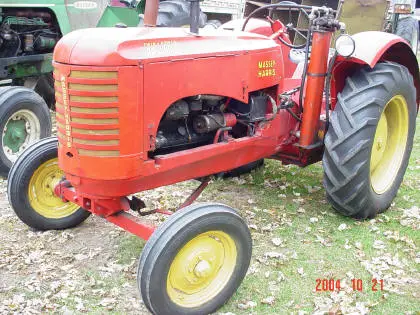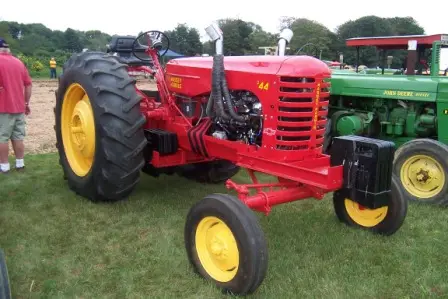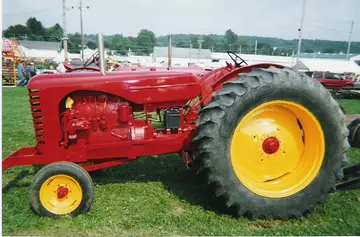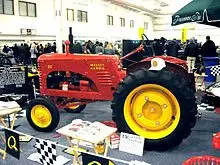
The Massey-Harris 744 is one of the early tractors named in the company’s history on English Wikipedia, in the same group as the Pony, the Model 20 and the Model 81. It belongs to the years between the first own-design Massey-Harris tractor of 1930 and the post-war generation of 22, 33, 44 and 55.
Massey-Harris 744 at a glance
| Maker | Massey-Harris Limited, Toronto, Canada |
|---|---|
| Type | farm tractor |
| Place in the range | early tractor line-up |
| Listed with | GP 15/22, Pacemaker, Model 101, Pony, Model 20, Model 81 |
| First own-design tractor | the GP of 1930, four-wheel drive with a Hercules engine |
| Early range in horsepower | from 20 hp (GP 15/22) to 35 hp (Model 101) |
| Combine of the same years | No. 20 of 1938 |
| Post-war generation | M-H 22, 33, 44 and 55 |
| Company formed | 1891, merger of the Massey Manufacturing Co. and A. Harris, Son and Company |
| Engine and production years | not recorded in the sources used here |
There is no Wikipedia page for the 744 itself; the model is named in the Massey-Harris company history on English Wikipedia, which is also the source of the background given here.
History of the Massey-Harris 744
A company that came late to tractors
Massey-Harris Limited was formed in 1891 by the merger of the Massey Manufacturing Co. and A. Harris, Son and Company, and became the largest agricultural equipment maker in the British Empire. Its trade was threshing machines, reapers and other harvest equipment. Tractors arrived by stages: machines bought from the Parrett Tractor Company of Chicago Heights from 1917 were built in Massey-Harris’ own Weston, Ontario factory from 1919, but that production ended in 1923 because the models were no longer competitive. From 1927 the company sold tractors made by the J. I. Case Plow Works under the Wallis name and in 1928 bought that business.
The GP of 1930
The first tractor designed by Massey-Harris itself was the GP, for general purpose, presented in 1930. It was a four-wheel-drive machine with four wheels of equal size and a Hercules engine. Around it the company built an early range that English Wikipedia lists as the 20 hp GP 15/22 of 1930–36, the 25 hp Pacemaker of 1936–39, the 35 hp Model 101 of 1938–42, the Pony, the Model 20, the Model 81 and the Model 744. The 744 is named in that list and nowhere else in the sources, so its place in the range is known from the company history rather than from a page of its own.
Before the post-war generation
The early tractors were followed by the final Massey-Harris generation, introduced immediately after the Second World War: the 25 hp M-H 22, the 35 hp M-H 33, the 45 hp M-H 44 and the 55 hp M-H 55. In the same years as the 744 the company also worked on harvesting machinery, producing the No. 20 self-propelled combine in 1938. In 1953 Massey-Harris merged with Harry Ferguson Limited to form the company later known as Massey Ferguson.
Design and features
- Early model: the 744 is listed among the tractors built before the post-war series.
- Part of a broad range: it stood alongside the GP 15/22, Pacemaker, Model 101, Pony, Model 20 and Model 81.
- After the GP: the first own-design Massey-Harris tractor, the four-wheel-drive GP, appeared in 1930.
- Harvesting years: the company produced its first self-propelled combine, the No. 20, in 1938.
- Before the merger: the model predates the 1953 merger with Harry Ferguson that created Massey Ferguson.
Massey-Harris 744 versions
- Massey-Harris 744: the model named among the early tractors.
- GP 15/22 (1930–36): 20 hp, four-wheel drive, the first Massey-Harris design of its own.
- Pacemaker (1936–39): 25 hp.
- Model 101 (1938–42): 35 hp.
- Pony, Model 20 and Model 81: the other early models listed with the 744.
The other early tractors are described with the Pony and the No. 20 combine. The post-war range began with the M-H 22. More machines are in the Massey-Harris collection.
Video: massey harris 744 d ploughing in norway
Video on YouTube.
Sources
- Massey Ferguson, English Wikipedia: early model list, GP, No. 20, post-war series
- Massey-Harris, German Wikipedia: company history, the GP of 1930