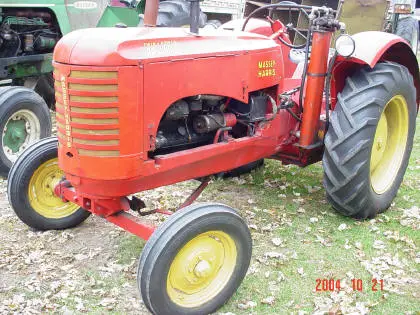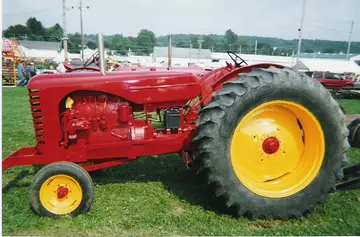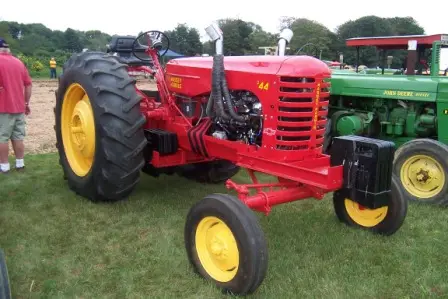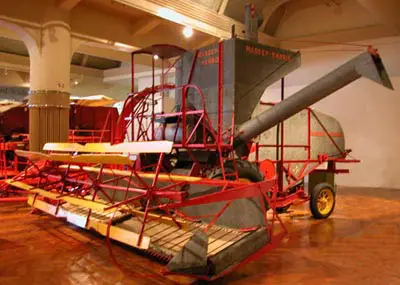
The Massey-Harris No. 21 was the lighter and cheaper combine developed from the No. 20, tested in 1940 and put on sale in 1941. Wartime shortages kept its numbers down, but 500 of the machines were sold under the Harvest Brigade scheme and brought in the 1944 and 1945 harvests across the United States and Canada.
Massey-Harris No. 21 at a glance
| Maker | Massey-Harris Limited, Canada |
|---|---|
| Type | self-propelled combine harvester |
| Developed from | the No. 20 of 1938 |
| Tested | 1940 |
| On sale | 1941 |
| Wartime scheme | the Harvest Brigade |
| Machines in the scheme | 500 |
| Buyer obligation | at least 2,000 acres threshed with each machine |
| Harvests | 1944 and 1945, in the United States and Canada |
| Commemoration | Historic Land Vehicles stamp series of 1995 and a Canada Post stamp of 8 June 1996 |
| US market share of Massey-Harris | 51% of self-propelled combines in 1951 |
| European production | Eschwege, Germany, from 1952 |
There is no Wikipedia page for the No. 21 itself; the combine is described in the Massey-Harris company history on English and German Wikipedia. The two articles differ on whether the model was presented in 1941 or 1942.
History of the Massey-Harris No. 21
From the No. 20 to the No. 21
Massey-Harris entered combine harvesting in 1938, when Massey engineer Tom Carroll produced the No. 20, described as the world’s first affordable, mass-produced self-propelled combine. The machine was too heavy and expensive for extensive production, so it served as the guide for a lighter and less costly design, the No. 21. English Wikipedia dates the testing of the No. 21 to 1940 and its sale to 1941; German Wikipedia describes the model as presented in 1942. Either way, the war intervened before the combine could be built in large numbers, because materials were short.
The Harvest Brigade
The answer was a scheme rather than a factory. Joe Tucker, Massey-Harris’ sales manager for the United States, persuaded the War Production Board to release material for 500 vehicles on condition that Massey-Harris sold 500 No. 21 combines on the American market, with each buyer obliged to thresh at least 2,000 acres. The machines went to work in the 1944 and 1945 harvests in the United States and Canada. The No. 21 was later honoured on a Historic Land Vehicles stamp in 1995 and on a Canada Post stamp issued on 8 June 1996.
A combine company
The success of the Harvest Brigade made combine manufacture the main business of Massey-Harris. The company was the market leader in self-propelled combines in the 1950s and held 51% of the American market in 1951. New combine plants were opened in Toronto and at Trafford Park, Manchester, in 1946, and production began at Eschwege in Germany in 1952. In 1953 Massey-Harris merged with Harry Ferguson Limited to form Massey-Harris-Ferguson, later Massey Ferguson.
Design and features
- Lighter and cheaper: designed from the experience of the heavy No. 20.
- Self-propelled: a combine with its own power unit, not an implement pulled by a tractor.
- Harvest Brigade: 500 machines sold under a wartime arrangement with the War Production Board.
- Long working life: the brigade machines harvested in both 1944 and 1945.
- Commemorated: honoured on postage stamps in 1995 and 1996.
- Proof of a market: the model helped make Massey-Harris the leading combine maker of the 1950s.
Massey-Harris No. 21 versions
- No. 21 (tested 1940, on sale 1941): the standard combine.
- Harvest Brigade machines (1944–45): 500 combines sold under the wartime scheme.
- No. 20 (1938): the heavier predecessor from which the No. 21 was developed.
- MF 201 combine chopper harvester (1971): a later Massey Ferguson machine that won the Prince Philip Prize for Australian Design.
The earlier machine is described in the article on the Massey-Harris No. 20. Tractors of the same period include the Pony, and the post-war range began with the M-H 22. More machines are in the Massey-Harris collection.
Video: Massey Harris 21 – Combine Movie Canada 1947
Video on YouTube.
Sources
- Massey Ferguson, English Wikipedia: No. 20 and No. 21, stamps, market share
- Massey-Harris, German Wikipedia: Harvest Brigade, 500 machines, 2,000 acres, plants