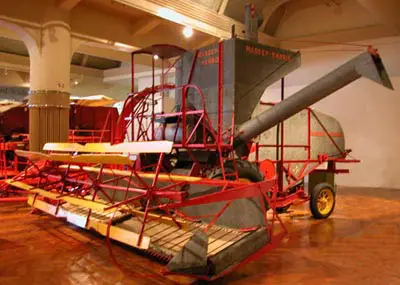
The Massey-Harris No. 20 of 1938 was the machine with which Massey engineer Tom Carroll changed grain harvesting: the world’s first affordable, mass-produced self-propelled combine. It was too heavy and expensive to be built in large numbers, but it set the pattern for the lighter and cheaper No. 21 that followed.
Massey-Harris No. 20 at a glance
| Maker | Massey-Harris Limited, Canada |
|---|---|
| Type | self-propelled combine harvester |
| Year | 1938 |
| Designer | Tom Carroll, Massey engineer |
| Claim | the world’s first affordable, mass-produced self-propelled combine |
| Main drawback | too heavy and expensive for extensive mass production |
| Led to | the No. 21, tested in 1940 and on sale in 1941 |
| Commemoration | the No. 21 was pictured on a Canada Post stamp on 8 June 1996 |
| Company in the 1950s | market leader in self-propelled combines, 51% of the US market in 1951 |
| European combine production | Cologne-Westhoven plant, from 1929 |
There is no Wikipedia page for the No. 20 itself; the machine is described in the Massey-Harris company history on English and German Wikipedia.
History of the Massey-Harris No. 20
A harvest machinery company
Massey-Harris was formed in 1891 by the merger of the Massey Manufacturing Co. and A. Harris, Son and Company and became the largest agricultural equipment maker in the British Empire. Its business had grown out of threshing machines and reapers, and the company expanded through purchases: in 1910 it bought the Johnston Harvester Company of Batavia, New York, making it one of Canada’s first multinational firms, and in 1927 it acquired a factory at Cologne-Westhoven in Germany, where combines were built from 1929. Grain harvesting was the field in which the company would make its name.
The machine of 1938
The breakthrough came from Massey engineer Tom Carroll in 1938. His No. 20 is described as the world’s first affordable, mass-produced self-propelled combine, and German Wikipedia calls it the first self-propelled combine of North American production. It was a self-propelled machine rather than an implement pulled by a tractor, and it worked, but it was too heavy and expensive for extensive mass production. Its real importance lay in what it taught: the No. 20 served as the guide for the design of the lighter and less costly No. 21.
From one machine to a speciality
The No. 21 was tested in 1940 and put on sale in 1941. Wartime shortages kept numbers down, but 500 of the combines were sold under the Harvest Brigade scheme and brought in the 1944 and 1945 harvests in the United States and Canada. After that success, combine manufacture became the main business of Massey-Harris. In the 1950s the company was the market leader in self-propelled combines and held 51% of the US market in 1951; new combine plants opened in Toronto and at Trafford Park, Manchester, in 1946, and production began at Eschwege in Germany in 1952. The No. 21 was commemorated on a Canada Post stamp on 8 June 1996.
Design and features
- Self-propelled: the No. 20 was a combine that carried its own power unit instead of being pulled by a tractor.
- First of its class: described as the world’s first affordable, mass-produced self-propelled combine.
- Tom Carroll’s design: the work of a Massey engineer in 1938.
- Heavy and costly: the reason the No. 20 was not built in large numbers.
- Blueprint for the No. 21: the lighter and cheaper combine that followed it.
- Start of a speciality: combines became the company’s main business after the Harvest Brigade.
Massey-Harris No. 20 versions
- No. 20 (1938): the original self-propelled combine.
- No. 21 (tested 1940, on sale 1941): the lighter, cheaper development of the No. 20.
- Harvest Brigade No. 21: 500 machines sold under the wartime scheme and used in 1944–45.
- MF 201 combine chopper harvester (1971): a much later Massey Ferguson machine that won the Prince Philip Prize for Australian Design.
The wartime story of the combine is told in the article on the Massey-Harris No. 21. Tractors of the same years include the Pony and the Model 744. More machines are in the Massey-Harris collection.
Video: Massey Harris #20 Combine ASABE Landmark No 15
Video on YouTube.
Sources
- Massey Ferguson, English Wikipedia: Tom Carroll, the No. 20 and No. 21, market share, stamps
- Massey-Harris, German Wikipedia: combine production at Cologne-Westhoven, the No. 21 and the Harvest Brigade