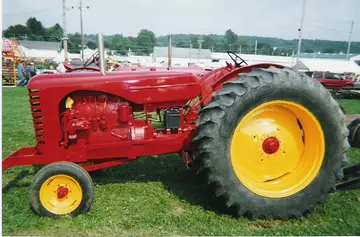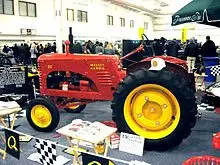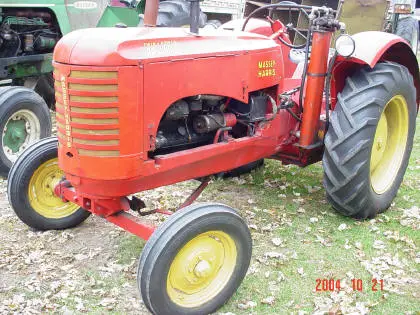
The Massey-Harris 22 was the smallest of the four tractors in the company’s final pre-merger generation, introduced immediately after the Second World War with 25 horsepower. It was the first model to offer Massey-Harris’ own three-point hitch, the Hitch-All, and from 1949 it could be ordered with the Draft-o-Matic hydraulic system.
Massey-Harris 22 at a glance
| Maker | Massey-Harris Limited, Canada |
|---|---|
| Type | farm tractor |
| Series | final Massey-Harris generation, introduced immediately after World War II |
| Power | 25 hp |
| Siblings | M-H 33 (35 hp), M-H 44 (45 hp), M-H 55 (55 hp) |
| Hydraulics | Draft-o-Matic, optional from 1949 |
| Three-point hitch | Hitch-All, first offered in 1951 |
| Compatiblity | not compatible with Harry Ferguson’s system and technically inferior to it |
| Replaced | 1952, by the M-H 23 Mustang |
| Company merger | 1953, with Harry Ferguson Limited |
There is no Wikipedia page for the M-H 22 itself; the model is described in the Massey-Harris company history on English and German Wikipedia.
History of the Massey-Harris 22
The post-war range
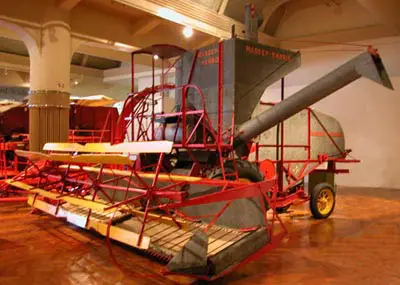
The final generation of Massey-Harris tractors was introduced immediately after the Second World War and consisted of four models: the 25 hp M-H 22, the 35 hp M-H 33, the 45 hp M-H 44 and the 55 hp M-H 55. The 22 was the smallest of the four and the entry point to the range, in the years when Massey-Harris was also the leading maker of self-propelled combines in North America.
Draft-o-Matic and the Hitch-All
In 1949 Massey-Harris introduced a hydraulic system called Draft-o-Matic, offered as an option on the Model 22; a year later the same system was available on the Models 30 and 44. In 1951 the company went further and offered its own three-point hitch, the Hitch-All, first on the Model 22. It was not compatible with the system developed by Harry Ferguson and was technically inferior to it — an awkward position for a company that would merge with Harry Ferguson Limited only two years later.
The end of the 22
The M-H 22 was replaced in 1952 by the M-H 23 Mustang. In 1955 the 30 hp Massey-Harris 50 was introduced, based on the Ferguson TO-35 and also built as the F-40 for Ferguson dealers; it came in utility, high-crop utility and row-crop forms, the last with a choice of single, tricycle or wide adjustable front ends. In 1956 the three larger models of the generation were replaced by the 333, 444 and 555, the triple series, which remained in production until 1958.
Design and features
- 25 hp: the smallest engine in the post-war Massey-Harris range.
- Draft-o-Matic: the hydraulic system offered as an option from 1949.
- Hitch-All: Massey-Harris’ own three-point hitch, first offered on this model in 1951.
- Not Ferguson-compatible: the Hitch-All would not work with Harry Ferguson’s system and was inferior to it.
- Short career: replaced in 1952 by the M-H 23 Mustang.
Massey-Harris 22 versions
- M-H 22 (25 hp): the standard model of the post-war generation.
- M-H 23 Mustang (1952): the replacement for the 22.
- M-H 33, 44 and 55: the larger tractors of the same generation, of 35, 45 and 55 hp.
- M-H 50 (1955): the 30 hp model based on the Ferguson TO-35, also sold as the F-40.
The larger tractors of the same generation are the M-H 44 and the M-H 55. The early range that came before it included the Pony. More machines are in the Massey-Harris collection.
Video: Massey Harris 22
Video on YouTube.
Sources
- Massey Ferguson, English Wikipedia: post-war series, 23 Mustang, M-H 50, triple series
- Massey-Harris, German Wikipedia: Draft-o-Matic and Hitch-All