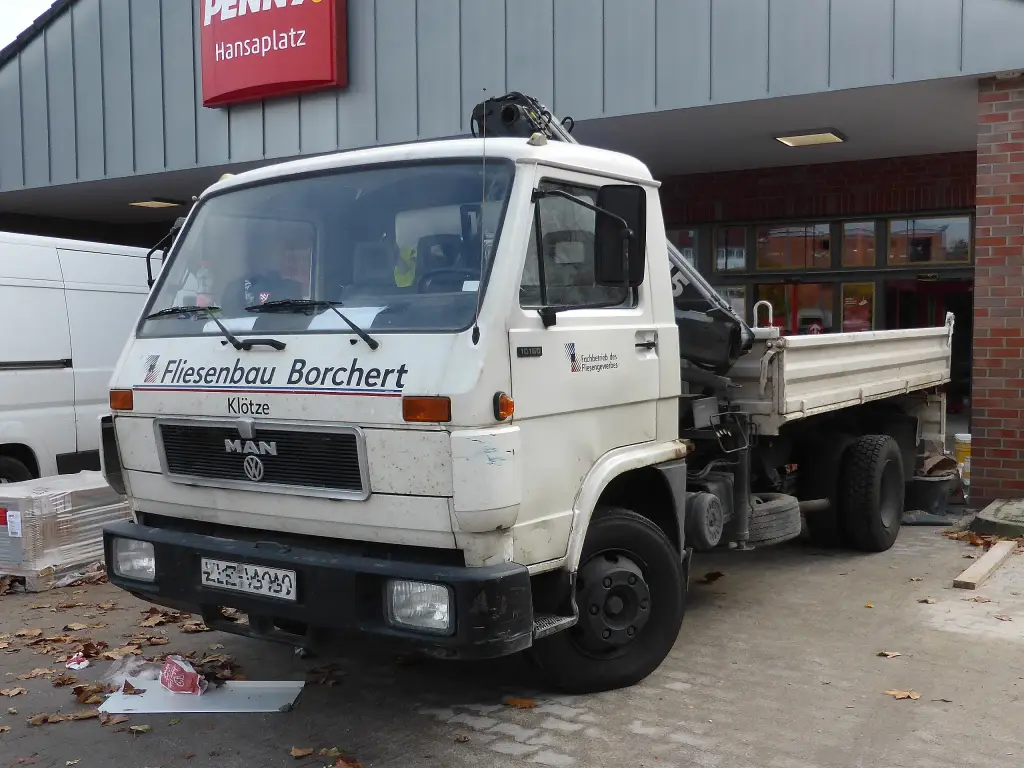
The MAN-VW was a light truck developed jointly by MAN and Volkswagen and built from 1979 to 1993. It was originally called the 6–9 tonner, became the 6–10 tonner in 1981 and was sold as the G 90 from 1987.
MAN-VW at a glance
| Production | 1979–1993 |
|---|---|
| Partners | MAN and Volkswagen, cooperation agreement of 25 August 1977 |
| Class | light truck, 6–10 tonnes |
| Cab | derived from the Volkswagen LT |
| Division of work | MAN supplied engines, chassis and front axles; VW the cab, gearbox and rear axles |
| Engines | 66 and 100 kW (90 and 136 hp); from 1987 74 and 110 kW (100 and 150 hp) |
| Gearbox | fully synchronised five-speed manual |
| Bodies | platform lorry, tipper, tractor unit and chassis with cab |
| Plants | Hanover (VW) and Salzgitter-Watenstedt (MAN) |
| Built | about 72,000 |
| Successors | MAN L2000 and Volkswagen L80 |
Written from the German Wikipedia article, the only one on the subject.
History of the MAN-VW
After MAN’s cooperation with the French maker Saviem ended in 1977, MAN looked for a new partner for building light trucks and found one in Volkswagen. On 25 August 1977 the two companies signed a cooperation agreement covering the joint development and production of light lorries. The joint model was to have a tilting cab, following the example set by Magirus-Deutz in 1975. MAN contributed diesel engines, chassis and front axles, while the cab derived from the VW LT, the gearbox and the rear axles came from Volkswagen. Unlike the Saviem-era trucks, the front carried the logos of both firms.
Model history
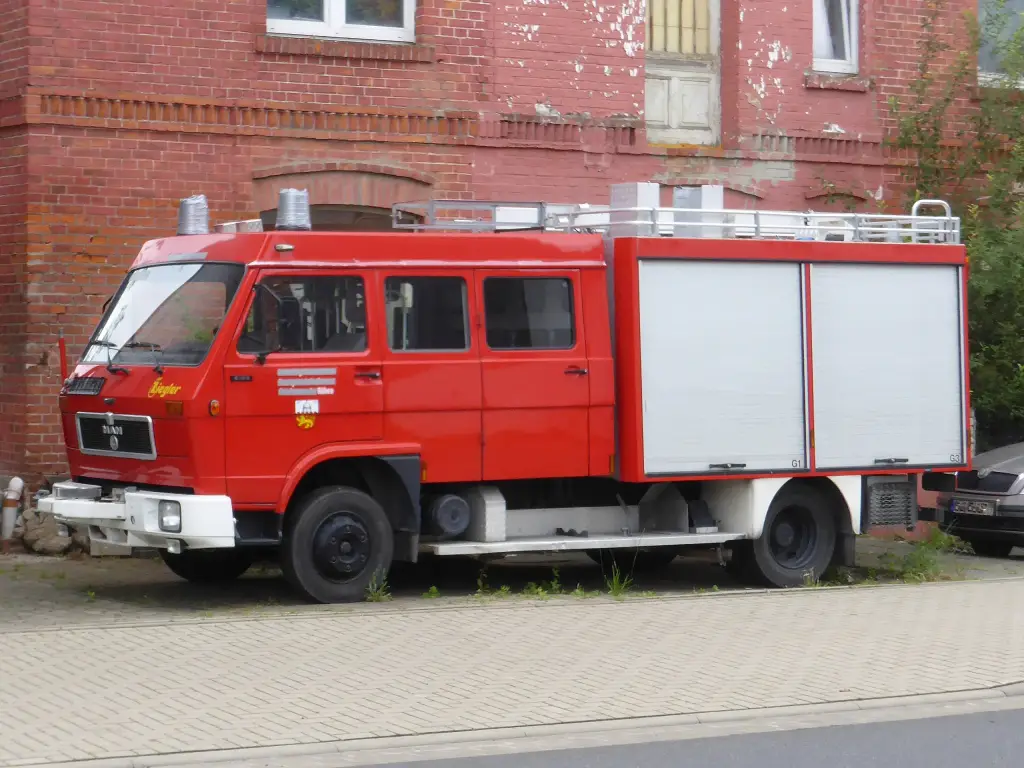
The truck appeared in 1979 with gross weights between 6 and 9 tonnes, and from 1981 also at 10 tonnes. Two naturally aspirated diesels of 66 and 100 kW (90 and 136 hp) were offered. It was available as a platform lorry, with a tipper body, as a tractor unit and as a chassis with cab. Three quarters of the vehicles were to be built at the VW plant in Hanover and one quarter at MAN’s Salzgitter-Watenstedt works; because fewer trucks were sold than planned, the split became roughly 50:50, and in the final years production was in Salzgitter only.
The 1987 G 90
The only major revision was presented at the 1987 International Motor Show. The round headlamps either side of the grille were replaced by rectangular units in the bumper, the displacement per cylinder grew from 0.95 to 1.15 litres and engine speed dropped from 3000 to 2700 rpm. Output rose to 74 and 110 kW (100 and 150 hp), and with a new interior the truck was marketed as the G 90, sometimes the G series. The MAN and VW cooperation ended in 1993 after about 72,000 vehicles. MAN developed the L2000 as successor, starting at 7.49 tonnes with a cab closer to its heavy trucks, while Volkswagen developed the L80, built in Brazil and later modernised as the VW Delivery and Worker.
Design and features
- Joint development: MAN mechanicals and a Volkswagen LT cab, with both logos on the front.
- Tilting cab: the cab tilted forward, following the 1975 Magirus-Deutz example.
- Body options: platform, tipper, tractor unit and chassis-cab, with all-wheel drive, ABS, double cab and air suspension available.
- G 90 update: the 1987 revision brought rectangular headlamps, more displacement and 100 or 150 hp.
MAN-VW versions
- 6.90 and 6.100: six-tonne models with 90 or 100 hp.
- 8.90, 8.100, 8.136 and 8.150: eight-tonne models.
- 9.136 and 9.150: nine-tonne models.
- 10.136 and 10.150: ten-tonne models from 1981.
- G 90: the 1987 facelift with 100 or 150 hp.
The MAN-VW was replaced by the MAN L2000, the ancestor of today’s MAN TGL. MAN’s heavier trucks are in the MAN F series article, and all MAN vehicles are in the MAN collection.
Video: Oli in Action, RW 1 KatS MAN-VW Bj. 1987
Video by heidertimo on YouTube.
Sources
- MAN-VW, German Wikipedia: history, engines, model names, production