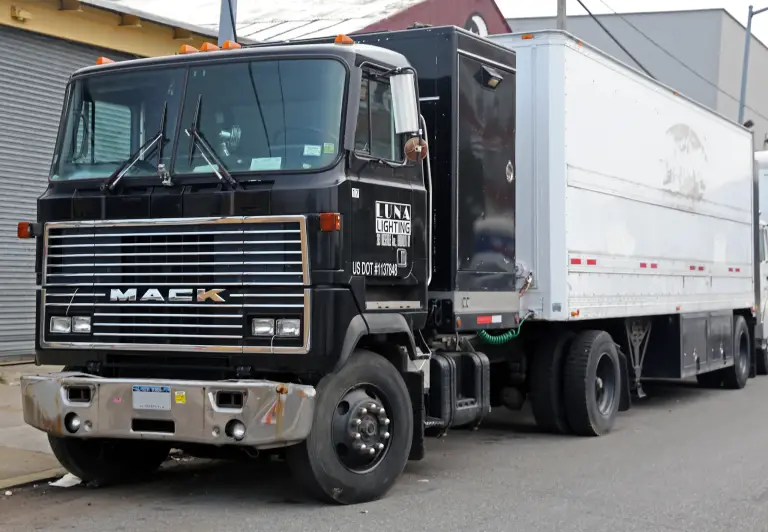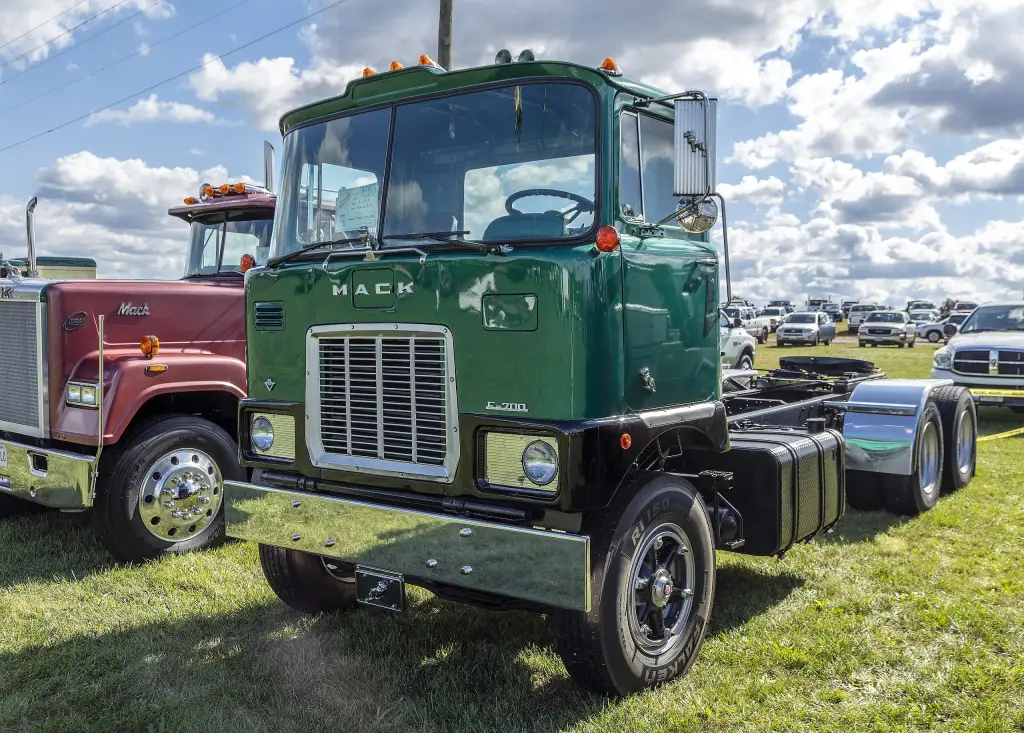
The Mack F series was the third generation of cab-over-engine trucks from Mack Trucks. Production ran from 1962 to 1981, mostly as a set-forward-axle truck, with a setback-axle version shipped overseas. Its cab came as a 50-inch day cab or with sleepers of 72, 80 and finally 86 inches.
Mack F series at a glance
| Production | 1962–1981 |
|---|---|
| Generation | third cab-over line from Mack |
| Front axle | set forward; setback version for export |
| Day cab | 50 in (1,372 mm) |
| Sleepers | 72 in, 80 in, later 86 in “bustle back” |
| Model range | F6xx, F7xx, F8xx, F9xx |
| Mack engines | Maxidyne and Thermodyne, 260–375 hp |
| Other engines | Cummins 250–350 hp, Detroit Diesel 270–430 hp, Caterpillar 325 hp |
| Front axle rating | 18,000 lb (8,200 kg), drop-forged I-beam |
| Rear axle rating | 23,000 lb (10,000 kg) |
| Maximum GCWR | 75,000 lb (34,000 kg) |
| Front springs | taper-leaf |
Based on one source, the English Wikipedia article on the Mack F series.
History of the Mack F series
By 1962 Mack had already built two generations of cab-over trucks, and the F series was the third. The layout put the cab above the engine and the front axle, which shortened the truck and let hauliers pull longer trailers inside the length limits of the day. The design was sold mainly as a set-forward-axle truck; a setback-axle version went for export. The cab could be ordered as a 50-inch day cab with no bunk, or with a 72-inch or 80-inch sleeper, and a later “bustle back” stretched the sleeper to 86 inches.
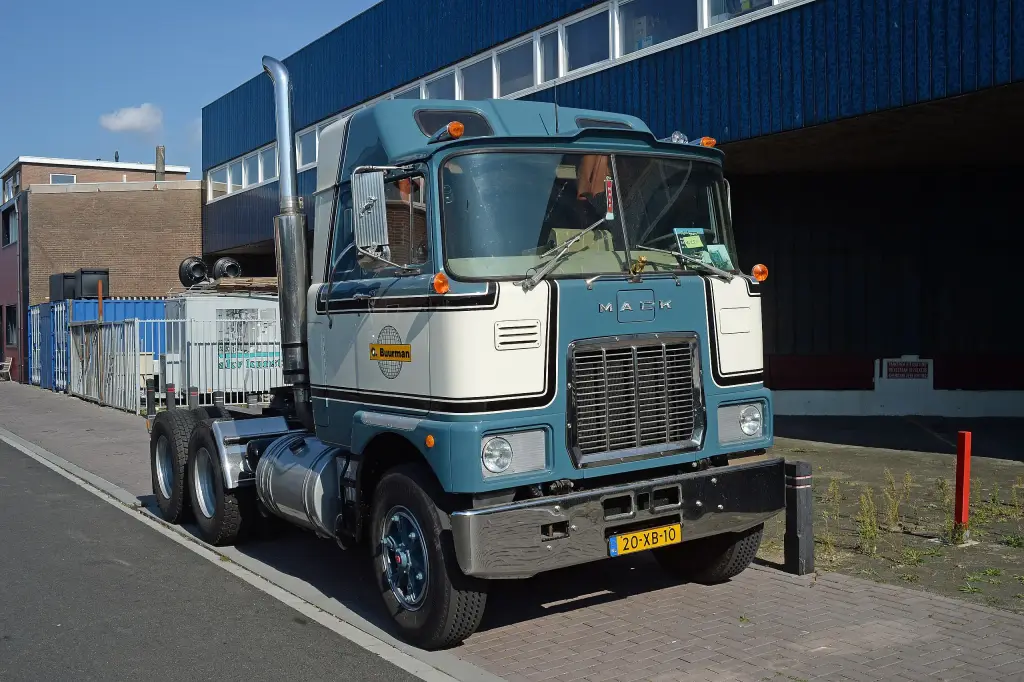
The engine list was deliberately broad. Buyers could have Mack’s own Maxidyne or Thermodyne diesels from 260 to 375 hp, Cummins engines from 250 to 350 hp, Detroit Diesel from 270 to 430 hp, or a Caterpillar rated at 325 hp. The Caterpillar 3406 was the big-bore option and came in high-torque-rise and conventional torque-rise versions; the Detroit Diesel 71 series gave a high torque curve, and the Cummins Formula 350 “Big Cam” was governed at 1,900 rpm with 1,065 lb-ft of torque, while the Formula 290 reached 930 lb-ft at the same speed. The Cummins NTC range was also available.
The chassis was built for comfort as well as strength. Taper-leaf front springs were used instead of multi-leaf springs: because the leaves are of equal length and different contour they do not slide against each other, which removes the inter-leaf friction that makes a multi-leaf spring harsh. Forged aluminium rear brackets and shackles completed the arrangement. The front axle was a drop-forged I-beam rated at 18,000 lb, the rear axle at 23,000 lb, power steering was available and the maximum gross combination weight was 75,000 lb. Production ended in 1981.
Design and features
- Four cab lengths: a 50-inch day cab and sleepers of 72, 80 and 86 inches.
- Five diesel makes: Mack, Cummins, Detroit Diesel and Caterpillar power, with Mack’s own engines topping out at 375 hp.
- Taper-leaf springs: equal-length leaves that do not slide, for a smoother ride than multi-leaf springs.
- Heavy ratings: 18,000 lb front axle and 75,000 lb maximum gross combination weight.
- Standard fittings: 50-gallon fuel tank, cab roof vent, 42,000 BTU heater and defroster, low air pressure buzzer and vertical exhaust.
Mack F series versions
- F6xx: the lightest chassis class in the range.
- F7xx: the mid-range chassis, including the F-700.
- F8xx: the heavy chassis, including the F786.
- F9xx: the top of the range.
- Setback-axle F series: built for export rather than the home market.
The F series was the cab-over alternative to the conventional Mack B series and R series, and the cab-over line continued with the Mack MH Ultra-Liner. More trucks are in the Mack collection.
Sources
- Mack F series, English Wikipedia: production years, cab sizes, engines, chassis ratings