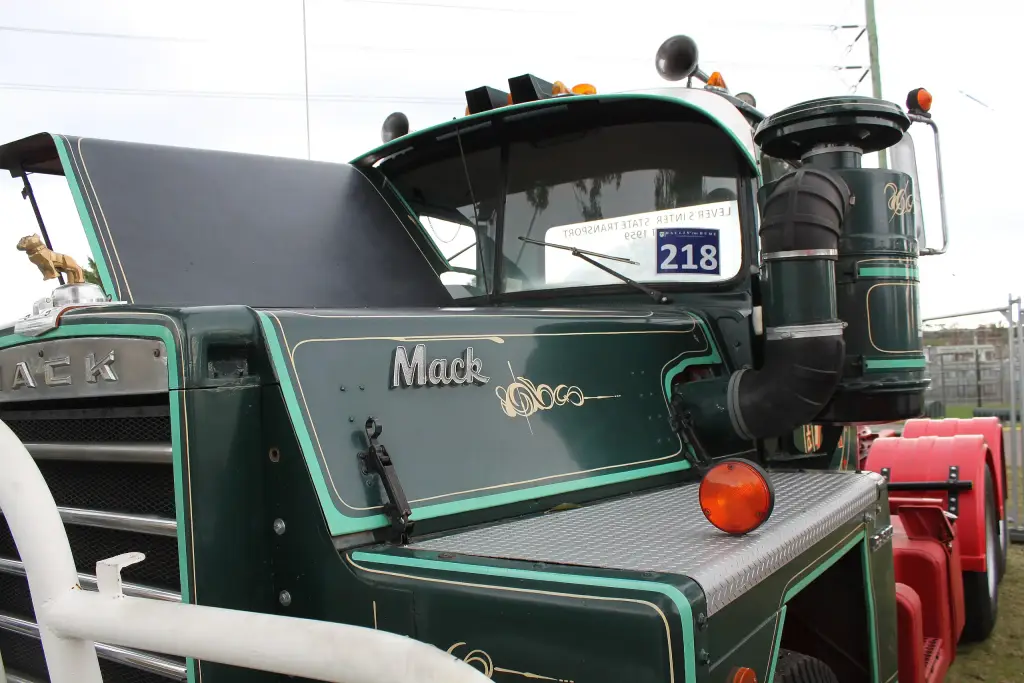
The Mack R series, also called the Mack Model R, was Mack Trucks’ heavy conventional truck from 1966 to 2005. Apart from the Kenworth W900 it is the longest-produced commercial truck in history, and the one-piece fibreglass hood hinged at the front that it introduced became the industry standard.
Mack R series at a glance
| Production | 1966–2005 |
|---|---|
| Predecessor | Mack B series |
| Type | Class 8 heavy conventional (bonneted) truck |
| Cab | same width as the B series, higher inside, almost vertical windshield |
| Hood | one-piece fibreglass, hinged at the front |
| First engine | Thermodyne, then Maxidyne diesels from 1966 |
| Engine codes | EN petrol, END diesel, ENDT turbocharged diesel, then displacement |
| Built at | Allentown, Pennsylvania; Macungie after 1975 |
| Also built | Hayward, California (until 1980); Australia; Iran (licensed, before 1979) |
| Cab update | 1973, deeper rear wall and new dashboard |
| Longest production | second only to the Kenworth W900 |
Based on one source, the English Wikipedia article on the Mack R series.
History of the Mack R series
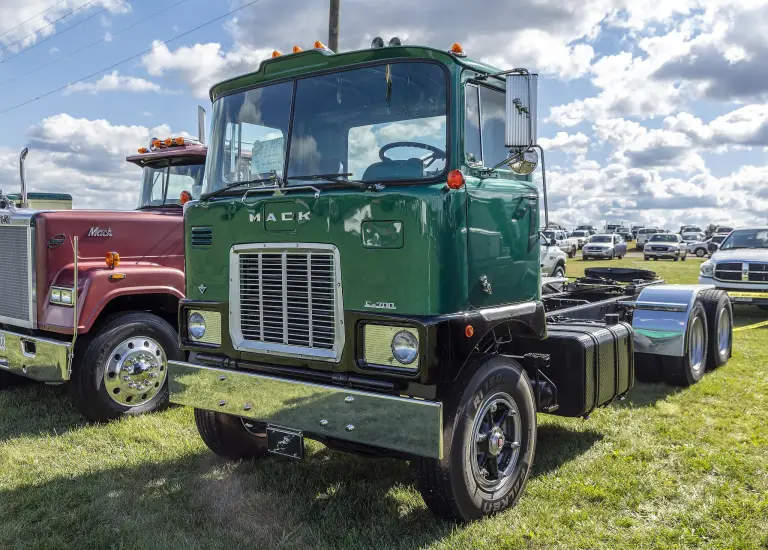
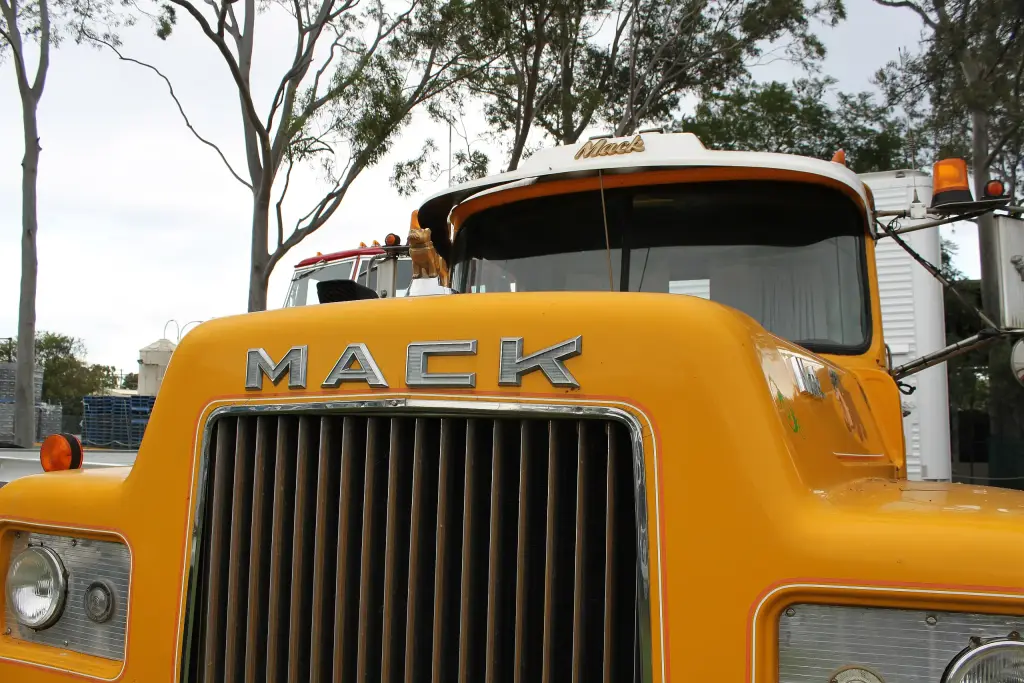
The R series was introduced in 1965 and went on sale while the B series was still in production, so that customers could change over gradually. The most important change was the cab: it kept the width of the B series but was taller inside, the windshield was almost vertical in the manner of the L series trucks, the driver’s seat was height adjustable and more sound-deadening was used. Outside, the long hood with separate fenders of the B gave way to a one-piece fibreglass hood hinged at the front, which gave unprecedented access to the engine and became the industry standard.
Power came first from the Thermodyne family of petrol and diesel sixes and eights, and by 1966 from the new Maxidyne diesel, which produced a constant high torque over a narrow rev band so that the driver shifted less. The engine codes told the story: EN for petrol, END for diesel, ENDT for turbocharged diesel, followed by the displacement in cubic inches. The Maxitorque transmission arrived with the Maxidyne. The RL lightweight, built largely in aluminium including the frame, appeared in 1967 as a “western” model, and in 1973 the cab was given a deeper rear wall, a new dashboard and more plastic trim.
The R series was assembled in Allentown, Pennsylvania, and from 1975 in Lower Macungie; several versions, the Superliner among them, were built in Hayward, California until Mack closed that plant in 1980. The series was also built in Australia and, before 1979, under licence in Iran. Through the 1990s Mack moved highway buyers to the CH and CL, but the severe-duty R models carried on: the RD and RM ended production in late 2003 as 2004 models, the RB and DM were scheduled into 2004, and the Granite took over their work. A batch of R-Model Legend trucks, with special paint, badges and steering wheels, marked the end of the RD and RM run in 2003.
By 1988 the engine numbering had changed. The D, T and N prefixes disappeared because every engine was now a turbocharged diesel; M meant Maxidyne, C meant a California-certified engine, and 6, 7 and 9 stood for the 672 cubic inch six, the 728 cubic inch six added in 1987 and the 998 cubic inch V8, followed by the horsepower rating. A suffix L marked an Econodyne low-speed engine. The setback-axle RB arrived in the 1990s, and in 1991 the RD was given a new, more aerodynamic nose with square sealed-beam headlights, while the other R models kept the 1965 face to the end.
Design and features
- Tilting fibreglass hood: one piece, hinged at the front, giving full access to the engine.
- Maxidyne and Maxitorque: constant-power diesels and a transmission that cut the number of gear changes.
- Air-ride cab: one of several R series firsts, along with an integral engine compression brake.
- RL lightweight: an aluminium-framed western model from 1967.
- Huge model spread: tractors, rigids, tandems, severe-service chassis and export versions.
Mack R series versions
- R600 and R700: the standard highway tractors of the range.
- R685: a later designation using the post-1988 engine numbering.
- RB600: the setback front axle version introduced in the 1990s.
- RL: the aluminium lightweight western model of 1967.
- RM: the heavy chassis that ran alongside the RD to 2003.
- RW713 and the RW Superliner: the long-hood western tractor that became the Super-Liner in 1977.
The R replaced the Mack B series; its construction derivatives are described on the Mack RD series and Mack RS series pages, and its long-hood western version became the Mack Super-Liner. More trucks are in the Mack collection.
Sources
- Mack R series, English Wikipedia: development, engines, production history, variants