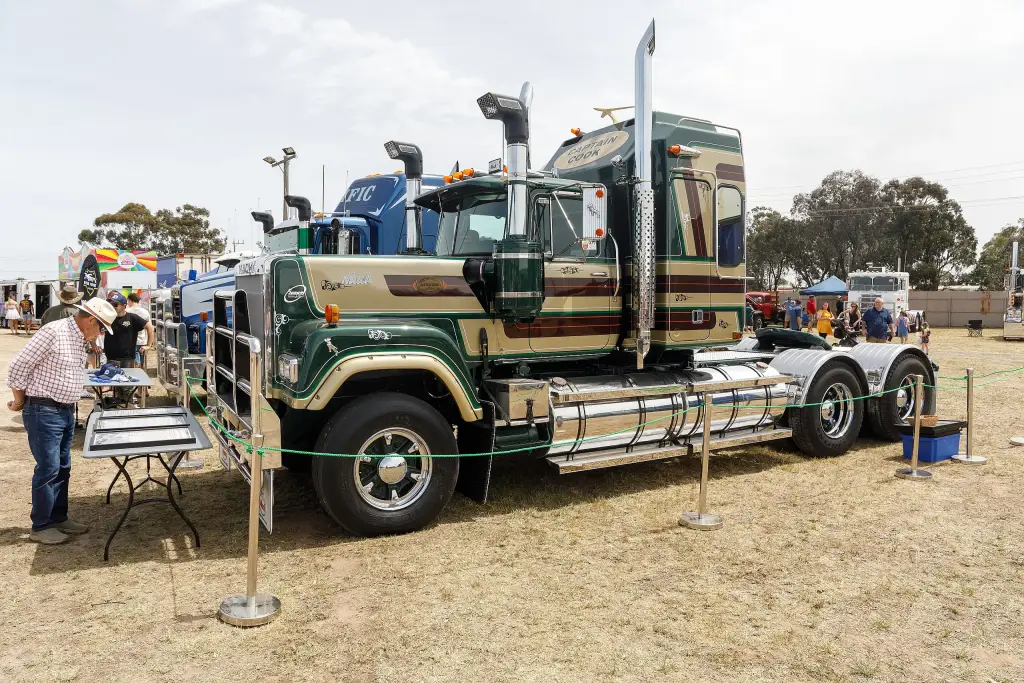
The Mack Super-Liner was Mack’s flagship conventional truck in North America from 1977 to 1993. It grew out of a Brockway project, used the cab of the R series and the frame of the WR Cruise-Liner, and was replaced by the CL700. Mack Australia has built it since 1980 and is now in its third generation.
Mack Super-Liner at a glance
| North American production | 1977–1993 |
|---|---|
| Factory designation | RW700 |
| Predecessor | RS700 western conventional |
| Cab | from the Mack R series |
| Frame | from the WR Cruise-Liner cab-over |
| First generation | four round headlights in a rectangular housing |
| Second generation (1985) | four square headlights, full-length Ultra-Liner frame rails |
| Replaced by | CL700, a longer-hood version of the CH600 |
| Australian production | since 1980, third generation |
| Engine in Australia | MP10, 685 hp, shared with the Titan |
Based on one source, the English Wikipedia article on the Mack Super-Liner.
History of the Mack Super-Liner
The Super-Liner began as a Brockway project in the early 1970s. Brockway, a Mack subsidiary that competed almost directly with its parent in heavy trucks, used the R series cab and set out to build a truck with a squared-off hood that could take a larger radiator and engine. Mack closed Brockway in 1977 after labour disputes, kept the design and finished it as a set-forward-axle tractor that entered production at the end of 1977, internally designated the RW700. Because the design already used a Mack RS cab, only minor detail changes were needed before production, and the new truck replaced the RS700 western conventional.
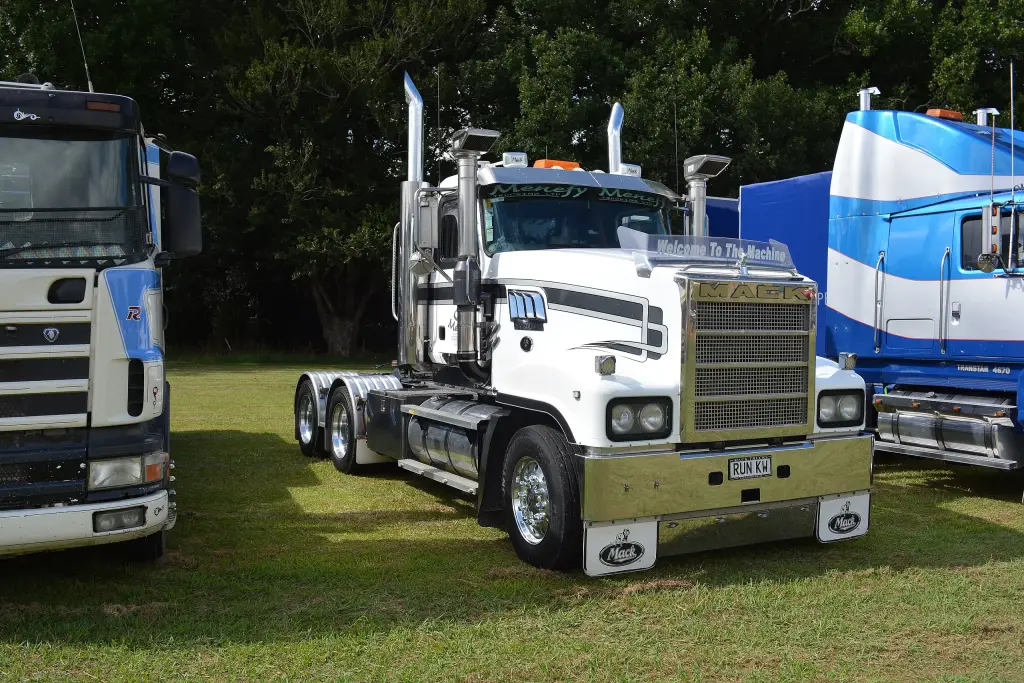
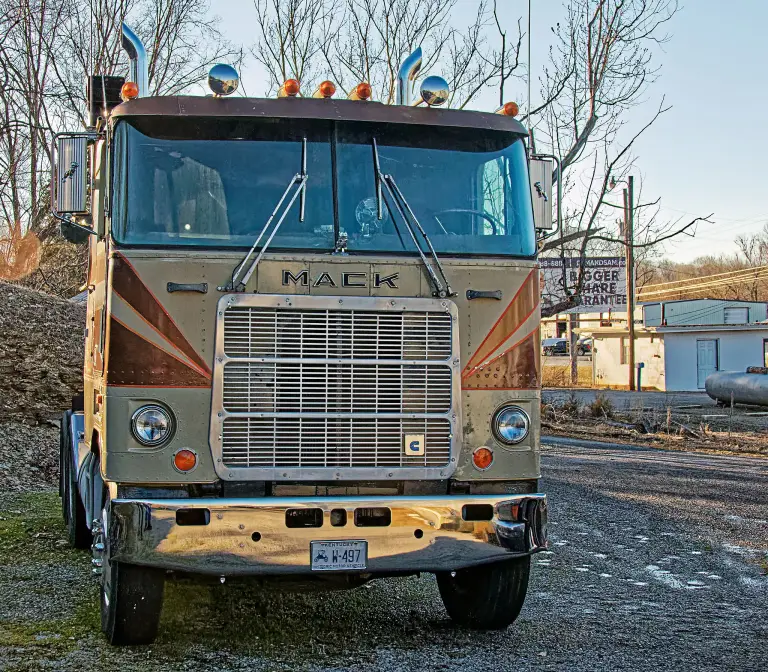
The first-generation Super-Liner shared the cab of the R series tractors and was built on the frame of the WR Cruise-Liner cab-over. It can be recognised by four round headlights in a rectangular housing and a three-spoke steering wheel. For 1985 Mack introduced the Super-Liner II: visually similar but with four square headlights, it adopted the full-length frame rails of the MH Ultra-Liner cab-over and gained a smaller two-spoke steering wheel and interior detail changes.
To mark the Super-Liner II, Mack built the Magnum special edition for 1985. The Magnum was an appearance package: black paint with Magnum lettering on the hood, red and orange cab striping and a red interior, with the Mack E9 V8 of 400 to 500 hp and a Mack T2090 nine-speed as standard. Mack made 250 Magnums, 186 of them Super-Liner IIs and 64 Ultra-Liners. Production in North America ended after 1993, and Mack replaced the RW-700 with the CL700, a longer-hood version of the CH600 that moved to a set-back front axle but kept the Super-Liner frame.
Design and features
- Squared-off hood: the design that started the project at Brockway, made to hold a larger radiator and engine.
- Super-Liner II (1985): square headlights and the full-length frame rails of the MH Ultra-Liner.
- Magnum edition: black-and-red special edition with the 400–500 hp E9 V8, 250 built.
- Australian line: built since 1980 on R series frames, now in its third generation below the Titan.
- Bicentennial edition: 16 Super-Liner IIs built for Australia Day 1988 with a 500 hp E9 V8.
Mack Super-Liner versions
- Super-Liner RW700 (1977–1984): four round headlights and a three-spoke wheel.
- Super-Liner II (1985–1993): four square headlights and Ultra-Liner frame rails.
- Magnum (1985): 186 black special editions with the E9 V8 and T2090 gearbox.
- Super-Liner II Bicentennial (1988): 16 Australian trucks named after figures in Australian history.
- Australian Super-Liner: built since 1980 on R series frames, now with the 685 hp MP10.
The Super-Liner replaced the Mack RS series and was replaced by the Mack CL series; it shared its cab with the Mack R series and its driveline thinking with the Mack MH Ultra-Liner. More trucks are in the Mack collection.
Sources
- Mack Super-Liner, English Wikipedia: development, generations, Magnum, Australian production