The Lexus HS is a compact executive sedan introduced in 2009 as the HS 250h. It was the first dedicated hybrid in the Lexus range and the first Lexus offered with a four-cylinder engine, and it was sold mainly in Japan and the United States.
Lexus HS at a glance
| Class | compact executive sedan, dedicated hybrid |
|---|---|
| Unveiled | January 2009, North American International Auto Show |
| On sale | July 2009 in Japan, August 2009 in the United States |
| Model | HS 250h |
| Engine | 2.4-litre 2AZ-FXE four-cylinder, 110 kW (147 hp) |
| Combined output | 139 kW (187 hp) and 187 N·m |
| Battery | nickel-metal hydride, 41 kg |
| Fuel economy | 35 mpg city and 34 mpg highway (US EPA) |
| Acceleration | 0-60 mph in 8.4 seconds |
| Top speed | 180 km/h (112 mph) |
| Drag coefficient | 0.27 |
| US sales ended | 2012 |
based on one source (English Wikipedia)
History of the Lexus HS
The HS 250h was presented at the North American International Auto Show in January 2009 and went on sale in Japan in July 2009, followed by the United States in August 2009 as a 2010 model. Lexus said the car answered demand from buyers who wanted a dedicated hybrid from a luxury maker, and the success of the Toyota Prius with well-off customers was part of the thinking. At its launch it was the most fuel-efficient model in the Lexus range and was claimed to be the most fuel-efficient luxury vehicle in the United States.
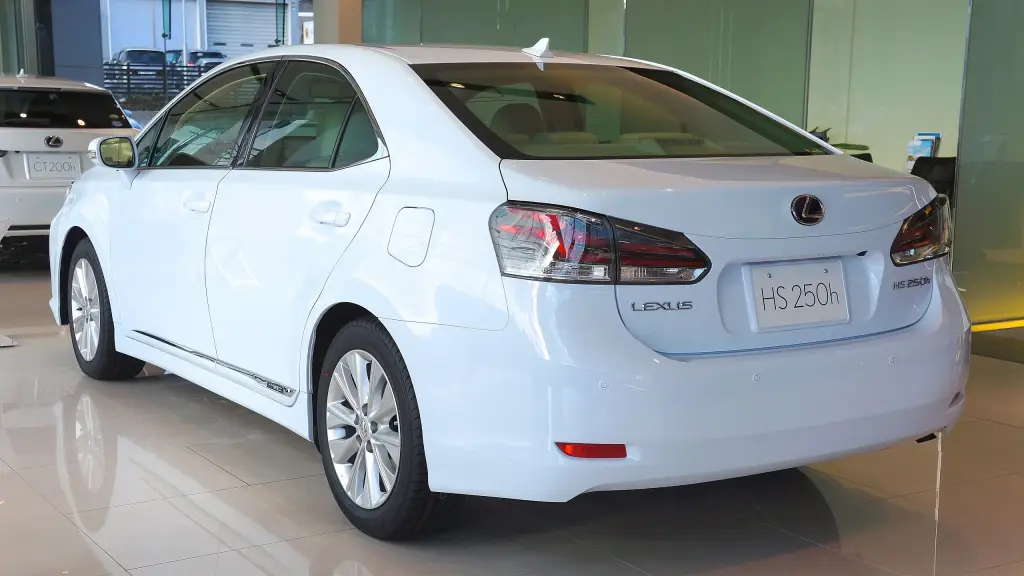
The car used the Toyota New MC platform and was 4,700 mm long, slightly larger than the IS but smaller than the ES, with front-wheel drive. Its 2.4-litre engine ran on the Atkinson cycle and worked with an electric motor through a continuously variable transmission; a 41 kg nickel-metal hydride battery sat between the boot and the rear seats, and an exhaust heat recovery system shortened warm-up. Plant-derived bioplastic was used for interior parts, and Lexus said 85 percent of the car could be recycled. Japanese buyers got a Harmonious Driving Navigator that scored their driving style.
Sales in the United States fell by nearly three-quarters in 2011 despite success in Japan, and Lexus removed the HS 250h from its American range in late May and early June 2012, by which time the ES 300h was arriving as a larger front-wheel-drive hybrid sedan. The Toyota Sai, a sister model with the same platform and hybrid system, was launched in Japan in October 2009. The HS was never sold in Europe, where the IS 220d and the Toyota Avensis covered the same size.
Design and features
- Dedicated hybrid: the HS was designed as a hybrid from the start rather than converted from a petrol model.
- Four-cylinder first: it was the first Lexus with an inline-four engine, a 2.4-litre Atkinson-cycle unit.
- Bioplastic interior: plant-derived materials were used for trim, cargo space and foam, and 85 percent of the car was recyclable.
- Low drag: a drag coefficient of 0.27 helped the car reach 35 mpg in the city.
- Remote Touch: the HS introduced the haptic controller and the Lexus Enform telematics service.
Lexus HS versions
- HS 250h (2009): the only version, a front-wheel-drive hybrid sedan.
- Toyota Sai (2009): the Japanese sister model on the same platform and drivetrain.
- US and Japanese specification: the American car lacked the Japanese Harmonious Driving Navigator.
The HS was the hybrid sedan that came before the CT 200h and was replaced in effect by the ES 300h. Its front-wheel-drive counterpart in the range was the IS; more cars are in the Lexus collection.
Sources
- Lexus HS, English Wikipedia: development, powertrain, equipment, sales