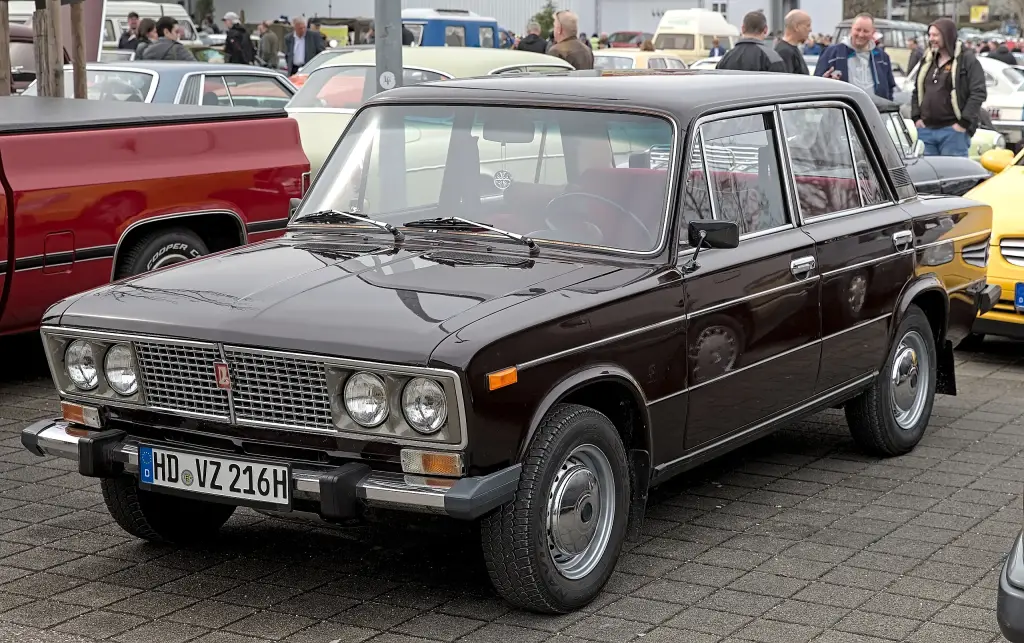
The VAZ-2106 Zhiguli, known in export markets as the Lada 1600 or Lada 2106, was a four-door saloon built by VAZ from 1976 to 2006. Nicknamed Shestyorka, the sixth, it became one of the most successful Lada models and was produced for thirty years.
VAZ-2106 at a glance
| Maker | VAZ, later Izhevsk Avto and Anto-Rus |
|---|---|
| Production | 1976–2006 |
| Export names | Lada 1600, Lada 2106 |
| Nickname | Shestyorka |
| Body | four-door saloon |
| Engine | 1,568 cc four, 78 hp |
| Torque | 117 N·m |
| Top speed | 150 km/h |
| 0–100 km/h | 16 seconds |
| VAZ production ended | 2001 |
| Izhevsk production ended | 2006 |
Based on one source: the English Wikipedia article on the VAZ-2106.
History of the VAZ-2106
The 2106 was derived from the VAZ-2103 and created as its alternative because of the expense and complexity of producing chrome elements, which were severely reduced on the new car, although it did not fully replace the 2103 until that model was discontinued in 1984. Like the 2103 it was a four-door, four-seat saloon, but it was powered by a more powerful 78 hp 1,568 cc single-overhead-camshaft inline four of Lada’s own design. It used the pistons of the VAZ-21011’s 1,294 cc engine and the crankshaft of the VAZ-2103’s 1,452 cc unit. Although only marginally more powerful, it produced more torque, 117 N·m instead of 103, which made it easier to drive. Top speed was 150 km/h, with 0 to 100 km/h in 16 seconds. For many buyers it was the top of the Eastern Bloc charts for comfort and prestige, since the more expensive GAZ and ZIL cars were out of reach.
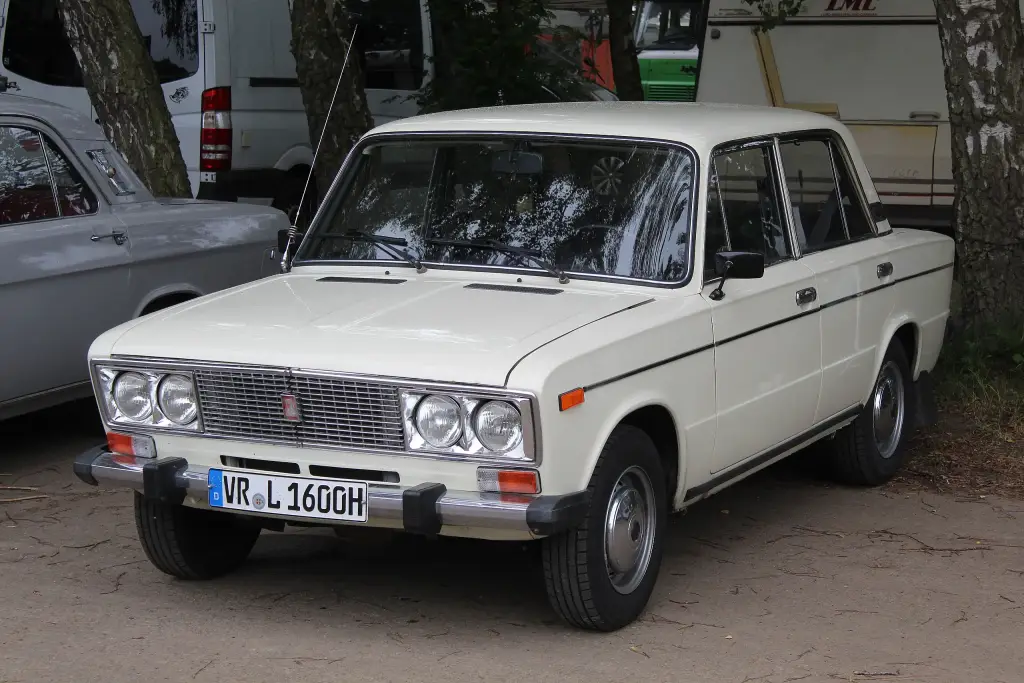
The car debuted in December 1975 and became the most popular and most numerous VAZ product. Externally it differed from the 2103 through a smaller grille with plastic headlight surrounds, different bumpers and wider tail lights with reverse lights, then a new feature for VAZ. Inside it was almost the same as its predecessor, but it was the first VAZ model with height-adjustable headrests on the front seats; its steering wheel was decorated with Russian ornaments and the Lada logo on a leather centre. In 1976, being the newest model in the VAZ range, it served as the basis for the prototype that became the VAZ-2121 Niva the following year, which borrowed its 1,600 cc 75 hp engine, lights, indicators, mirrors, headrests, steering wheel and instruments.
Later changes
In the second half of the 1990s the 2106 was severely restyled and its chrome elements further reduced. The chrome mirrors had already become black metallic in the first half of the 1980s, when the 2103 was discontinued; now the grille became black plastic with a new Lada badge, and chrome rim covers and body-edge trim were removed. The chromed bumpers and Fiat 124 door knobs stayed until the very end. Inside, the ageing Fiat 125 steering wheel was replaced, the wood-effect dashboard gave way to a black one, and the original folding seats were replaced with more modern ones.
Versions and production
The 21061 with the 75 hp 1,452 cc VAZ-2103 engine and the 21063 with the 64 hp 1,294 cc unit appeared in 1979; the 21063 disappeared in 1993, while the cheaper 21061 became the sales leader and helped make the 2106 the top-selling Lada. In Canada the model was sold from late 1978 to early 1979 as the Lada Signet, with the official factory name VAZ 21061-37, and it was made until 1984. A variant called 21061-41 had Canadian bumpers and fittings but European repeaters and tail lights, and is one of the rarest of the series. Rally-prepared versions reached up to 135 hp from the 1.3-litre engine, 150 hp from the 1.6 and 240 hp from a turbocharged sixteen-valve 1.8.
The car was in serial production for thirty years, from 1976 to 2006, although production at the VAZ plant ended after twenty-five years, in 2001, with manufacture continuing at Izhevsk for the final five years; it was also built in Ukraine by Anto-Rus. In 2002 the IZhmash version was awarded zero stars out of four by the Russian ARCAP safety programme, whose reviewers noted that the car was outdated by the time of the test, its construction dating back to the 1960s. In 2017 an old VAZ-2106 taking part in the Banjul Challenge crossed twelve European and African countries in fifteen days, from St Petersburg to Banjul in the Gambia, and was then given to local residents.
Design and features
- 1.6-litre engine: 78 hp and 117 N·m, with more torque than the 2103.
- Better equipment: the first VAZ with height-adjustable front headrests.
- Long production: thirty years, from 1976 to 2006.
- Niva ancestor: its engine and fittings were borrowed for the 1977 Niva.
VAZ-2106 versions
- VAZ-2106: the base 1.6-litre saloon, Lada 1600 for export.
- VAZ-21061: 1.5-litre version of 75 hp, the sales leader.
- VAZ-21063: 1.3-litre version of 64 hp, built until 1993.
- Lada Signet: Canadian version, factory code VAZ 21061-37.
- 21061-41: rare Canadian-market variant with mixed fittings.
- Rally versions: up to 240 hp from a turbocharged 1.8.
The 2106 was the successor to the VAZ-2103 and followed the VAZ-2101; its engine and fittings went into the Lada Niva. More models are in the Lada collection.
Sources
- VAZ-2106, English Wikipedia: history, engines, versions, production