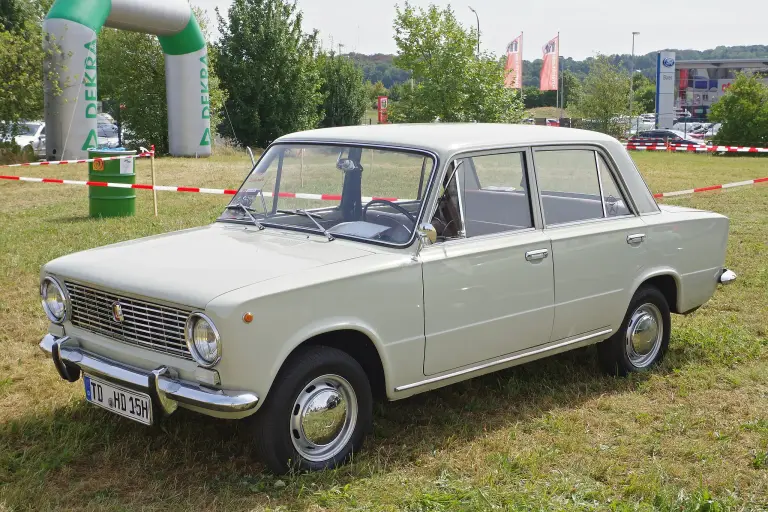
The VAZ-2103 Zhiguli, better known outside the Soviet Union as the Lada 1500 and nicknamed Troika at home, was a deluxe compact saloon produced by AvtoVAZ from 1972 to 1984. Developed alongside the Fiat 124 Special, it was the most prestigious model in the early Lada range.
VAZ-2103 at a glance
| Maker | AvtoVAZ, Tolyatti, Russia |
|---|---|
| Production | December 1972–1984 |
| Export name | Lada 1500 |
| Nickname | Troika |
| Body | four-door saloon |
| Engine | 1,452 cc four, 75 hp |
| Drive | rear-wheel drive |
| Weight | 1,030 kg |
| Brakes | front discs, aluminium drum brakes at the rear |
| Developed with | Fiat, alongside the Fiat 124 Special |
| UK sales | May 1976–May 1979 |
Based on one source: the English Wikipedia article on the VAZ-2103.
History of the VAZ-2103
The 2103 was developed jointly by VAZ and Fiat at the same time as the Fiat 124 Special, and the two models had the same basis and influenced each other. It was built under licence and tailored to the Soviet and Eastern European markets. Compared with the earlier VAZ-2101 it had four headlights in double sets, a different grille and direction indicators, side mouldings and larger tail lights. Its main difference was the more powerful 75 hp 1,452 cc straight-four petrol engine, and it also had a vacuum brake booster, self-adjusting rear brakes and a new Fiat 125-based front panel. The interior was more upmarket, with a different steering wheel, cloth trim on export versions instead of vinyl, and a dashboard with wood imitation, a tachometer, an oil pressure gauge and a clock.
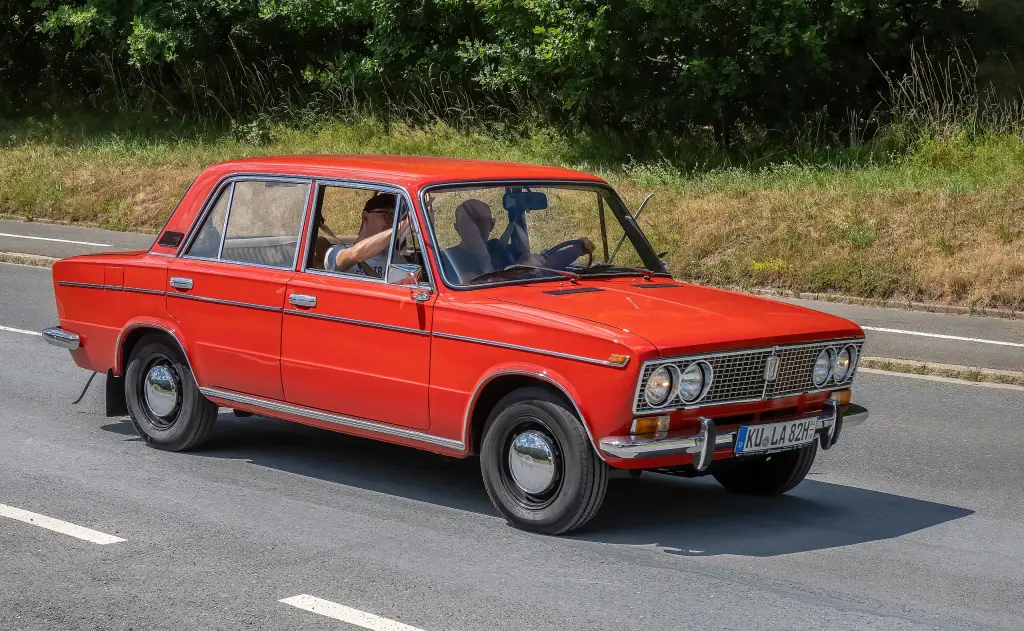
Compared with the Fiat 124 Special, the 2103 used thicker-gauge steel, so that it weighed 1,030 kg, 105 kg more than the Fiat. It had an overhead-camshaft engine in place of the Fiat’s OHV unit and aluminium drum brakes at the rear instead of discs. It carried a starting handle for cranking the engine if the battery went flat in Siberian winter conditions, an auxiliary fuel pump and improved soundproofing. It was later joined by the 1,198 cc 21035 and the 1,294 cc 21033, which used the VAZ-21011 engine. The suspension, carburettor and other parts were modified for the Russian climate, and all versions had suspension that gave a comfortable ride even on tough gravel roads.
The Lada was a hit in the Soviet Union. The more expensive 2103 was considered a prestigious model and was very popular among white-collar workers, but the Tolyatti plant could not keep up with demand and buyers waited years for a car. VAZ was forbidden from selling it in markets where it would compete with the Fiat 124; exports to Western Europe began in 1974, when the 124 was discontinued in favour of the Fiat 131 Mirafiori. The 2103 was sold there from the mid-1970s to the early 1980s as a de luxe version of the VAZ-2101. In Britain it was offered from May 1976 to May 1979 and was the second Lada sold in that market. Although the VAZ-2106 began to replace it from 1976, the 2103 remained in production until 1984 and was the first VAZ model to be discontinued, despite not being the oldest, mainly because of the complexity and expense of its chrome-plated elements. Reviewers from the French L’Auto-Journal called it an extremely serious working instrument able to operate in the worst conditions, and a well-made car capable of being serviced anywhere, even by its owner.
Versions
The base VAZ-2103 of December 1972 to 1984, exported as the Lada 1500, was the four-door saloon with the 1.5-litre engine of 75 hp. The VAZ-21033 of 1977–1984, exported as the Lada 1300S, used the 1.3-litre 69 hp VAZ-21011 engine; it began as an export variant for Western Europe and reached the Soviet market around 1981–1982 as a cheaper alternative. The VAZ-21035 is claimed for 1973–1981 with the 1.2-litre 64 hp VAZ-2101 engine, but it is very poorly documented and there is no evidence of series production. A right-hand-drive VAZ-21032 with the 1.5-litre engine was sold in Britain as the Lada 1500 Saloon from May 1976 to May 1979, while the planned right-hand-drive 21036 with the 1.3-litre engine never entered production. The 21031 designation was used by two different cars: originally the model that became the VAZ-2106, and later a small batch of 2103s fitted with the 1.6-litre VAZ-2106 engine as test mules in summer 1975.
Design and features
- Deluxe trim: cloth upholstery on exports, wood-effect dashboard, tachometer and clock.
- Twin headlights: four lamps, a different grille and larger tail lights than the 2101.
- More power: a 1,452 cc engine of 75 hp and a vacuum brake booster.
- Export success: sold as the Lada 1500 and, in Britain, as the Lada 1500 Saloon.
VAZ-2103 versions
- VAZ-2103 (1972–1984): the base 1.5-litre saloon, Lada 1500 for export.
- VAZ-21033 (1977–1984): 1.3-litre version, Lada 1300S for export.
- VAZ-21035: poorly documented 1.2-litre variant, probably not series-built.
- VAZ-21032: right-hand-drive 1.5-litre car for Britain.
- VAZ-21036: planned right-hand-drive 1.3-litre version, never produced.
- VAZ-21031: designation used for the future 2106 and for 1.6-litre test cars.
The 2103 followed the VAZ-2101 and was developed into the VAZ-2106; its estate relative was the Lada Riva family. More models are in the Lada collection.
Sources
- VAZ-2103, English Wikipedia: history, design, versions, exports