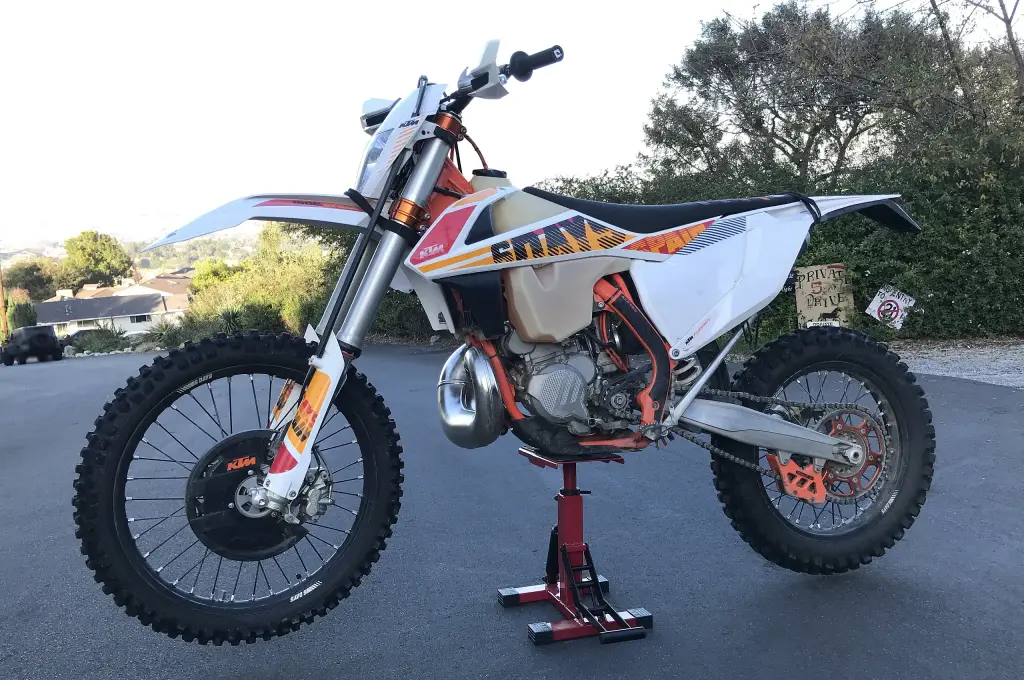
The KTM 300 is a series of two-stroke enduro and off-road motorcycles made by KTM. It began with the Penton-inspired 300 GS of 1984 and grew into a range that includes the dirt-only 300 MXC, the road-legal European 300 EXC, the close-ratio 300 XC, the wide-ratio 300 XC-W and the motocross 300 SX.
KTM 300 at a glance
| Maker | KTM, Austria |
|---|---|
| Type | two-stroke enduro and off-road motorcycles |
| First model | 1984 300 GS |
| Versions | 300 GS, 300 DMX, 300 MXC, 300 EXC, 300 XC, 300 XC-W, 300 SX |
| Early engine | 297 cc, 73 mm x 72 mm bore and stroke |
| First 300 | 250 bored to 273 cc, discontinued in 1987 |
| 1990 | 300 EXC, the present-day 300 |
| Rear suspension | PDS linkless, 320 mm travel |
| Electric start | standard on all 300s from 2008 |
| Carburettor | reduced from 38 mm to 36 mm in 2004 |
| Gearbox | five-speed, six-speed from 2011 |
| Related model | Husaberg TE300 (2010-2012) |
based on one source
History of the KTM 300
1984-1989
The original 300 GS Enduro grew out of experience with the 250 cc Penton Hare Scrambler and other air-cooled two-stroke KTM enduros. When the rules for the open class of the International Six Days Enduro allowed any machine larger than 250 cc from 1986, KTM experimented with a water-cooled over-250 bike for that class. The firm bored its 250 out to 273 cc and called it a 300; this version was discontinued in 1987. KTM also tried sleeving down its 500 MXC two-stroke to 350 cc as the 350 MXC, but the left-side kick-starter and right-side chain were not popular.
1990-1997
In 1990 KTM got serious and the present-day 300 was born. Dubbed the 300 EXC, its engine delivered very smooth power without a power hit, worked well at low rpm and gave the rider control from tight trails to wide-open stretches, while the plush suspension compared well with the older GS models. The bike was also offered as the 300 D/XC, a California desert version, and as an MX. These early motors had 297 cc with a 73 mm bore and 72 mm stroke, but ignition and jetting problems plagued them. In 1992 the company suffered financial woes and development slowed. The 1993 KTMs had Öhlins upside-down forks, and Motoplat’s closure that year forced KTM to switch to SEM ignition. The 1996 model had Marzocchi forks, an Öhlins shock, a chrome exhaust and Boyesen reeds, and for 1996-97 a 360 cc version was offered. In 1997 KTM moved to Kokusan ignition.
1998-2003
1996 was the first year of KTM’s trademark orange bikes. Along with larger radiators, the 300 received KTM’s PDS linkless rear suspension with 320 mm of wheel travel, and a bored-out 380 cc version was offered from 1998 to 2000. In 1999 the 300 received a hydraulic clutch, and the 2000 motor benefited from a redesigned cylinder.
2004-2007
2004 brought another frame change and significant engine changes, including a new bore and stroke and a carburettor reduced from 38 mm to 36 mm, which saved 8 lb (3.6 kg) and ended the jetting problems. For 2006 the US version of the 300 EXC was replaced by the XC and XC-W, both with five-speed gearboxes and a stator for producing electricity: the XC had a close-ratio box, no wiring for lights and stiffer suspension, while the XC-W had a wide-ratio box, headlight, tail light and the softer PDS suspension. The 2007 model added a dual ignition mapping switch on the handlebar.
2008-2016
The 2008 KTM 300 EXC was the first electric-start two-stroke enduro bike released by a major manufacturer, and all models have PDS rear suspension. For 2010 Husaberg, the other KTM-owned bike company, offered the TE300, an XC-W with minor bodywork and suspension changes, and the 2011 Husaberg TE 300 was essentially a rebadged KTM 300. In 2011 the models received six-speed gearboxes, a new exhaust and translucent fuel tanks; the XC moved to linkage rear suspension in 2012 while the XC-W kept PDS. 2013 brought a DDS diaphragm-spring clutch with a lighter pull, a stronger 410 W starter and triple clamps changed from 22 mm to 20 mm offset, and 2015 models gained WP 4CS forks with rebound in one leg and compression in the other.
Design and features
- PDS suspension: KTM’s linkless rear system with 320 mm of travel.
- Electric start: standard from 2008, a first for a two-stroke enduro.
- XC and XC-W: close-ratio motocross-style or wide-ratio with lights.
- DDS clutch: diaphragm-spring clutch from 2013 with a lighter lever pull.
KTM 300 versions
- 300 GS and 300 DMX (1984-1987): the original 273 cc machines.
- 300 EXC: the road-legal European enduro.
- 300 XC: close-ratio gearbox, no lighting wiring, stiffer suspension.
- 300 XC-W: wide-ratio gearbox with headlight, tail light and PDS suspension.
- 300 SX: the motocross version.
- Husaberg TE300: a rebadged 300 sold from 2010 to 2012.
The 300 grew out of the KTM 250. The four-stroke equivalents are the 450 and the 500, and more models are in the KTM collection.
Sources
- KTM 300, English Wikipedia: model progression from 1984 to 2016