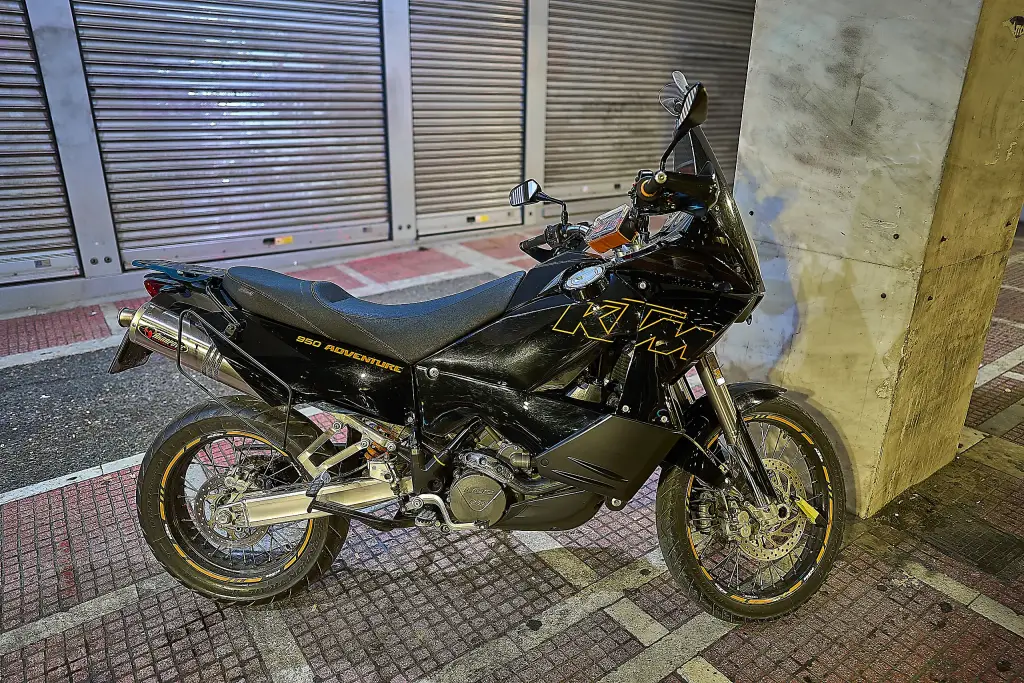
The KTM 950 Adventure is a dual-sport motorcycle produced in Austria by KTM and powered by a liquid-cooled, four-stroke, DOHC 942 cc 75-degree V-twin producing around 102 bhp (76 kW). It was KTM’s first twin-cylinder production model and the beginning of the LC8 engine family.
KTM 950 Adventure at a glance
| Maker | KTM, Austria |
|---|---|
| Type | dual-sport motorcycle |
| Engine | 942 cc 75-degree V-twin, liquid-cooled, DOHC |
| Output | around 102 bhp (76 kW) |
| Engine family | LC8 |
| Debut | 2003 Intermot motorcycle show |
| Production | from February 2003 to 2006 |
| Design partner | KISKA GmbH |
| Development rider | Fabrizio Meoni |
| Front suspension | WP forks, compression adjustment at the bottom, damping at the top |
| Rear suspension | WP shock with rebound adjustment and hydraulic preload knob |
| Successor | KTM 990 Adventure |
based on one source
History of the KTM 950 Adventure
Bepono and the search for an engine
The story of the KTM 950 Adventure started in 1992, when a one-off special called the Bepono, built for the German BoTT series by two engineering students from a pair of KTM LC4 cylinders on a special crankcase, was displayed on the KTM stand at the IFMA show in Cologne. That was only a teaser. In 1996 the Stuttgart design office Kraft Technik was commissioned by KTM to produce a design for a V-twin hard enduro, possibly using the 60-degree RSV900 Rotax engine being developed for Aprilia, but the Italians refused to share it. An alternative, the Swedish Folan 60-degree V-twin, was abandoned after KTM’s successful stock market listing.
Developing the LC8
In early 1998, as the company grew and needed to expand its single-cylinder range with a twin-cylinder product line, a new V-twin became a priority. KTM chief engineer Wolfgang Felber studied twin-cylinder engine formats and vehicle concepts, and by August 1998 the design team had settled on a 75-degree V-twin with emphasis on light weight and compact build. KTM took the entire R&D process in-house and hired Claus Holweg as project manager from Rotax; within a year the new LC8 engine line had its first dyno run on 11 August 1999.
Body design and rally testing
KTM’s design and management departments put designers and model-makers together to establish a concept vehicle, and the prototype’s design was completed by KISKA GmbH, KTM’s design partner, and presented at the Munich motorcycle show in 2000. After critical votes, KTM CEO Stefan Pierer rejected the first draft of the Adventure except for a few details, the chassis and the engine. The designers used strained and broken lines with an angular fairing. For real-world experience the engineering team asked rally pilot Fabrizio Meoni to assist: in early 2001 engineers fabricated a frame with ratings defined by Meoni, and in February 2001 he began a series of evaluations in Tunisia. Later that year Meoni won the Rallye des Pharaons, following it with victory on the Dakar in 2002, which confirmed the 950 Adventure was ready for the market.
Production
The 950 Adventure was formally presented at the 2003 Intermot motorcycle show, and production of the LC8 began in February 2003. KTM stopped producing the 950 Adventure in 2006; its successor was the KTM 990 Adventure, with a slightly different displacement and fuel injectors instead of carburettors.
Suspension
Front and rear suspension was made by White Power (WP) in the Netherlands, a KTM subsidiary. The forks allow compression adjustment at the bottom and damping adjustment at the top, with spring preload set on the top cap. The rear shock has rebound adjustment at its base and high and low speed damping adjustable with a clicker dial and a 14 mm hex at the top, where high and low speed refer to the speed of compressing the spring rather than the speed of the motorcycle. On all 950 and 990 Adventure models the rear shock has hydraulic preload adjustment accessible with a knob on the left side of the bike; the 950 Super Enduro R instead uses a large mechanical nut.
Design and features
- First KTM twin: the 950 Adventure launched the LC8 engine family.
- Rally pedigree: developed with Fabrizio Meoni and tested in Tunisia.
- WP suspension: fully adjustable forks and shock, with hydraulic preload at the rear.
- Angular bodywork: designed by KISKA with strained, broken lines.
KTM 950 Adventure versions
- 950 Adventure (2003-2006): the original carburettor model.
- 950 Super Enduro R: with a mechanical preload nut on the rear shock.
- 990 Adventure: the 2006 successor with fuel injection.
The successor is the 990 Adventure; the single-cylinder line is represented by the 690. More models are in the KTM collection.
Sources
- KTM 950 Adventure, English Wikipedia: engine, development history, suspension