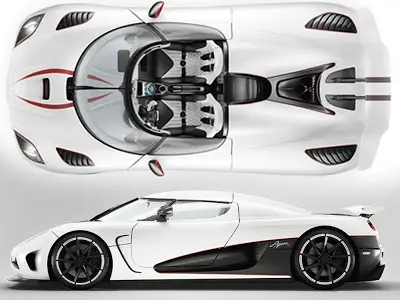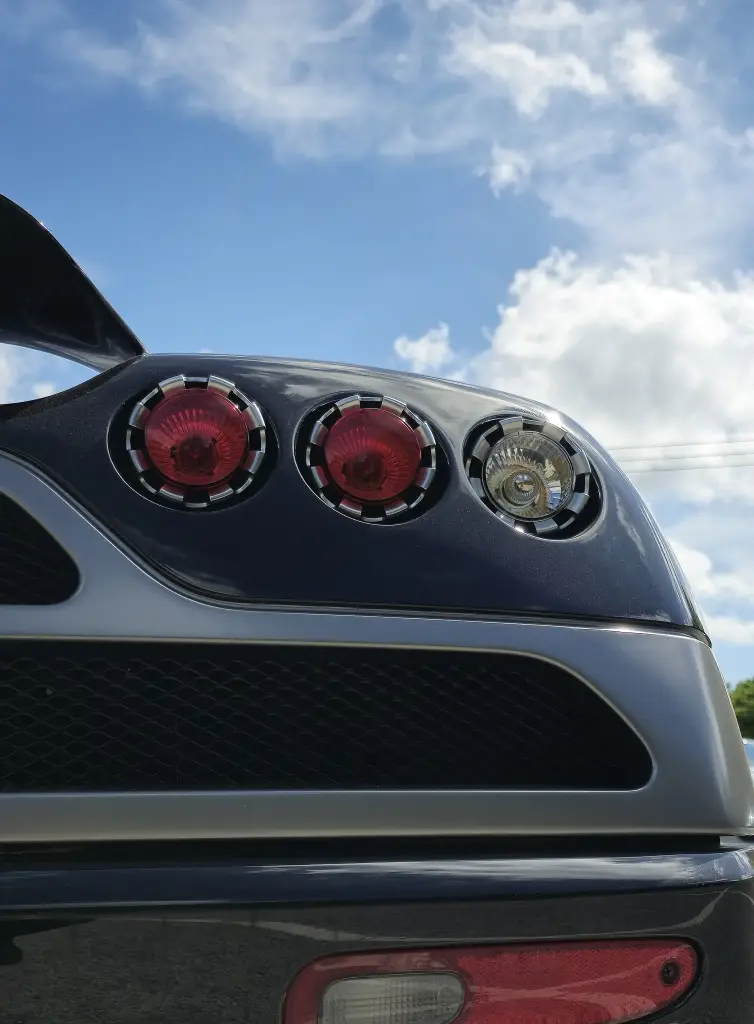
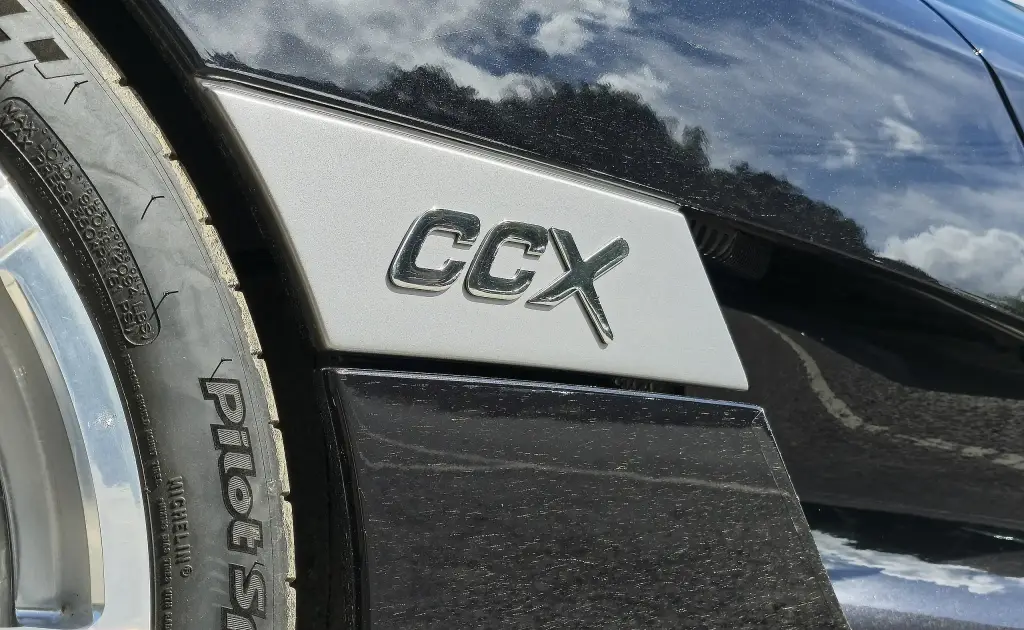
The Koenigsegg CCX was the car that took the Swedish company towards the United States. Unveiled at the Geneva Motor Show in 2006, it replaced the CCR’s Ford engine with Koenigsegg’s own 4.7-litre twin-supercharged V8 and reworked the body to meet US regulations.
Koenigsegg CCX at a glance
| Maker | Koenigsegg Automotive, Ängelholm, Sweden |
|---|---|
| Unveiled | Geneva Motor Show, 2006 |
| Name | Competition Coupé X, X for ten years since the first CC |
| Engine | 4.7-litre twin-supercharged V8, in-house |
| Power | 806 PS (593 kW; 795 hp) at 7,000 rpm |
| Torque | 920 N·m at 5,500 rpm |
| Fuel | 91 octane petrol |
| Gearbox | six-speed manual or six-speed sequential |
| Drag coefficient | Cd 0.32 |
| Downforce | 60 kg front, 65 kg rear at 200 km/h |
| Wheels | 19-inch front, 20-inch rear |
| Body | 88 mm longer than the CCR |
History of the Koenigsegg CCX
A global car
The project began with the aim of making a global car, designed and engineered to comply with global safety and environmental regulations, particularly to enter the United States market. To sell cars in the US, many alterations were made to the design of the CCR. The previously used Ford Modular engine was replaced by an in-house Koenigsegg engine designed to run on 91 octane fuel, readily available in the United States, and to meet Californian emission standards. The name CCX stands for Competition Coupé X, the X marking the tenth anniversary of the completion and test drive of the first CC prototype in 1996.
Powertrain
Unveiled at the 2006 Geneva Motor Show, the CCX used a new 4.7-litre twin-supercharged V8 producing 806 PS at 7,000 rpm and 920 N·m at 5,500 rpm on 91 octane fuel. The engine is of all-aluminium construction in 356 aluminium with a T7 heat treatment, cast by Grainger & Worrall, a casting specialist with Formula One experience. It was built, assembled and tested at Ängelholm, lubricated by a dry sump system with a separate oil pump; internal oil sprayers cool the pistons so the engine can run high cylinder pressure on 91 octane. Combined fuel consumption was 14 mpg US. Gearboxes were a CIMA six-speed manual or a six-speed sequential manual, and power went through a torque-sensitive limited-slip differential.
Body and chassis
The chassis is carbon fibre reinforced with Kevlar and aluminium honeycomb, as on earlier models. The body kept the targa top and the dihedral synchro-helix actuation doors but was completely reworked: a new front bumper, enhanced brake cooling, fog lamps, US-patented headlamps, a bonnet intake acting as a ram air booster, air intakes behind the front wheels and a glass window over the engine. The car is 88 mm longer than the CCR to comply with US rear impact regulations and to free space around the rear muffler, and there is 50 mm more headroom inside, with Sparco carbon fibre seats.
Aerodynamics and running gear
Frontal area is 1.867 m² with a drag coefficient of 0.32 and a CdA of 0.56 m². A flat underside with venturi tunnels at the rear and an optional rear spoiler improve downforce, which reaches 60 kg over the front axle and 65 kg over the rear at 200 km/h. Carbon fibre wheels, the first in the industry as optional equipment, are 3 kg lighter than the standard forged alloy telephone-dial wheels; both use centre locking nuts and measure 19 inches at the front and 20 at the rear, on 255/35 Y19 and 335/30 Y20 Michelin Pilot Sport 2 tyres. Optional carbon ceramic brakes with eight-piston calipers measure 380 mm at the front and six-piston 362 mm at the rear.
Design and features
- In-house V8: a 4.7-litre twin-supercharged engine built for 91 octane US fuel and Californian emissions rules.
- US-ready body: 88 mm longer than the CCR, with patented headlamps and a bonnet ram-air intake.
- Carbon fibre wheels: optional, 3 kg lighter than the forged alloy wheels.
- Carbon ceramic brakes: optional 380 mm front and 362 mm rear discs.
- Targa top and dihedral doors: carried over from the CCR, with a glass window over the engine.
- Aerodynamics: flat underside, rear venturi tunnels and optional rear spoiler, Cd 0.32.
Koenigsegg CCX versions
- CCX (2006): the standard car with 806 PS on 91 octane petrol.
- CCXR: the flex-fuel version running on E85, E100 or 98 octane petrol, with up to 1,018 PS on ethanol.
- CCX Edition (2008): a 4.8-litre remapped engine with 900 PS on normal gasoline, limited to two cars.
- CCXR Edition (2008): the same track-focused package for the CCXR, limited to four cars.
- CCXR Special Edition: a further edition of the CCXR shown at Geneva in 2008.
The CCX replaced the CCR, its ethanol sister was the CCXR, and the Agera R came next. More Koenigseggs are in the Koenigsegg collection.
Video: Stig crashes Koenigsegg CCX – Top Gear series 8 – BBC
Video on YouTube.
Sources
- Koenigsegg CCX, English Wikipedia: engine, body, wheels, variants