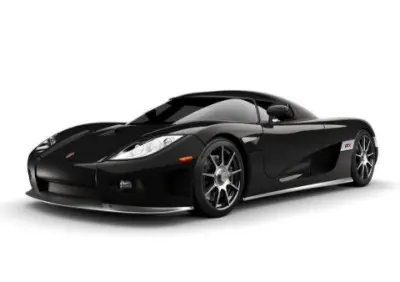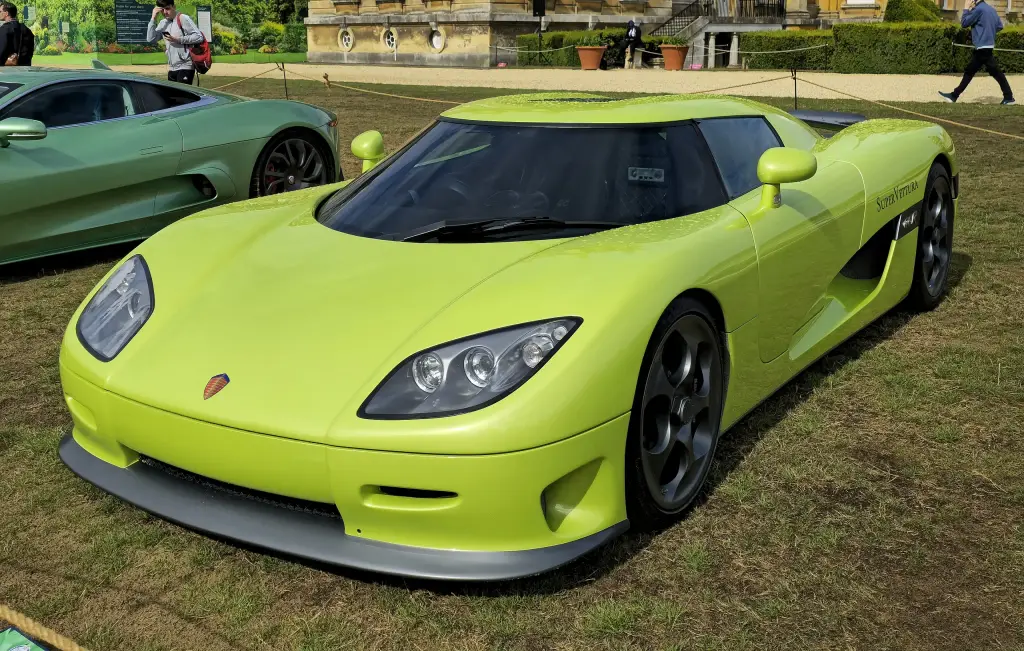
The Koenigsegg CCR was the most powerful version of the CC range when it appeared at the Geneva Motor Show in March 2004. With a twin-supercharged 4.7-litre V8 it claimed 388 km/h, and in February 2005 a standard car reached 387.87 km/h at the Nardò Ring to take the production car speed record.
Koenigsegg CCR at a glance
| Maker | Koenigsegg Automotive, Ängelholm, Sweden |
|---|---|
| Debut | Geneva Motor Show, March 2004 |
| Predecessor | Koenigsegg CC8S |
| Engine | 4.7-litre V8, twin Rotrex superchargers |
| Power | 806 hp (601 kW; 817 PS) at 6,900 rpm |
| Torque | 920 N·m at 5,700 rpm |
| Gearbox | six-speed manual |
| 0–100 km/h | 3.2 seconds |
| 0–200 km/h | 9.3 seconds |
| 0–300 km/h | 24.9 seconds |
| Top speed | 388 km/h, over 395 km/h theoretical |
| Record run | 387.87 km/h at Nardò, 28 February 2005 |
History of the Koenigsegg CCR
Geneva 2004
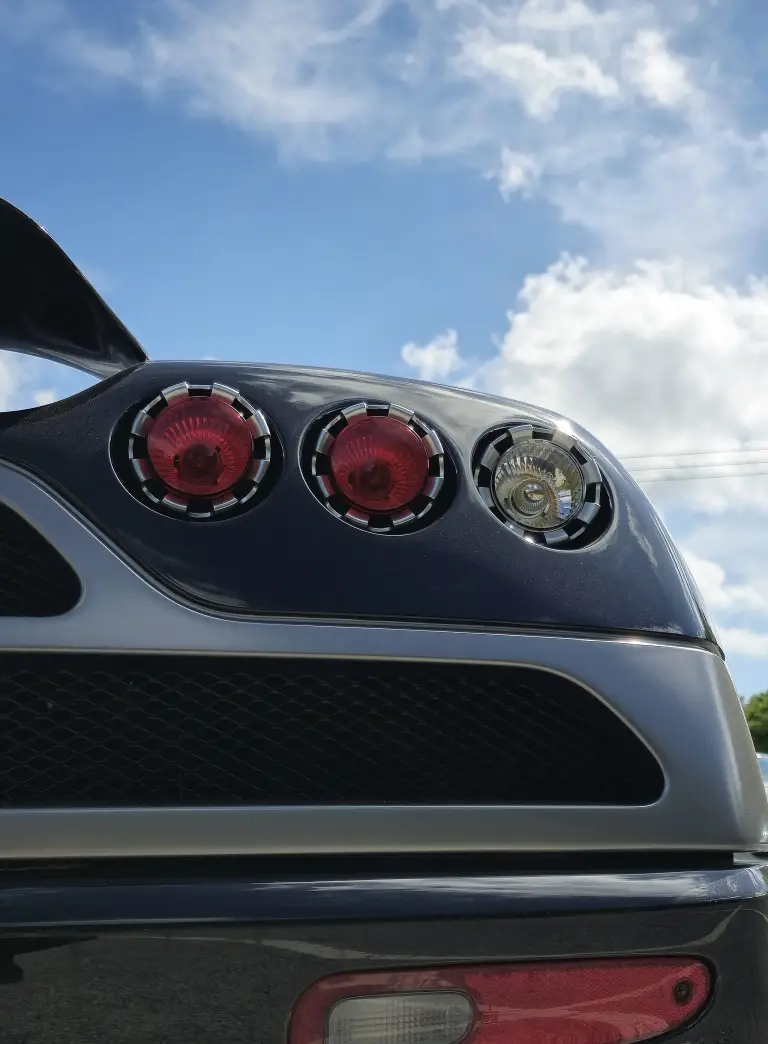
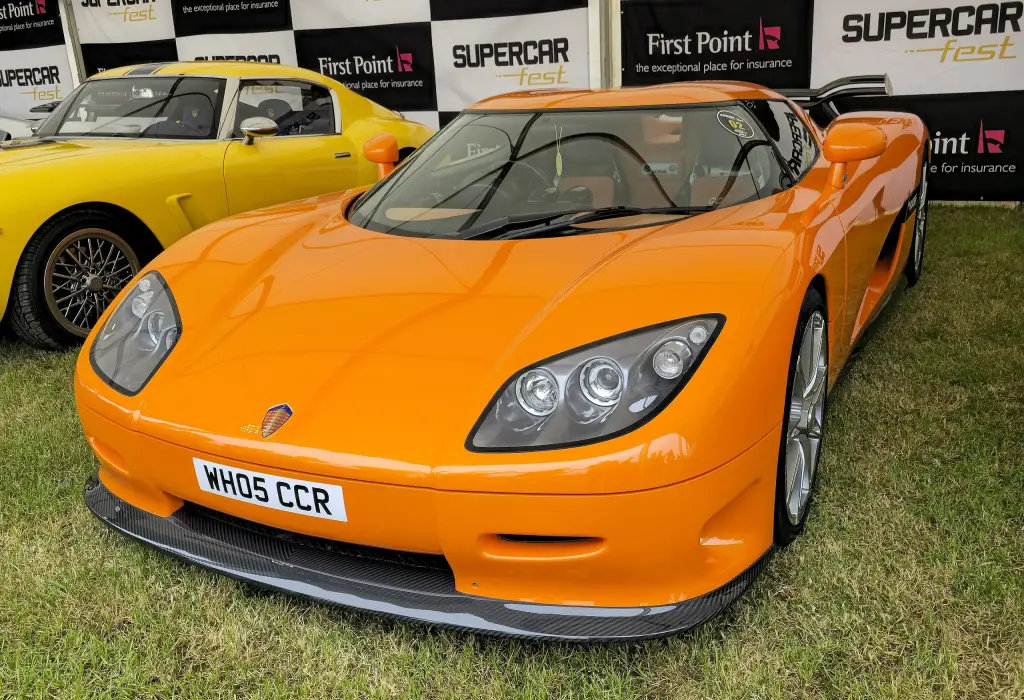
The CCR debuted at the March 2004 Geneva Auto Show as the most powerful version of the Koenigsegg CC range at the time. Like the CC8S it had dihedral synchro-helix actuation doors, but it brought a larger front splitter for better downforce, a tweaked headlight arrangement, a rear wing, larger tyres and wheels with larger brakes, upgraded suspension and a more powerful engine. Twin Rotrex superchargers raised output to 601 kW (806 hp; 817 PS) at 6,900 rpm and 920 N·m at 5,700 rpm.
The ghost badge
To honour the Swedish Fighter Jet Squadron No 1 (Johan röd), which had occupied the facility Koenigsegg now uses, the CCR is adorned with the symbol of a ghost, the squadron’s emblem.
Record at Nardò
At its debut Koenigsegg claimed the CCR to be the fastest production car, with a theoretical top speed of more than 395 km/h. The claim was tested on 28 February 2005 at Italy’s Nardò Ring, where five Koenigsegg engineers and mechanics with founder Christian von Koenigsegg ran a standard CCR driven by Loris Bicocchi to 387.87 km/h, breaking the fastest production car record. In April 2005 a prototype of the Bugatti Veyron took the crown with a top speed over 400 km/h.
Special editions
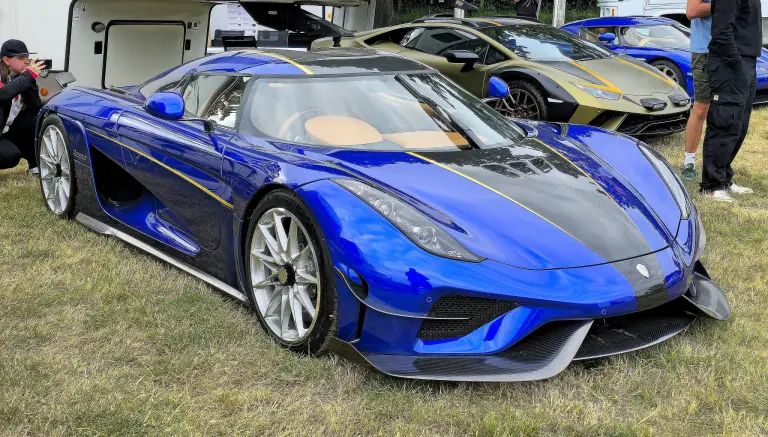
An original sky-blue CCR with a white and blue interior returned to the factory in 2012 for major upgrades requested by its owner and was dubbed the CCR Revo: clear-coated carbon fibre body with candy red accents, a red and black interior, CCX rear diffuser, side skirts, fog lights, front splitter and wheels, the twin-deck rear spoiler of the CCXR and uprated engine management and superchargers. In 2011 the German tuner EDO Competition modified another CCR into the CCR Evolution, raising power from 815 to 903 PS, changing the drive ratio and fitting Alcantara trim, a new centre console and an infotainment system for €40,000.
Design and features
- Twin superchargers: two Rotrex units give the 4.7-litre V8 806 hp and strong low-speed response.
- Aerodynamics: a larger front splitter and a standard rear wing compared with the CC8S.
- Running gear: larger wheels and tyres, larger brakes and uprated suspension.
- Ghost badge: a tribute to Fighter Squadron No 1, which once used the Koenigsegg factory.
- Dihedral doors: the synchro-helix doors carried over from the CC8S.
Koenigsegg CCR versions
- CCR (2004): the standard car, 806 hp, 388 km/h.
- CCR Revo (2012): a factory-upgraded car with carbon body, red accents and CCXR-style rear wing.
- EDO Competition CCR Evolution (2011): a German tuner’s car with 903 PS, revised gearing and Alcantara interior.
The CCR followed the CC8S and was replaced by the CCX, whose CCXR version donated its rear spoiler to the CCR Revo. More Koenigseggs are in the Koenigsegg collection.
Video: Road Trip in the Koenigsegg CCR Revo [Shmee’s Adventures]
Video on YouTube.
Sources
- Koenigsegg CCR, English Wikipedia: specification, record, special editions