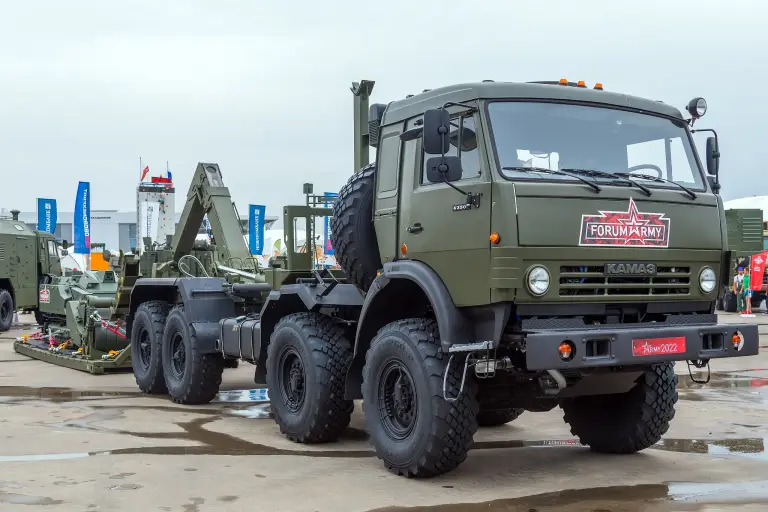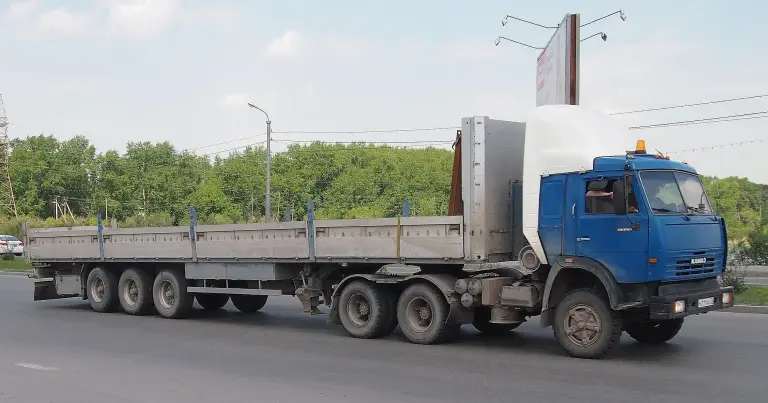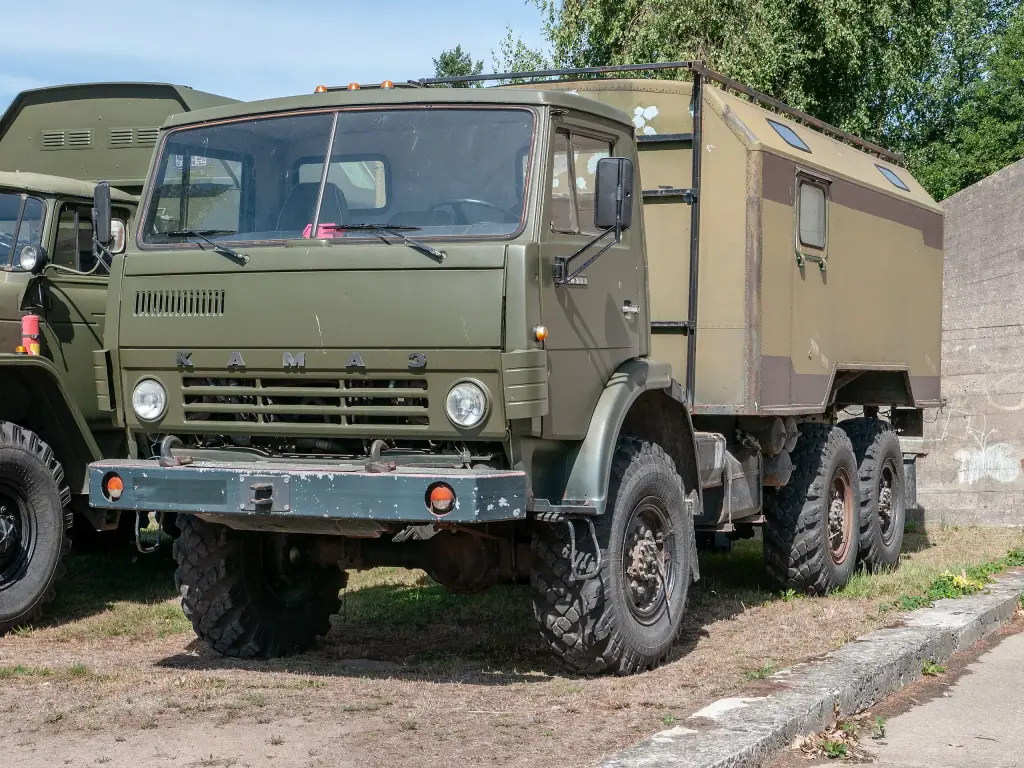
The KamAZ-4310 is the all-wheel-drive six-by-six that KamAZ built in series from 1981 to 1995. It shared its cab, engine and most of its chassis with the road-going KamAZ-5320, and it became the basis of the plant’s whole later family of off-road trucks.
KamAZ-4310 at a glance
| Maker | KamAZ, Naberezhnye Chelny |
|---|---|
| First prototype | 1971 |
| Pre-series | 1972–1978 |
| Series production | January 1981 – 1995 |
| Layout | 6×6, permanent all-wheel drive |
| Payload | 6,000 kg |
| Engine | KamAZ-740.10, 10.85 l V8 diesel |
| Power | 210 hp; 220 hp from 1989 |
| Gearbox | five-speed manual, synchronised on II–V |
| Transfer case | two-speed, torque split 1:2 front to rear bogie |
| Tyres | 1220×400-533 IP-184, single on all axles |
| Electrical system | 24 V, two 6ST-190 batteries |
| Built | 273,901 |
History of the KamAZ-4310
The design goes back further than the production date suggests. In 1971, a decade before the model reached the assembly line, the plant showed its first KamAZ-4310 prototype with single tyres on all axles, permanent all-wheel drive, a tilting cab over the engine and the KamAZ-740 diesel. Pre-series production followed in 1972 and produced four slightly different types, all built until 1978. Serial manufacture started in January 1981, when the first batch of series trucks was presented as a gift to the 26th congress of the Communist Party.
The 4310 was closely related to the road-going KamAZ-5320, from which it differed mainly in the permanent drive to all six wheels and in a payload raised by a tonne to six tonnes. The transmission was built around a five-speed gearbox with synchronisers on second to fifth and a two-speed transfer case that distributed torque between the permanently driven front axle and the rear bogie in a ratio of 1:2; the axles had mechanically lockable differentials, and the front axle used disc-type constant-velocity joints. The steering had hydraulic assistance, the brakes were pneumatic drums of 400 mm and the electric system ran on 24 volts from two 6ST-190 batteries.
A mechanical winch was part of the equipment of the off-road versions: driven from a power take-off through a propeller shaft, it pulled up to 10,800 kgf forward and 15,400 kgf backward with a pulley, and its rope was 74.5 to 76.5 m long when paid out forward. In 1988 the transfer case received pneumatic control, and in 1989 the truck was modernised with the more powerful KamAZ-740.10-20 of 220 hp instead of 210 hp. Production ended in 1995 in favour of the KamAZ-43114; by then the plant had built 273,901 vehicles of the model, and the sports team KamAZ-master used the 4310 as the basis for its first rally truck, the S4310.
Design and features
- Permanent all-wheel drive: a two-speed transfer case with a lockable centre differential and a 1:2 torque split.
- Lockable axles: mechanically lockable differentials on all axles and disc-type constant-velocity joints at the front.
- Winch: up to 10,800 kgf forward with a pulley, with a rope of about 75 m.
- Shared family engineering: the same cab and V8 as the road-going KamAZ-5320.
- Long service: fourteen years in production and more than a quarter of a million built.
KamAZ-4310 versions
- KamAZ-4310: the basic flatbed of 1981–1989 with six tonnes of payload.
- KamAZ-43105: a version with the longer 5,100 mm flatbed of the KamAZ-5320 and without the winch and tyre-pressure system.
- KamAZ-43101: the designation of a pre-series type of 1972–1978 and later of the modernised truck of 1989–1995, with tyre-pressure regulation.
- KamAZ-43106: a modernised version of 1989–1995 with seven tonnes of payload.
- S4310: the first rally truck of the KamAZ-master team, built on the 4310.
The 4310 was replaced by the KamAZ-43114 and then by the KamAZ-43118; its two-axle relative is the KamAZ-4326. More trucks are in the KamAZ collection.
Sources
- KamAZ-4310, English Wikipedia: history, variants
- КАМАЗ-4310, Russian Wikipedia: transmission, winch, production total