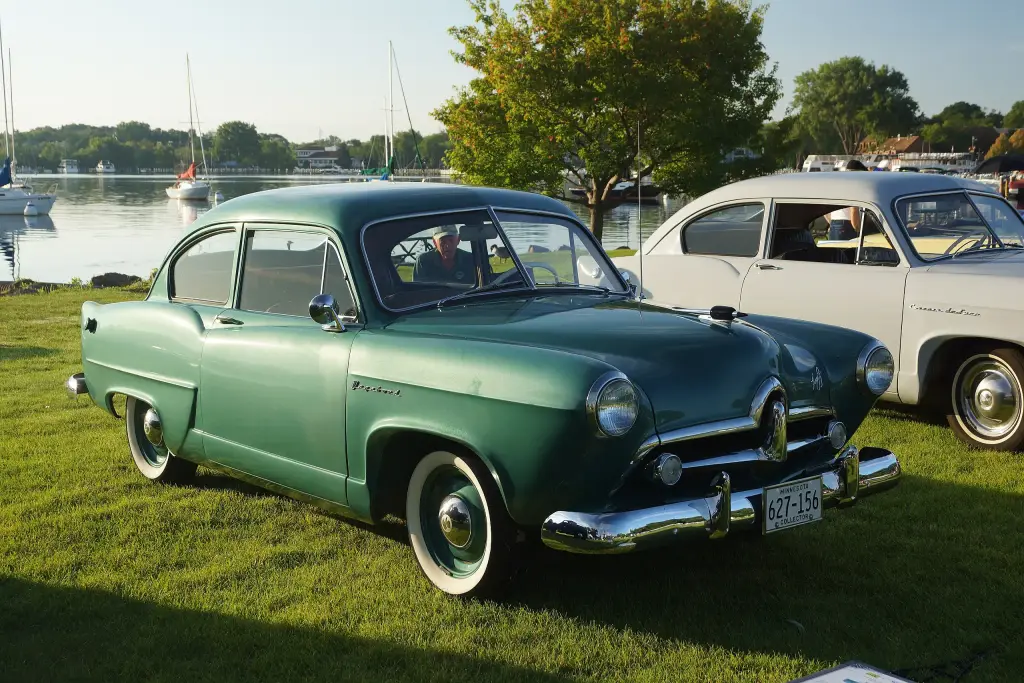
The Henry J was an American compact car built by the Kaiser-Frazer Corporation and named after its chairman, Henry J. Kaiser. Six-cylinder production began at the Willow Run factory in Michigan in July 1950, four-cylinder cars followed shortly after Labor Day, and the car was shown to the public on 28 September 1950. It was marketed until 1954.
Henry J at a glance
| Maker | Kaiser-Frazer Corporation, Willow Run, Michigan |
|---|---|
| Production | 1950–1954 |
| Public introduction | 28 September 1950 |
| Body | two-door sedan with fixed rear windows |
| Four-cylinder engine | 134.2 cu in (2.2 L), 68 hp (51 kW) |
| Six-cylinder engine | 161 cu in (2.6 L) L-head, 80 hp (60 kW) |
| Engine supplier | Willys-Overland |
| Base price limit | no more than $1,300 including federal tax and delivery preparation |
| Finance | $34 million loan from the Reconstruction Finance Corporation, 1949 |
| Fuel economy | up to 35 mpg driven conservatively; 25 mpg in advertising |
| 1952 Vagabond | 7,017 sold |
| Allstate version | sold through Sears, 1952–1953 |
| 1954 prices | Corsair $1,286; Corsair DeLuxe $1,437 |
based on one source: the English Wikipedia article on the Henry J.
History of the Henry J
An inexpensive car
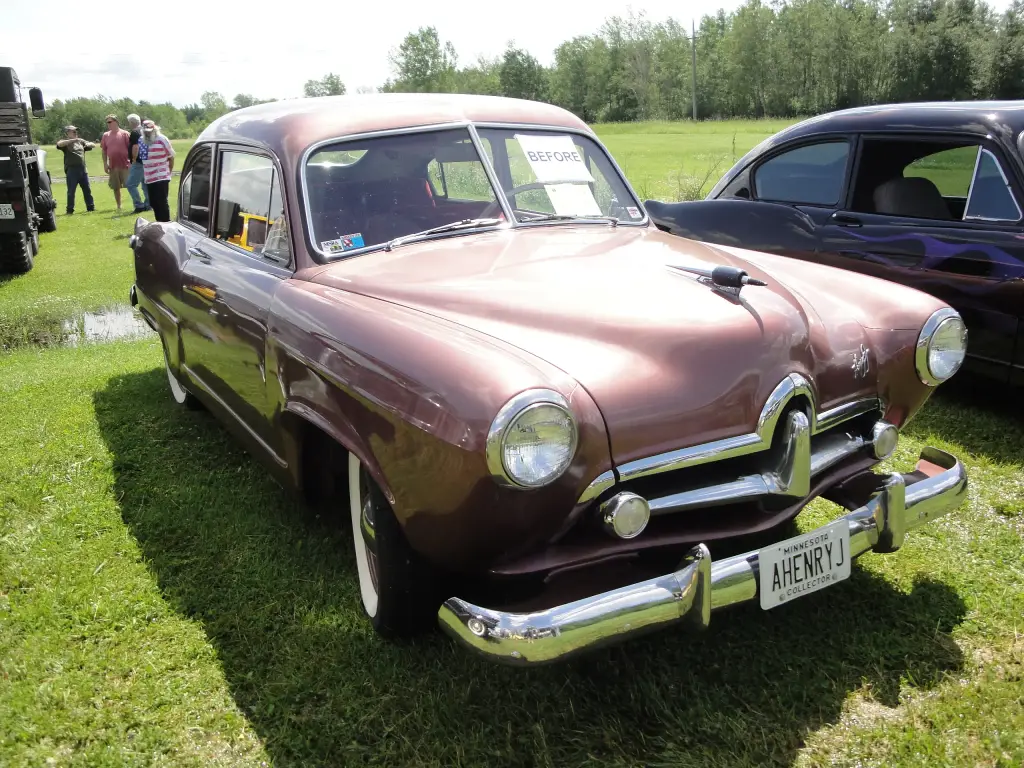
The Henry J was the idea of Henry J. Kaiser, who wanted to increase sales of his Kaiser line with a car that could be built cheaply and sold to the average American, in the same vein as Henry Ford’s Model T. The aim was to attract buyers who could only afford a used car, and the result was one of the pioneering American compact cars. The project was financed by a $34 million loan from the Reconstruction Finance Corporation in 1949. The loan set conditions: in its base form the car had to retail for no more than $1,300 including federal tax and delivery preparation, seat at least five adults, reach a sustained 50 mph, and be on sale by 30 September 1950.
Howard “Dutch” Darrin proposed a compact design based on the already approved future Kaiser with a shortened wheelbase, but Kaiser wanted an entirely new car and chose a design developed by American Metal Products. Darrin still improved its appearance with a dip in the beltline, windscreen and rear window, and added small tailfins.
Built with as few parts as possible
To reach the low price the Henry J was designed with the fewest possible components. Early cars had no rear trunk lid at all: the trunk was reached by folding down the rear seat. The car was offered only as a two-door sedan with fixed rear windows, and the basic version lacked a glove compartment, armrests, a passenger-side sun visor and flow-through ventilation. Before release, engineers took the first production cars to Arkansas for durability testing, where 100 miles on the roughest roads were reckoned to equal 5,000 miles of ordinary driving.
Power came from Willys-Overland. The 134.2 cu in four-cylinder produced 68 hp and was the same engine used in the CJ-3A Jeep, with interchangeable block and internals; later cars could be had with a 161 cu in L-head six of 80 hp. The four-cylinder could return up to 35 mpg when driven conservatively, and a Henry J won the Mobil Economy Run in 1953.
A difficult market
The Korean War broke out as the Henry J was launched. Military allocations limited steel for civilian cars, and the Willow Run plant also had a subcontract for Fairchild C-119 Flying Boxcar aircraft, which disrupted the assembly line. The car was cheap, but a Chevrolet 150 cost less than $200 more and had an opening trunk lid and opening rear windows; the standard Chevrolet, Ford and Plymouth were also larger. From the 1951 model year Kaiser-Frazer offered an opening trunk lid in an Accessory Group.
Sales disappointed. Leftover 1951 models were fitted with an outside continental tyre and an upgraded interior and sold as the 1952 Vagabond, of which 7,017 found buyers. From 1952 Kaiser sold a rebadged version through Sears under the Allstate name, with its own grille, bonnet ornament, hubcaps, badges, interior trim, tyres and batteries; Sears dropped it after two years. The car was also built in Japan from 1951 to 1954 under licence by East Japan Heavy-Industries, part of the Mitsubishi group. For 1952 came the Corsair four-cylinder and Corsair DeLuxe six-cylinder with a full-width grille and tail lamps in the rear fins; the 1953 Corsair used the smaller four and had a padded dashboard as standard. For 1954 the Corsair was listed at $1,286 and the Corsair DeLuxe at $1,437.
Design and features
- Fewest parts: the body was designed around the lowest possible number of components to keep the price down.
- No early trunk lid: the first cars were loaded through the folding rear seat.
- Willys engines: the four-cylinder was shared with the CJ-3A Jeep, and Willys-Overland supplied all engines.
- Economy: up to 35 mpg, a Mobil Economy Run win in 1953, and advertising built around running costs.
- Compact pioneer: one of the first American compact cars, aimed at buyers of used cars.
Henry J versions
- Henry J (1950–1951): the original two-door with fixed rear windows and no trunk lid.
- Vagabond (1952): leftover 1951 cars with a continental tyre and better interior; 7,017 sold.
- Allstate (1952–1953): Sears version with unique grille, badges and trim.
- Corsair and Corsair DeLuxe (1952–1954): restyled front with a full-width grille and tail lamps in the fins.
- Japanese licence production (1951–1954): built by East Japan Heavy-Industries.
The Henry J underpinned the glassfibre Kaiser Darrin sports car, and it stood below the larger Kaiser saloons. More cars are in the Kaiser collection.
Sources
- Henry J, English Wikipedia: development, price limits, engines, marketing, Vagabond, Allstate, Corsair