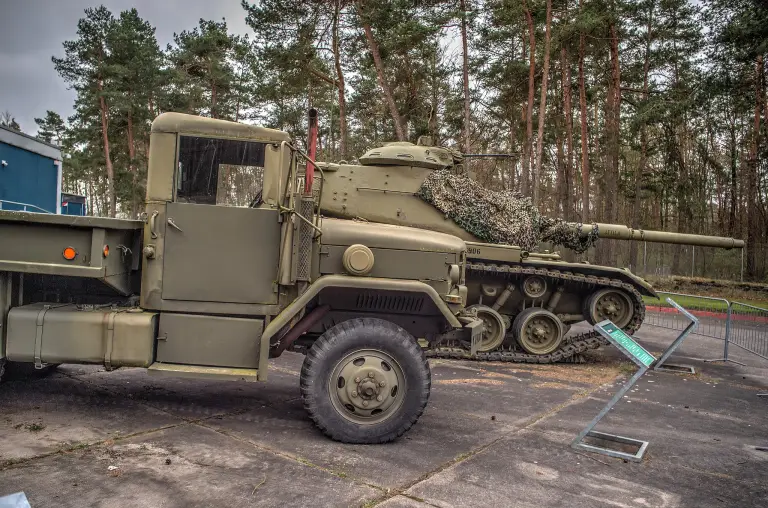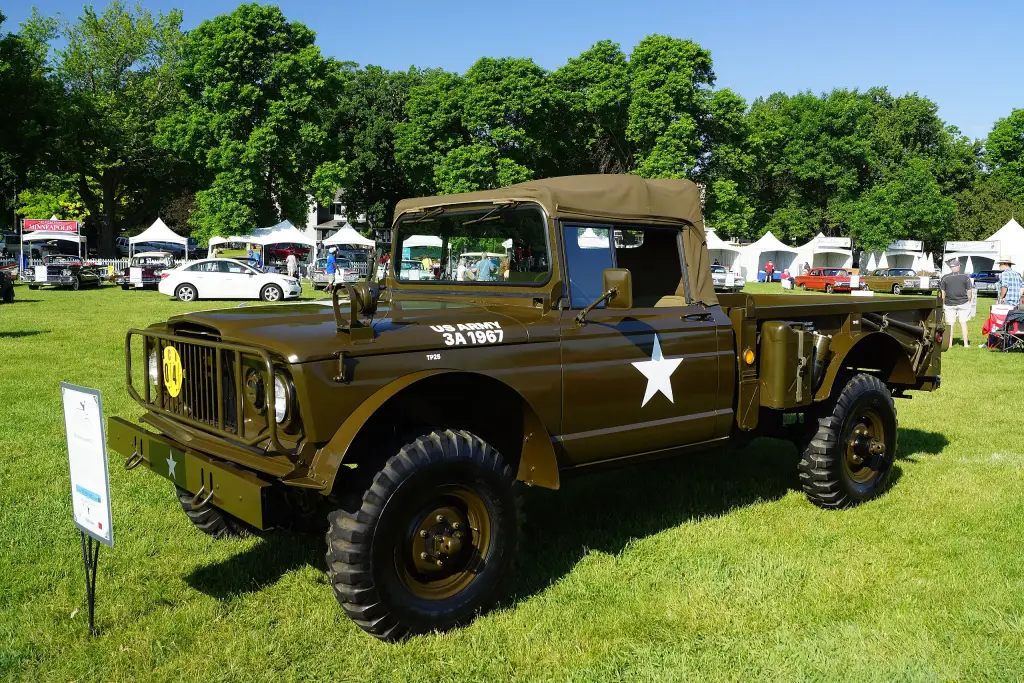
The Kaiser Jeep M715, sometimes called the “five quarter” for its 1¼-ton payload rating, is an American light military truck based on the civilian Jeep Gladiator (SJ). Design and development began in 1965 to replace the Dodge M37, and the M715 was the first “M”-series US tactical vehicle to use primarily commercial components.
Kaiser Jeep M715 at a glance
| Maker | Kaiser Jeep, Toledo, Ohio |
|---|---|
| Type | 1¼-ton 4×4 light military truck |
| Based on | civilian Jeep Gladiator (SJ) |
| Development began | 1965, to replace the Dodge M37 |
| Production | 1967–1969; between 30,500 and 33,000 built |
| Engine | 230.5 cu in overhead-cam six, 132.5 hp |
| Transmission | Warner T-98 four-speed manual |
| Transfer case | New Process NP200 two-range, 1.91:1 low |
| Length | 209.75 in without winch; 220.75 in with winch |
| Width | 85 in |
| Payload | 2,500 lb off-road; 3,000 lb on-road |
| Top speed | 55 mph |
| Electrical system | 24 volt, two 12-volt batteries |
based on one source: the English Wikipedia article on the Kaiser Jeep M715.
History of the Kaiser Jeep M715
A commercial truck in uniform
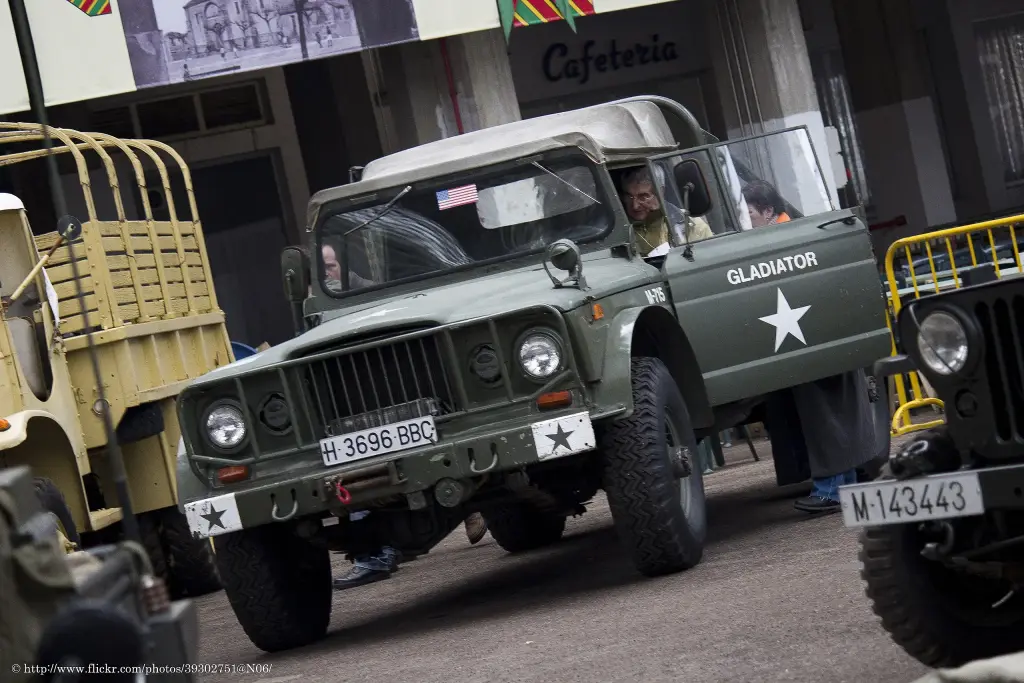
The M715 was developed from 1965 to replace the Dodge M37, a purpose-built military truck. In a departure from that approach, the M715 was the first “M”-series US tactical vehicle to use mainly commercial off-the-shelf components, based on the civilian Jeep Gladiator. It was built in Toledo, Ohio, between 1967 and 1969, with between 30,500 and 33,000 trucks produced. The family included the basic M715 cargo and troop carrier, the M724 bare cab and chassis for maintenance bodies, the M725 ambulance and the M726 telephone maintenance utility.
Service
The M715 served in the Vietnam War, on the Korean Demilitarized Zone and at European bases. Compared with the purpose-built Dodge M37 it was considered underpowered and fragile. The overhead-cam six-cylinder engines were not very reliable because of a lack of knowledge of the overhead-cam design and of maintenance, and they had been dropped from civilian models by 1968; the trucks also suffered from excessive oil consumption. Trucks with front winches were dangerous in rough cross-country use, because the winch drive shaft could separate from the winch and foul the steering, causing loss of control. The 1968 models sent to Korea had improperly welded frames that could break, and the vendor hired a Korean company to repair several hundred trucks held in depot stocks; by 1970 most of the 1968 models in Korea were being cannibalised for parts.
After the M715
From 1976 the US military replaced the M715 series with the Dodge M880 series, again a 1¼-ton militarised commercial truck. Kia later produced an M715-type vehicle, the KM450, for the South Korean Army under licence from the US government. The original design was remembered in concept vehicles too: Mopar built the Jeep NuKizer 715 in 2010 as a tribute, and FCA showed the Jeep Crew Chief 715 concept at the 2016 Easter Jeep Safari in Moab.
Design and features
- Commercial basis: built on the civilian Jeep Gladiator, the first M-series truck to use mainly off-the-shelf components.
- Overhead-cam six: a 230.5 cu in Tornado engine of 132.5 hp, powerful on paper but unreliable in service.
- Military equipment: 24-volt electrics, a two-range transfer case and optional front winch.
- Payload: 2,500 lb off-road and 3,000 lb on-road from a 5,500 lb truck.
- Family of bodies: cargo, ambulance and telephone-maintenance versions shared the chassis.
Kaiser Jeep M715 versions
- M715: the basic cargo and troop carrier.
- M724: bare cab and chassis, usually with a contact maintenance body.
- M725: ambulance.
- M726: telephone maintenance utility.
- KM450: a later Kia-built equivalent for the South Korean Army.
The M715 was the lighter stablemate of the M35 2½-ton truck in Kaiser Jeep’s military range, and it was based on the civilian Jeep Gladiator. More vehicles are in the Kaiser collection.
Video: Starting 1967 Kaiser JEEP M715
Video on YouTube.
Sources
- Kaiser Jeep M715, English Wikipedia: development, production, variants, service problems, specifications