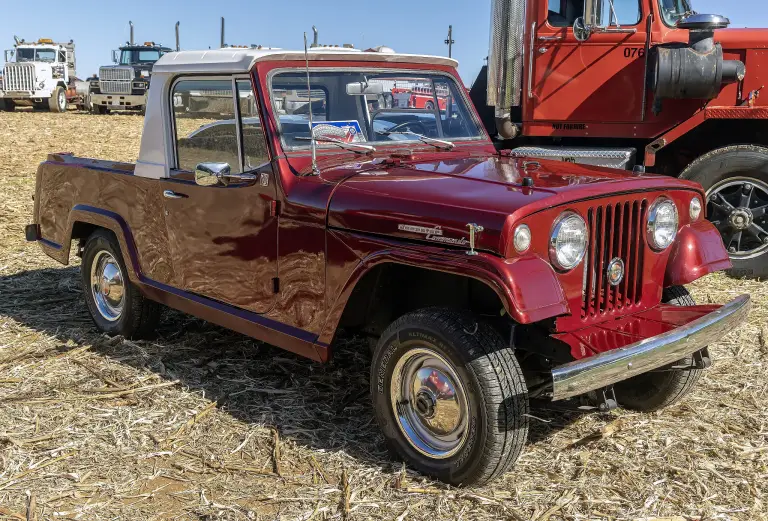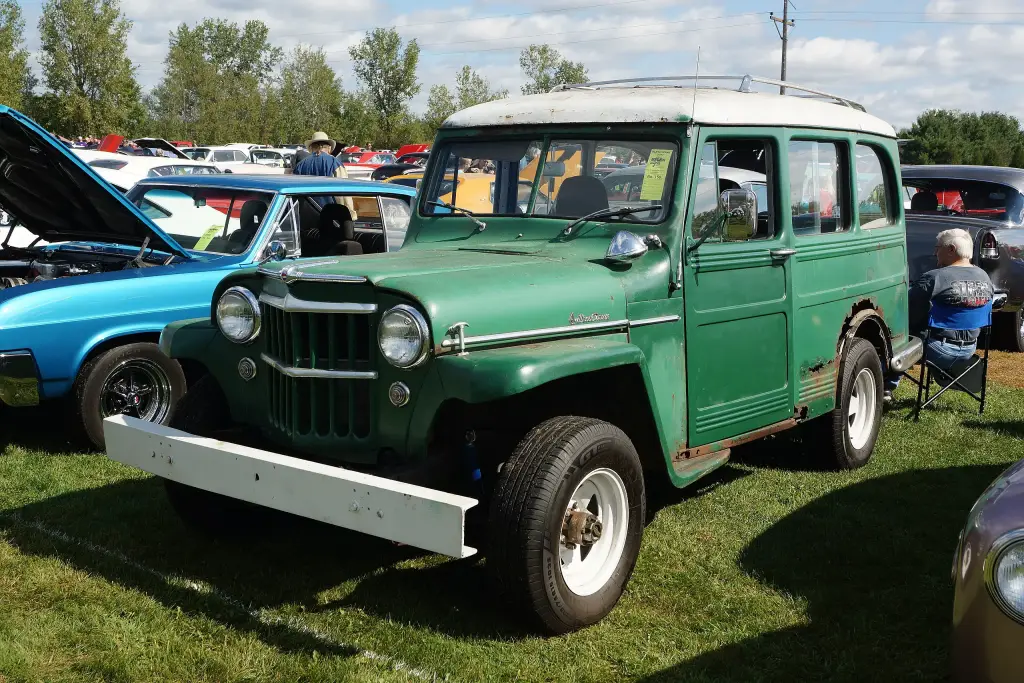
The Willys Jeep Station Wagon, also called the Jeep Utility Wagon and, as a van, the Jeep Panel Delivery, was built by Willys and Kaiser Jeep in the United States from 1946 to 1964. It was the first mass-market all-steel station wagon designed and built as a passenger vehicle. When four-wheel drive became an option in 1949, the two-wheel-drive car kept the Station Wagon name and the four-wheel-drive version was sold as the Utility Wagon.
Willys Jeep Station Wagon at a glance
| Maker | Willys-Overland, then Kaiser Jeep |
|---|---|
| Production | 1946–1964 in the United States |
| Also built | Argentina to 1970, Brazil to 1977 |
| Designer | Brooks Stevens, for Barney Roos |
| Body | all-steel station wagon; panel van from 1947 |
| Drive | rear-wheel drive; four-wheel drive optional from 1949 |
| First engine | L-134 Go-Devil four-cylinder |
| Six-cylinder | from the 1948 model year |
| Front suspension | Planadyne independent system on two-wheel-drive cars |
| Built in the US | over 300,000 wagons and variants |
| Names | Station Wagon (2WD), Utility Wagon (4WD), Panel Delivery |
History of the Willys Jeep Station Wagon
Brooks Stevens and the all-steel body
After the war Willys-Overland had no modern car for the civilian market, and executive vice president Barney Roos feared the company would not survive; he telephoned the industrial designer Brooks Stevens and asked for help at once. Stevens expanded the four-wheel-drive platform into a more car-like vehicle, and the resulting estate body is sometimes called the original SUV. Willys did not press its own bodies, and the body makers were busy, so Stevens designed panels that could be produced by firms used to making domestic appliances, whose presses could draw sheet metal only about six inches. The steel body was cheap to mass-produce, easier to maintain and safer than the wood-bodied wagons of the time; within two years only Crosley offered a comparable all-steel wagon, from 1947.
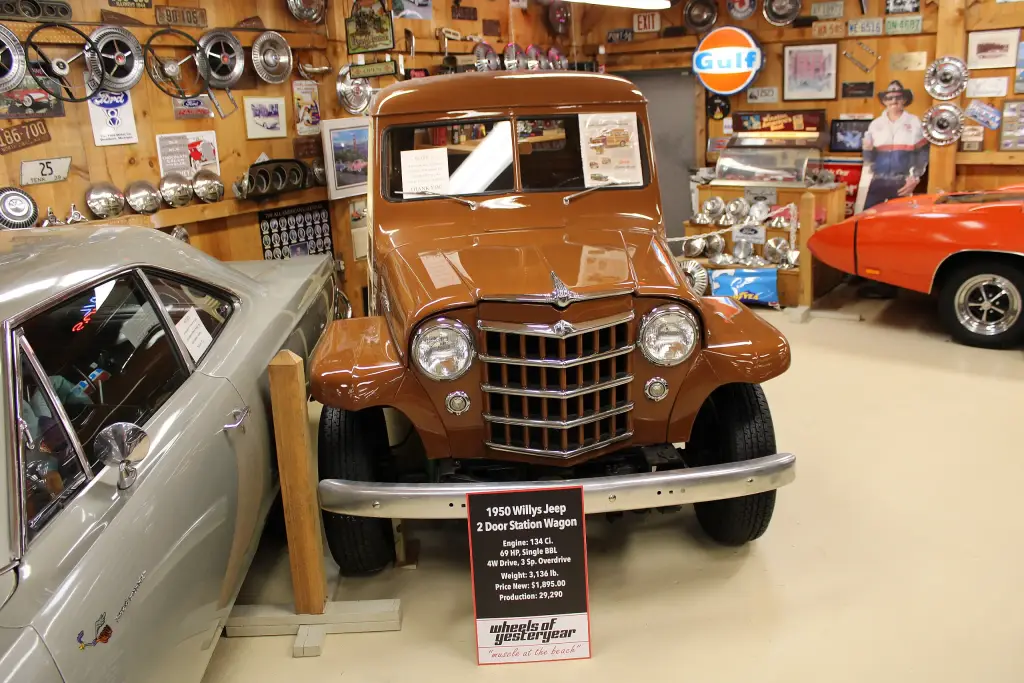
From 1946 to the Hurricane
The first Station Wagons went on sale in July 1946 as the 463, with a flat ten-slot grille and the L-134 Go-Devil four. A panel van with one seat and no side windows behind the front doors followed in 1947, along with the 663 on the 148 cu in Lightning six, of which 50 were built. A better-finished Station Sedan with basket-weave side trim came in 1948. Four-wheel drive became an option in 1949, and two-wheel-drive cars still outsold it into the 1950s. For 1950 the grille became a pointed v-shape with five horizontal bars, the 473 got the F-134 Hurricane and the 673 the 161 cu in Lightning six. The flathead Lightning gave way to the F-161 Hurricane in 1952, and for 1954, the first year under Kaiser, the 6-226 Super Hurricane flathead six arrived and the grille lost two of its horizontal slats.
Utility Wagon, Maverick and the end
In 1955 Willys left the passenger car market and renamed the vehicle the Utility Wagon, dropping the seventh seat and the overdrive, replacing the Planadyne front suspension of the two-wheel-drive car with a beam axle and making Warn locking hubs optional on four-wheel drive. The Maverick of 1958 was a more luxurious two-wheel-drive wagon with two-tone paint, a standard AM radio and extra stainless trim, named after the television series Willys sponsored. One-piece windscreens came to the two-wheel-drive cars in 1959 and to the four-wheel-drive wagons and deliveries in 1960. Production in the United States ended in 1964; Argentine assembly continued to 1970 and Brazilian to 1977. Over 300,000 wagons and their variants were built in the United States, and the cars were also assembled abroad from kits and under licence.
Design and features
- All-steel body: the first mass-market estate designed as a passenger car in steel.
- Six-inch draws: panels shaped so that appliance makers could press them.
- Planadyne suspension: Willys’ independent front end, based on a transverse seven-leaf spring.
- Utility Wagon: the four-wheel-drive version from 1949, often called the first SUV.
- Maverick: the 1958 luxury two-wheel-drive model with two-tone paint.
Willys Jeep Station Wagon versions
- Station Wagon (1946–1964): the rear-wheel-drive estate.
- Panel Delivery (1947): the van-bodied version.
- Utility Wagon (1949–1964): the four-wheel-drive models.
- Station Sedan (1948): the better-finished luxury model.
- Maverick (1958): the two-tone luxury two-wheel-drive wagon.
The Station Wagon was replaced by the Wagoneer in 1963, and its Argentine version is the IKA Estanciera. More models are in the Jeep collection.
Video: 1961 Willys Jeep Station Wagon / Overland-Willys Classic 4×4
Video by samspace81 on YouTube.
Sources
- Willys Jeep Station Wagon, English Wikipedia: design, production timeline, models, production totals