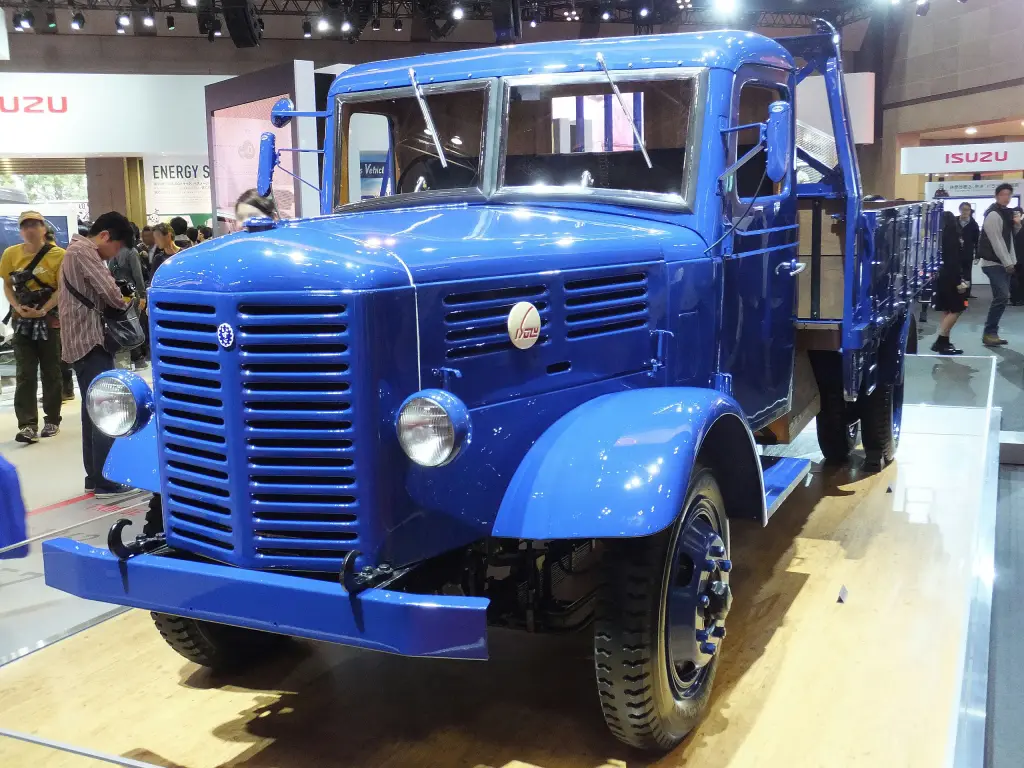
The Isuzu TX series was a truck built from 1934 until the end of the Second World War. Production resumed in 1946 and continued until 1979, with petrol or diesel engines, and the TX was the company’s first successful heavy-duty truck, used as a fire engine, tanker, dump truck, construction vehicle and general cargo carrier. It shared its chassis with the BX series bus and evolved from the Isuzu Sumida bus of 1929.
Isuzu TX at a glance
| Maker | Isuzu, originally Ishikawajima |
|---|---|
| Production | 1934–1945, then 1946–1979 |
| Class | heavy-duty truck |
| First models | TX35 with 1.5 t and TX40 with 2.0 t payload |
| Engine | 4.4 L flathead six-cylinder petrol, GA40 |
| Gearbox | dry clutch, four-speed |
| Dimensions | 6.64 m long, 4 m wheelbase, 2.19 m wide, 2.11 m high |
| Post-war petrol | TX80, five tonnes, 4,390 cc GD32 with 90 PS |
| Post-war diesel | TX61, six tonnes, 5,103 cc DA45 with 85 PS |
| Related bus | Sumida BX35, BX40 and BX45 |
based on one source (English Wikipedia)
History of the Isuzu TX
Origins
The TX grew out of a line that began with the British Wolseley CP 1.5-ton truck of 1924, built in Japan under licence by Ishikawa Automotive Works, a predecessor of Isuzu; the same company had built the Wolseley A9, the first car made in Japan, in 1922. By 1927 Ishikawajima had learned enough to end the tie-up and build trucks of its own design under the Sumida brand. The Japanese military had made domestic truck production a priority after seeing how many American GMC and Ford vehicles were imported, with Ford building a plant at Koyasu in Yokohama in 1925 and General Motors opening Osaka Assembly in 1927, and the Military Vehicle Assistance Act of 1918 had already pointed the same way. In 1931 a government committee brought the three major makers together to design a standard heavy truck, with the Ministry of Railways under Hideo Shima drawing the chassis, body and driving position, Ishikawajima the engine, DAT the transmission and Tokyo Gas & Electrical the axles.
The TX series
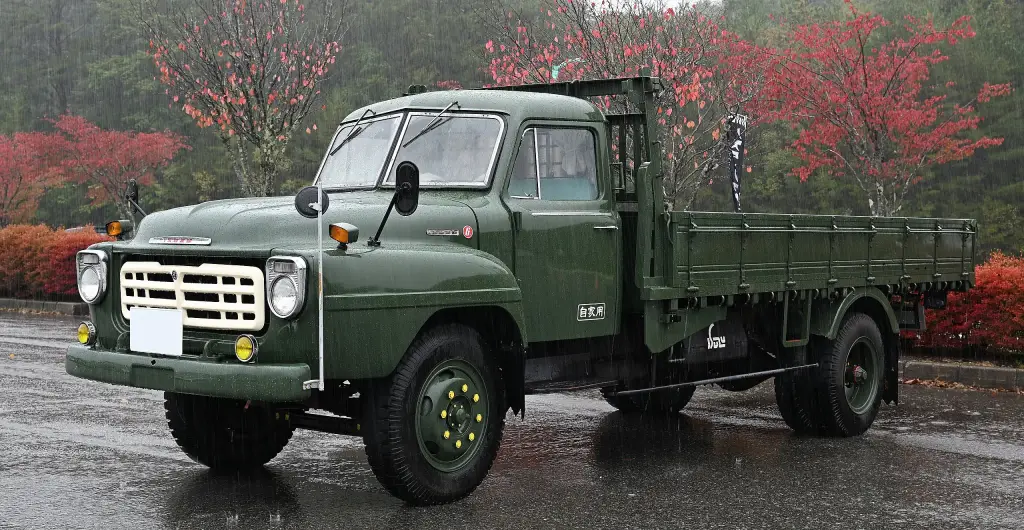
The TX was offered in 1933 by Kyodo Domestic Automobile in two payloads, the TX35 at 1.5 tonnes and the TX40 at 2.0 tonnes with off-road ability, sharing its chassis with the Sumida BX35, BX40 and BX45 buses that carried 15 to 35 passengers. Power came from the GA40, a 4.4-litre flathead six-cylinder petrol engine, through a dry clutch and four-speed gearbox. In 1934 the first Japanese-built military truck, the three-axle TU series with a diesel engine and an overall length of 5.4 m, joined the range as the Type 97.
After the war
When production resumed, the TX competed with the Toyota FA, Mitsubishi Fuso and Nissan Diesel. Early post-war models were the petrol TX80 and the diesel TX61: the five-tonne TX80 used the 4,390 cc GD32 engine with 90 PS at 2,800 rpm, while the TX61 had the 5,103 cc DA45 diesel, produced 85 PS and carried six tonnes. The series remained in production until 1979, by which time Isuzu’s truck range had moved on to newer designs.
Design and features
- First successful heavy truck: the model that established Isuzu in the class.
- Many roles: fire engine, tanker, tipper, construction and cargo work.
- Shared chassis: the same underpinnings as the Sumida BX buses.
- Long life: from 1934 to 1979 with a wartime break.
Isuzu TX versions
- TX35 (1933): 1.5-tonne payload.
- TX40 (1933): two tonnes with off-road capability.
- TU series (1934): three-axle military truck, known as the Type 97.
- TX80: post-war five-tonne petrol truck with 90 PS.
- TX61: post-war six-tonne diesel with 85 PS.
The TX’s bus sibling was the Sumida BX, and Isuzu’s later heavy trucks were the 810 and the Giga. More trucks are in the Isuzu collection.
Video: CAMIÓN CISTERNA “ISUZU TX-40” 1/72 HASEGAWA
Video by SPITTFIRE2010 on YouTube.
Sources
- Isuzu TX, English Wikipedia: origins, models, engines