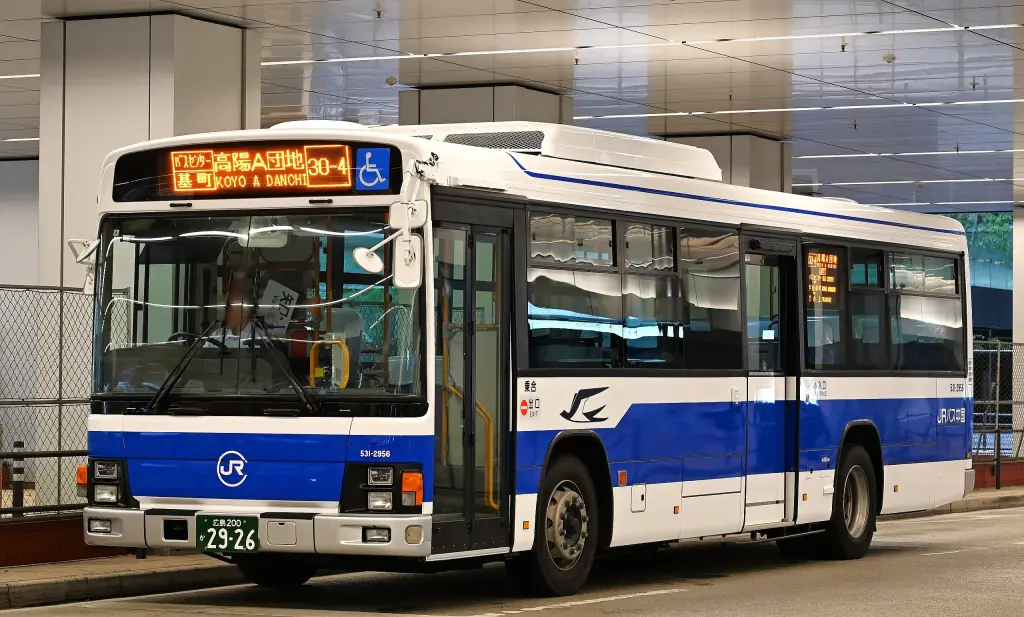
The Isuzu Erga is a heavy-duty single-decker bus that Isuzu produces through the J-Bus joint venture with Hino. It is primarily a public city bus, offered either as a complete bus or as a chassis for bodybuilders, and it is built by J-Bus in Japan as a step-entrance bus in one-step and two-step form or as a low-floor non-step bus in two body types.
Isuzu Erga at a glance
| Maker | Isuzu, built by J-Bus with Hino |
|---|---|
| Production | since 2000 |
| Class | heavy-duty single-decker city bus |
| Layouts | one-step, two-step and non-step (low-floor) types A and B |
| First generation | 2000–2015, LV280 and LV234 models |
| Engines | 8PE1, 6HH1, 6HK1 and 4HK1 over the generations |
| CNG | 8PF1, 6HF1 and 6HA1 engines in gas versions |
| Hybrid | Eaton parallel hybrid from 2012 |
| Erga Duo | articulated bus from 2019 |
| Erga EV | electric bus from 2024 |
| Hino twin | sold as the Hino Blue Ribbon II |
based on one source (English Wikipedia)
History of the Isuzu Erga
First generation (2000–2015)
The Erga replaced the Cubic with completely different styling: a deep double-curvature windscreen, a rounded roof dome and a separately mounted destination display. Its Hino-rebadged twin is the Blue Ribbon II. The range opened with the KL-LV280L1, N1 and Q1 models on the 8PE1 engine, with 8PF1 for CNG, and the KK/KL-LT233J2 on the 6HH1 engine. The PJ-LV234 generation of 2004 used the 6HK1 engine, and the PKG/PDG, LKG/LDG and QPG/QKG/QDG versions followed the Japanese emissions rules through 2007, 2010 and 2012. Non-step Type B buses, the KL-LV834 of 2000 to 2004, used the 6HK1 or 6HA1 CNG engine with a ZF Ecomat gearbox as standard.
Hybrid and second generation
In 2012 the QQG-LV234L3 and N3 appeared with Eaton’s parallel hybrid system, followed in 2015 by the QSG versions with an automated manual transmission. The second generation began in 2015, and from 2017 the 2TG/2PG/2KG/2DG-LV290 family used the 4HK1 engine, while the 2SG hybrid models used the A05C engine with Hino’s parallel hybrid system and an automated manual gearbox.
Erga Duo, EV and FCV
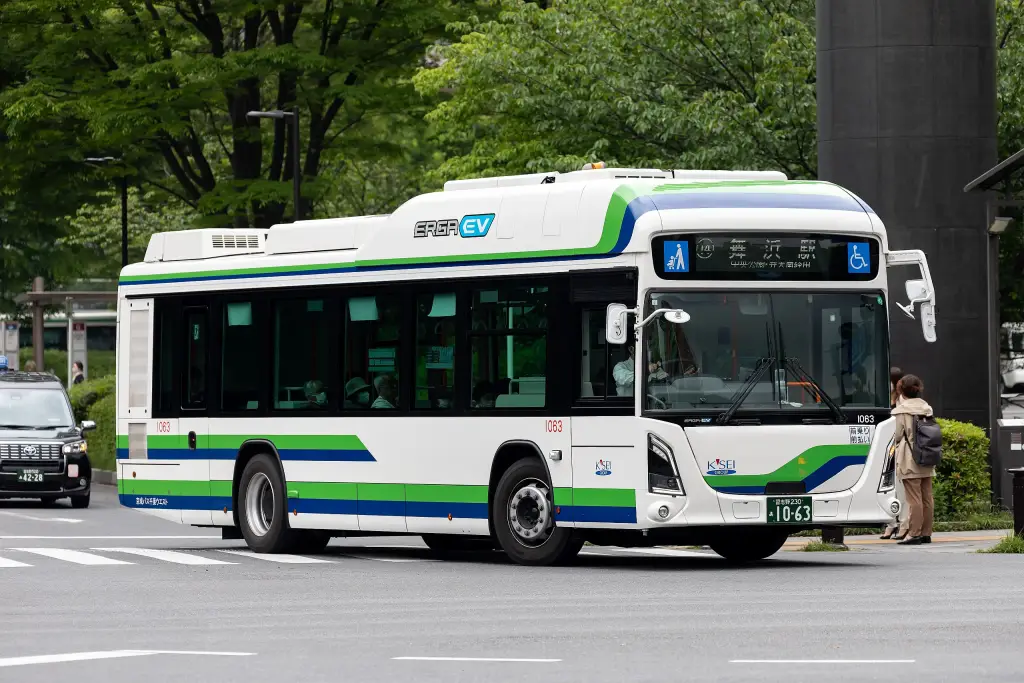
The Erga Duo, model LX525Z1, debuted on 27 May 2019 as the first mass-produced articulated bus made in Japan, alongside the Hino Blue Ribbon Hybrid articulated bus. It has an A09C six-cylinder engine of 360 hp, a Hino seven-speed automated manual transmission for its gross weight above 20 tonnes, and it was the first bus in the world with an emergency driving stop system; its all-wheel disc brakes are the only ones on a Japanese large bus. The Erga EV of 28 May 2024 was Japan’s first electric bus, the ZAC-LV828L1, and the Erga FCV of 5 October 2026 the country’s first fuel-cell bus. In August 2022 shipments of the Erga Hybrid and Duo were suspended after the Hino engine certification scandal. A separate Erga-J, a rebadged Hino Rainbow HR, was sold in 2000 and 2004.
Design and features
- J-Bus joint venture: built alongside the Hino Blue Ribbon II.
- Three layouts: one-step, two-step and non-step low-floor bodies.
- Hybrid drive: Eaton parallel hybrid from 2012.
- Erga Duo: Japan’s first mass-produced articulated bus, with an emergency driving stop system.
Isuzu Erga versions
- First generation (2000–2015): LV280, LT233 and LV234 models.
- Second generation (2015–): LV290 with the 4HK1 engine.
- Hybrid (2012–): QQG and QSG models, then the 2SG series.
- Erga Duo (2019–): articulated bus.
- Erga EV (2024–): electric bus.
- Erga FCV (2026–): fuel-cell bus.
The Erga replaced the Cubic, and Isuzu’s smaller city bus is the Journey. More vehicles are in the Isuzu collection.
Video: ISUZU ERGA BUS Meter engine start
Video by Kuruma JPN on YouTube.
Sources
- Isuzu Erga, English Wikipedia: generations, models, Erga Duo, EV and FCV