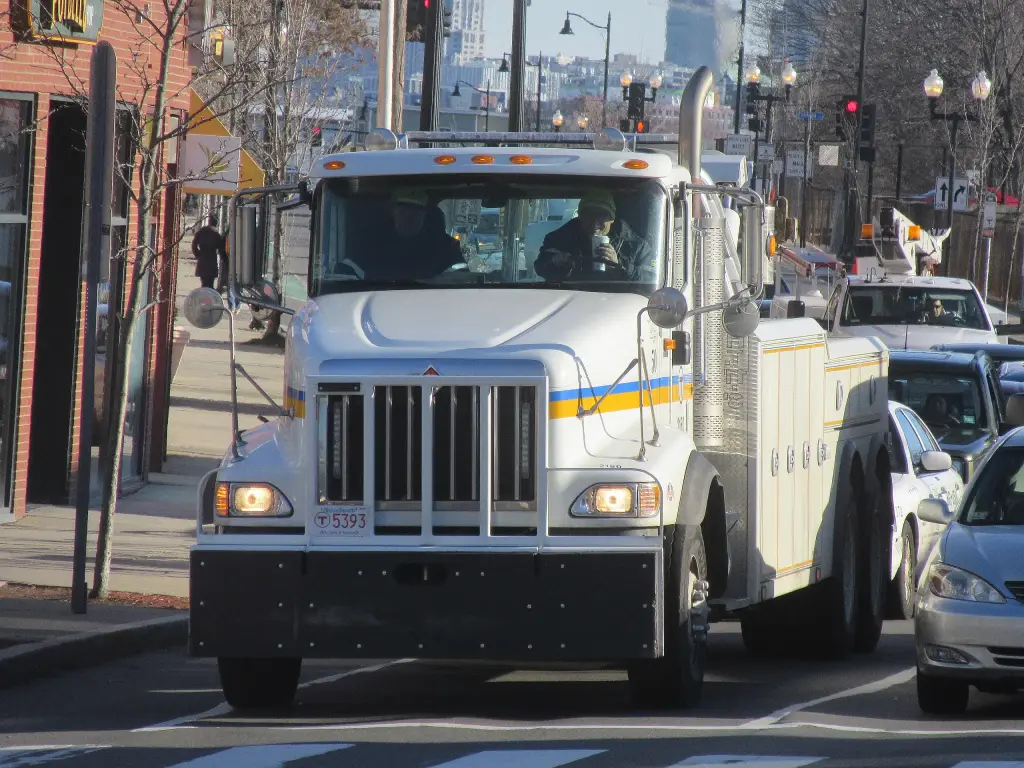
The International Paystar was International Harvester’s construction and severe-service truck, produced from 1972 to 2016 in three generations. It was the largest commercially marketed range the company sold, and for 2017 it was redesigned as the International HX.
International Paystar at a glance
| Maker | International Harvester, later Navistar International |
|---|---|
| Production | 1972–2016, three generations |
| Introduced | January 1972 as a construction version of the Transtar conventional |
| Replaced | the 210/230 and M-series trucks |
| First range | 5050 with mid-range engines and 5070 with heavy-duty engines |
| Layouts | 4×4, 6×4 and 6×6; mostly straight trucks, semitractors available |
| Second generation | 5500 with forward front axle, 5600 with set-back axle, 5900 semitractor |
| Later years | by 2013 mainly a semitractor in 6×4 and 8×6 form with high-power engines |
| Replaced by | International HX for 2017 |
Based on one source (English Wikipedia).
History of the International Paystar
A construction Transtar
The Paystar was introduced in January 1972 as a construction-specific version of the conventional Transtar. It replaced the long-running 210/230 and M-series trucks and was developed for both on and off-road use, making it the largest commercially marketed product range International sold. From 1972 to 1980 it came in two ranges: the 5050 with mid-range engines and the 5070 with heavy-duty engines. Both were available in 4×4, 6×4 and 6×6 configurations, usually as straight trucks, although most offered trailer brake options and semitractors were also available.
The second generation
The second generation increased weight capacity and engine power. The plate fenders and butterfly hoods of the first trucks were replaced by a one-piece forward-tilting hood, which made engine access easier on site. The 5500 had a forward front axle, the 5600 a set-back axle and the 5900 was a semitractor. Over the years the Paystar became more of a tractor: by 2013 it was commonly a semitractor, although straight-truck versions were still offered, while severe-service straight trucks were handled by the WorkStar, which was not sold as a tractor. In 2013 the Paystar was offered only as a 6×4 or 8×6 with high-horsepower engines.
The HX
For 2017 the Paystar was substantially redesigned and became the International HX series, ending a run of 44 years under the Paystar name.
Design and features
- Construction focus: designed from the start for on and off-road vocational work.
- All-wheel drive: 4×4, 6×4 and 6×6 versions were offered from the first generation.
- Tilting hood: the second generation replaced plate fenders and butterfly hoods with a one-piece forward-tilting hood.
- Biggest International: the largest commercially marketed range the company built.
- Heavy-haul tractors: later versions were mostly high-horsepower 6×4 and 8×6 semitractors.
International Paystar versions
- 5050 (1972–1980): mid-range engine version.
- 5070 (1972–1980): heavy-duty engine version.
- 5500: second-generation model with a forward front axle.
- 5600: second-generation model with a set-back front axle.
- 5900: second-generation semitractor.
The Paystar shared its cab with the International 9000 and sat above the S series; severe-service straight trucks later moved to the WorkStar. More trucks are in the International collection.
Sources
- International Paystar, English Wikipedia: generations, models, layouts