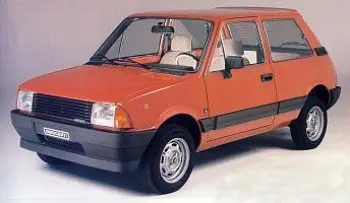
The Innocenti Mille was a rebadged Brazilian-built Fiat Uno sold in Italy under the Innocenti badge in the 1990s. A Polish-built version, the Mille Clip, followed as part of Fiat’s strategy of using the Milanese name for low-cost imported cars.
Innocenti Mille at a glance
| Maker | Innocenti, under Fiat ownership |
|---|---|
| Based on | Fiat Uno |
| Built in | Brazil; the Mille Clip in Poland |
| Body | three- and five-door hatchback |
| Engine | 1.0-litre four |
| Name | from the Fiat Mille, the Brazilian Uno after its 1994 restyling |
| Versions | Innocenti Mille and Innocenti Mille Clip |
| Market | Italy, as a low-cost rebadged model |
| Related Innocenti cars | Elba and Koral, also rebadged foreign-built Fiat-group cars |
| Uno production | Europe until 1995, Brazil until 2014 |
The sources describe the Innocenti Mille only briefly, as a rebadged Fiat Uno; no free photograph of an Innocenti-badged car was found on Commons, so the previous cover is kept.
History of the Innocenti Mille
The Uno behind the badge
The Fiat Uno was launched in January 1983 to replace the Fiat 127. Designed by Giorgetto Giugiaro of Italdesign, it was a tall, square three- and five-door hatchback with a drag coefficient of 0.34, and it was European Car of the Year for 1984. At launch it used 903, 1116 and 1301 cc petrol engines, and from 1985 a 999 cc FIRE unit replaced the smallest. Over 8.8 million were built, and the Uno remained in production in Europe until 1995 and in Brazil until 2014.
The Brazilian Uno
Brazilian production began in 1984. The South American car looked similar to the European Uno but was substantially different: it used a floorpan derived from the Fiat 147, with its own suspension, engines and transmissions, and was sold locally as the Uno CS. After a restyling in 1994 the Brazilian Uno took the name Fiat Mille. It was this car that supplied the basis for the Innocenti Mille.
The Innocenti badge as a low-cost label
After Fiat took over Innocenti in 1990, the Milanese factory closed in 1993 and the badge was reserved for low-cost cars built abroad and renamed for Italy: the Koral from Serbia, the Mille and Elba from Brazil, the Mille Clip from Poland, and passenger versions of the Piaggio Porter. The Innocenti Mille was therefore a Brazilian Uno with Innocenti badges, and the Mille Clip was its Polish-built counterpart. Both belonged to the final phase of the marque, when the name stood for a cheap imported car rather than a Milanese design.
Design and features
- Rebadged Uno: a Brazilian-built Fiat Uno with Innocenti badges for Italy.
- Low-cost position: part of Fiat’s strategy of using the Innocenti name for cheap imports.
- Two sources: Brazilian Mille and Polish-built Mille Clip.
- Familiar mechanicals: the Uno’s 1.0-litre four and front-wheel drive.
Innocenti Mille versions
- Innocenti Mille: the Brazilian-built version.
- Innocenti Mille Clip: the Polish-built version.
- Fiat Mille: the Brazilian Uno after the 1994 restyling, the car behind the badge.
The Mille was sold alongside the estate-bodied Innocenti Elba and the Serbian-built Innocenti Koral. More models are in the Innocenti collection.
Video: Pubblicità anni ’90 – Innocenti Mille Clip – 1995
Video on YouTube.
Sources
- Fiat Uno, English Wikipedia: launch, design, engines, production
- Fiat Uno, Italian Wikipedia: Brazilian production, Uno CS and Fiat Mille
- Innocenti, Italian Wikipedia: Innocenti Mille, Mille Clip and the badge strategy under Fiat