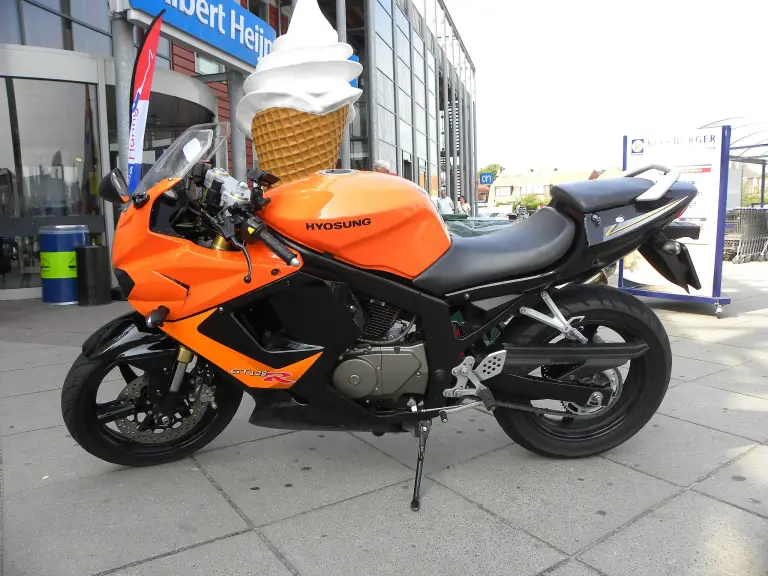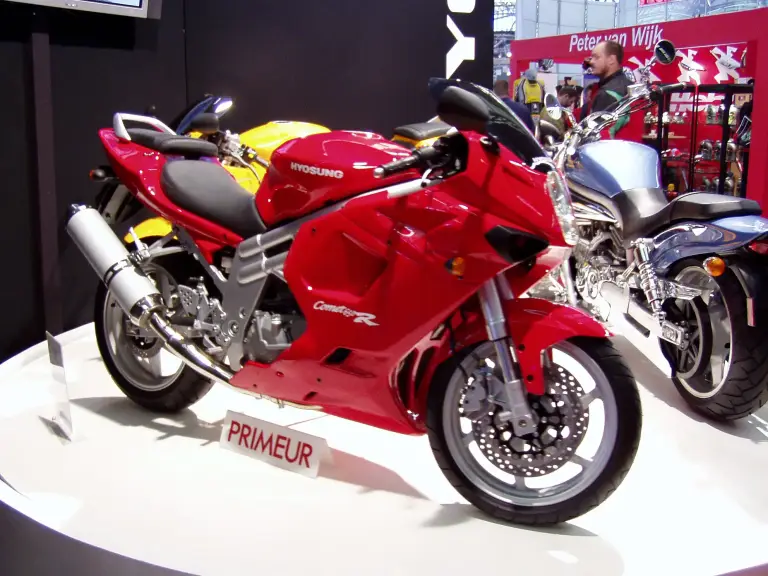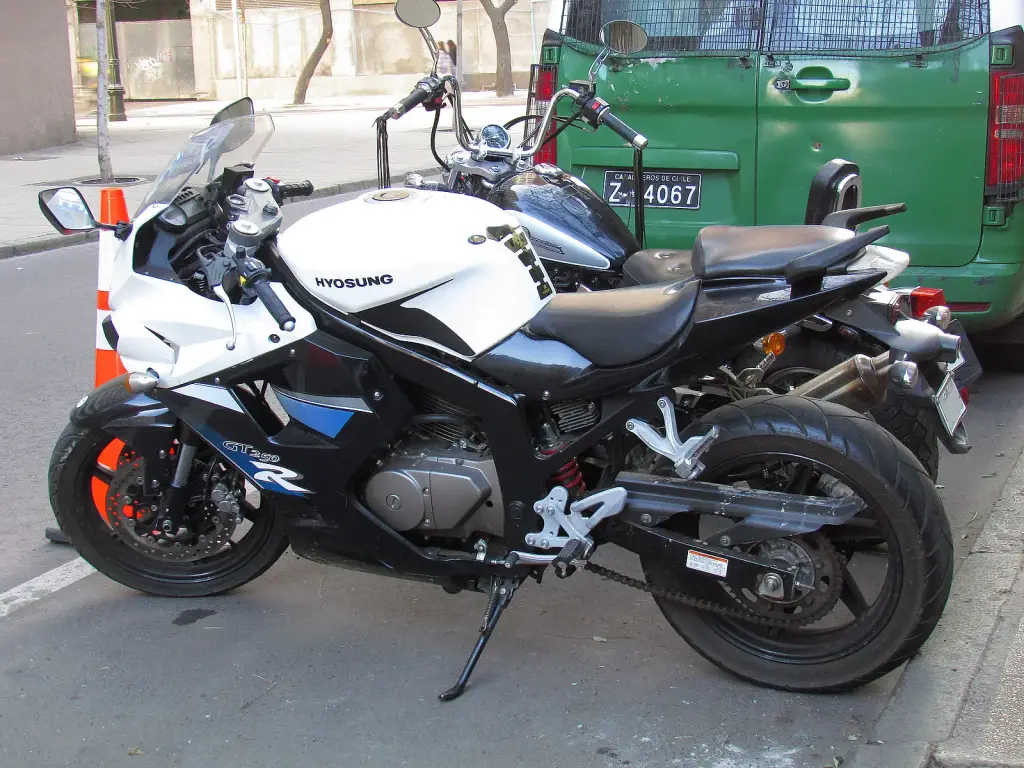
The Hyosung GT250 is part of the Korean firm’s GT series and shares most of its parts with the larger 650. It was offered in two forms: the naked GT250, sold as the Comet, and the faired GT250R sports bike. Both used the same 249 cc V-twin, so the bodywork was the main difference between them.
Hyosung GT250 at a glance
| Maker | Hyosung Motors & Machinery, South Korea |
|---|---|
| GT250 Comet | from 2004 |
| GT250R | from 2005 |
| Capacity | 249 cc |
| Engine | DOHC V-twin, eight valves |
| Engine design | by a team in Hamamatsu, Japan, with former Suzuki engineers |
| Fuel system | twin downdraft Mikuni carburettors, fuel injection from 2008 |
| Front brake | 300 mm disc, twin-piston caliper |
| Rear brake | 230 mm disc |
| Fuel tank | 17 litres |
| 0–60 mph | 7.6 seconds (Cycle World) |
Based on one source, the English Wikipedia article on the GT250.
History of the Hyosung GT250
The naked GT250 Comet was launched in 2004 and the faired GT250R the following year. Hyosung dropped the Comet name for the 2010 model, which was the first to have fuel injection as standard. Despite the badge history, early GT250R fairings still carried Comet stickers.
The 249 cc V-twin was designed in Hamamatsu, Japan, by a team that included engineers who had worked in Suzuki’s research and development departments. It uses roller-bearing camshafts, two-piece spring-damped bevel silent primary drive gears and dual squish combustion chambers, with double overhead camshafts and eight valves. Twin downdraft Mikuni carburettors were standard until 2008, when fuel injection became available.
Cycle World tested the GT250R at 7.6 seconds from 0 to 60 mph and 16.06 seconds over the quarter mile at 128.89 km/h. The magazine also recorded fuel consumption of 3.4 L/100 km, against 4.59 L/100 km for the Kawasaki Ninja 250R, which gave a range of about 500 km from the 17-litre tank. Non-adjustable 51 mm inverted forks were combined with a twin-spar steel frame, and the firm suspension gave good stability through corners. The GT250R came with a 300 mm front disc and twin-piston calipers, hardware usually found only on bigger sport bikes, with a single 230 mm rear disc.
For 2010 the GT250R was restyled, most visibly with a new rear LED stop and tail lamp. Electronic fuel injection became standard across Hyosung’s GT models, and the bike received an oil cooler rather than remaining simply air-cooled.
Design and features
- Suzuki-derived V-twin: designed in Hamamatsu by engineers with Suzuki experience.
- Two versions: the naked Comet and the fully faired GT250R on the same mechanicals.
- Strong brakes for the class: a 300 mm front disc with twin-piston calipers.
- Frugal: 3.4 L/100 km in Cycle World testing, about 500 km from a 17-litre tank.
- 2010 update: LED tail lamp, standard fuel injection and an oil cooler.
Hyosung GT250 versions
- GT250 Comet (from 2004): naked version, carburettors.
- GT250R (from 2005): faired sports version with the same engine and frame.
- Models from 2008: fuel injection available alongside carburettors.
- 2010 model: Comet name dropped, EFI and oil cooler standard, restyled tail.
The GT250 shares its chassis with the GT125 and its engine family with the GT650. The cruiser version of the same V-twin theme is the GV250.
Sources
- Hyosung GT250, English Wikipedia: production, engine, test figures, chassis, 2010 changes