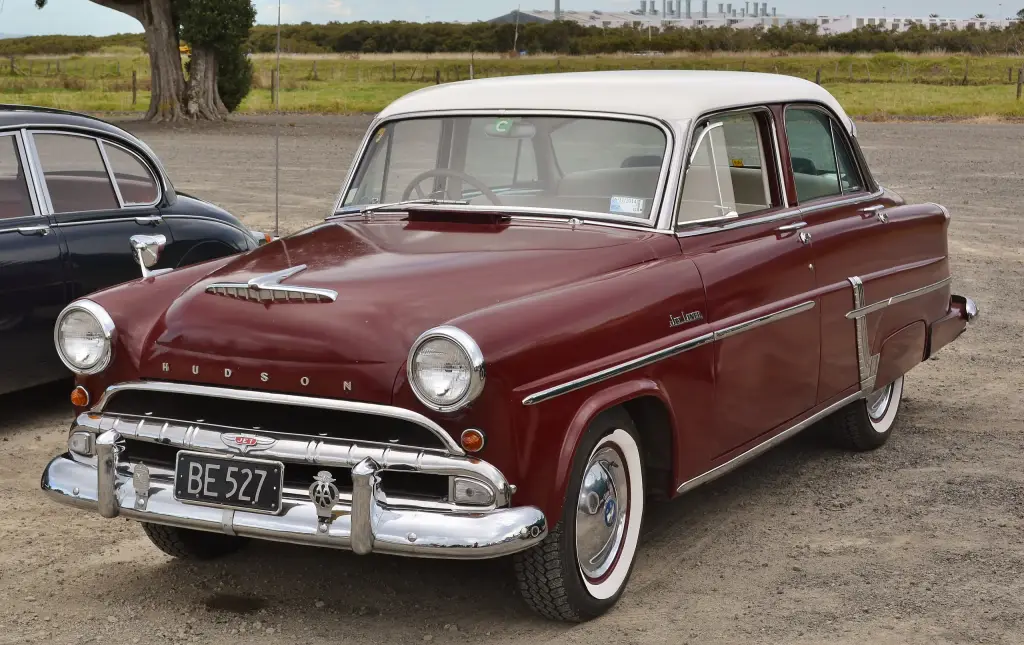
The Hudson Jet was Hudson’s compact car for the 1953 and 1954 model years, built to compete with the Nash Rambler and the Henry J. Well engineered and roomy, it arrived just as compact sales collapsed, and the losses on the project helped force Hudson into the 1954 merger that created American Motors.
Hudson Jet at a glance
| Maker | Hudson Motor Car Company, Detroit, Michigan |
|---|---|
| Production | 1953 and 1954 model years |
| Class | compact |
| Engine | 202 cu in (3.3 L) L-head straight-six |
| Power | 104 hp (78 kW) at 4,000 rpm |
| Torque | 158 lb·ft (214 N·m) at 1,600 rpm |
| Bodies | unitised Monobuilt bodies by the Murray Corporation of America |
| 1953 price | US$1,858 |
| Rivals | Nash Rambler and Henry J, the compacts that created the segment |
| 1953 production | a little more than 20,000 |
| Design influences | Hudson president A.E. Barit and Chicago dealer Jim Moran |
| Consequence | losses on the Jet contributed to the 1954 merger with Nash |
History of the Hudson Jet
Background
After the Second World War the American independents looked for segments the big three ignored. Nash launched the compact Rambler in April 1950 and Kaiser the Henry J in September 1950; together they sold more than 150,000 cars by 1951, about 3% of the American market. Hudson, with limited money, chose a compact rather than a V8 or a rebuilt full-size range. The result was meant to be roomy, comfortable, economical and cheap to maintain, with a welded unitised body.
Development
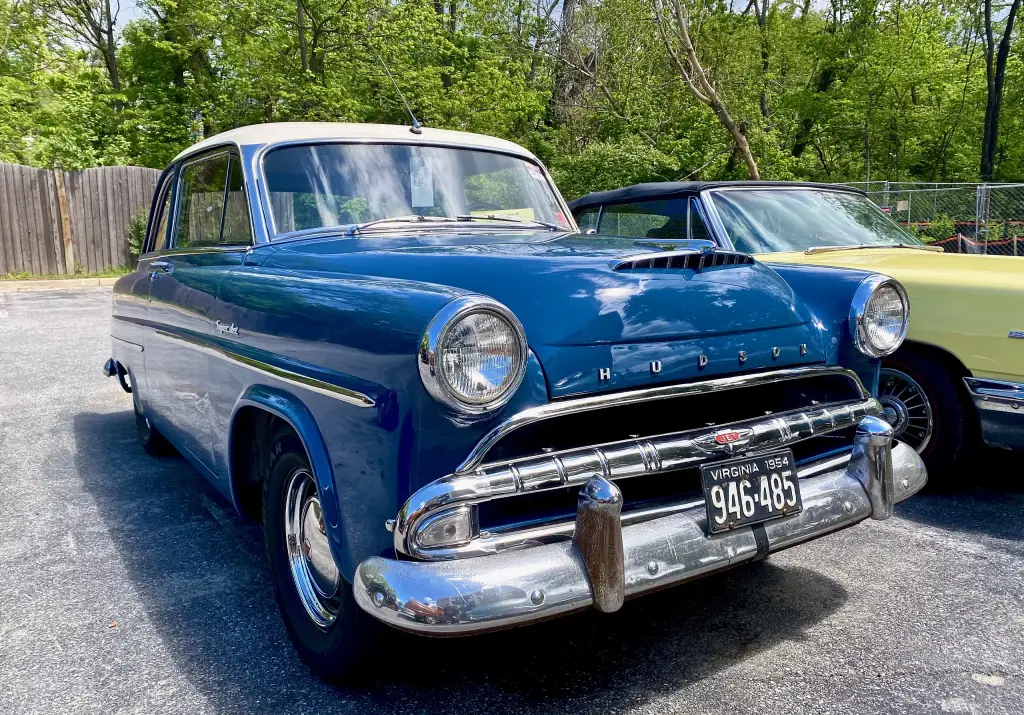
The 1950 Fiat 1400 was the inspiration, and early clay models were called “Bee” after Hudson’s Wasp and Hornet. Hudson president A.E. Barit overruled his stylists on several points: he wanted full-size car comfort, chair-high seating and a tall roof, then added a high rear fender and small round taillights copied from Oldsmobile, and a wrap-around rear window and roofline after the Chicago dealer Jim Moran admired the 1952 Ford. The finished Jet therefore looked in many ways like a smaller 1952 Ford.
Murray Corporation of America built the strong unitised bodies and agreed to spread the tooling cost over the production run, which made the car possible at all; but the cost-sharing agreement raised the price. In 1953 a Jet cost US$1,858, against US$1,734 for a full-size Ford and US$1,613 for a Chevrolet. Under the bonnet was a 202 cu in flathead six, a reworked version of Hudson’s prewar straight-eight with two cylinders removed, a longer stroke and full-pressure lubrication; it used a forged steel crankshaft and aluminium pistons.
Sales and aftermath
The Jet went on sale in the middle of the 1953 model year, but compact sales fell sharply between 1952 and 1954. Hudson built a little more than 20,000 Jets for 1953. The car itself had no real vices, yet the project’s losses, together with falling sales of the senior Hudson range, left the company no choice but to merge with Nash-Kelvinator and form American Motors in 1954.
Design and features
- Unitised Monobuilt body: a strong welded structure by Murray, engineered for the small-car market.
- 202 cu in flathead six: 104 hp and 158 lb·ft, with a forged crankshaft and aluminium pistons.
- Room and comfort: Barit insisted on full-size car seating and headroom in a compact package.
- Economy: low running costs and simple maintenance were central to the design brief.
Hudson Jet versions
- 1953 Jet: introduced in the middle of the model year at US$1,858.
- 1954 Jet: the second and final model year.
- “Bee” clay models: the working name and early studies before production.
- Styling borrowed from Oldsmobile and Ford: high rear fenders, round taillights and the wrap-around rear window.
The Jet was the compact companion to the Hornet and shared showrooms with the Commodore. More Hudson models are in the Hudson collection.
Video: 1954 Hudson Jet Liner For Sale
Video on YouTube.
Sources
- Hudson Jet, English Wikipedia: all facts on the background, development and sales