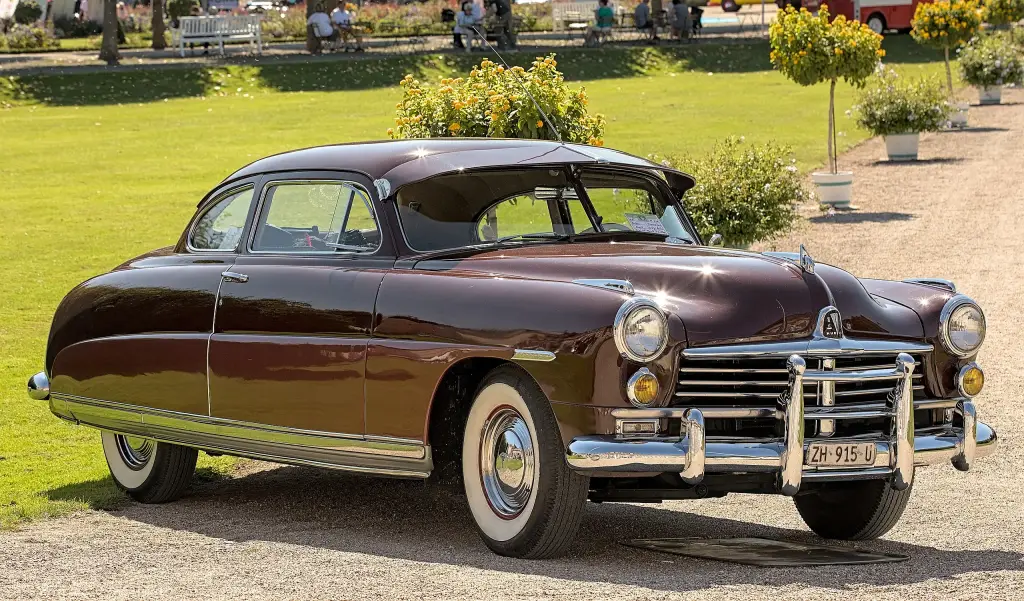
The Hudson Commodore was the largest and most luxurious car Hudson built, introduced in 1941 as the successor to the Greater 8. It came in three generations: the 1941–42 cars, the postwar models from 1946 and the rebuilt 1948 range with Hudson’s step-down body.
Hudson Commodore at a glance
| Maker | Hudson Motor Car Company, Detroit, Michigan |
|---|---|
| Production | 1941–1942 and 1946–1952 |
| Generations | three |
| Engines | 202 cu in (3.3 L) straight-six, 102 bhp; 254.4 cu in (4.2 L) straight-eight, 128 bhp |
| Wheelbase | 121 in (3,073 mm); 128 in (3,251 mm) for Custom Series 17 sedans |
| Clutch | Hudson Fluid-Cushioned Clutch with cork inserts in a sealed oil-filled housing |
| 1941 prices | US$1,028 for a Series 12 coupe to US$1,537 for a Custom Series 17 sedan |
| 1942 option | Drive-Master semi-automatic transmission |
| 1942 production | 5,396 cars before civilian production stopped on 5 February 1942 |
| First station wagon | Commodore Eight, about 100 built |
| Interior styling | Betty Thatcher, the first woman designer employed by a car manufacturer |
| 1948 design | step-down body with a low centre of gravity |
History of the Hudson Commodore
First generation (1941–1942)
The Commodore arrived in 1941 as Hudson’s most expensive and largest line, offered as sedans, coupes and convertibles, with a Commodore Eight station wagon as Hudson’s first car of that body style. The junior Commodores were the Series 12 with a 202 cu in six and the Series 14 with a 254.4 cu in straight-eight, both on a 121-inch wheelbase; the Custom Series 15 coupe used the same wheelbase and the Custom Series 17 sedan a 128-inch one. Every car had Hudson’s Fluid-Cushioned Clutch, a wet multi-plate unit with heat-treated cork inserts running in oil inside a sealed bell housing, which gave smooth engagement without a dry friction plate.
Marketing called the Commodore “America’s safest car”. It carried Double-Safe Hydraulics, a mechanical braking system working from the same pedal as a back-up for the hydraulic brakes, a handbrake mounted on the dashboard as a third way to stop, and coil-sprung independent front suspension with Hudson’s Auto-Poise Front Wheel Control. The hood was hinged at the front and opened from the rear by the windscreen, with a release lever beside the steering column. Hudson also sold a Sleeper Kit for sedans that turned the trunk into a double bed without disturbing the front seat.
The 1942 cars, released in August 1941, were facelifted with concealed running boards, new grilles and a white-triangle badge on the sides of the prow that lit with the headlights. A pioneering semi-automatic transmission called Drive-Master was offered in answer to General Motors’ Hydra-Matic: vacuum cylinders and solenoids worked the clutch and gears, with a dashboard knob for manual, clutchless or fully automatic driving. Civilian production ended on 5 February 1942, after 5,396 cars for the model year.
Second generation (1946–1947)
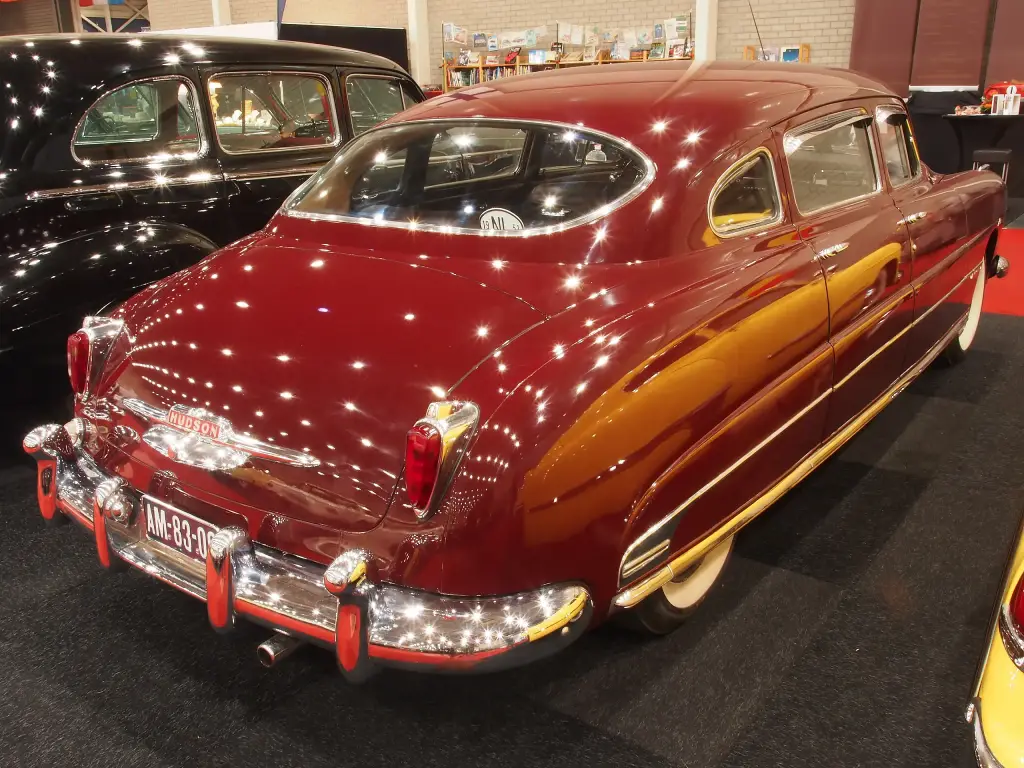
Hudson restarted car production on 30 August 1945 with designs based on the 1942 cars. The second-generation Commodore offered more standard equipment than its competitors, and it kept the prewar styling themes while the company prepared an all-new range.
Third generation (1948–1952)
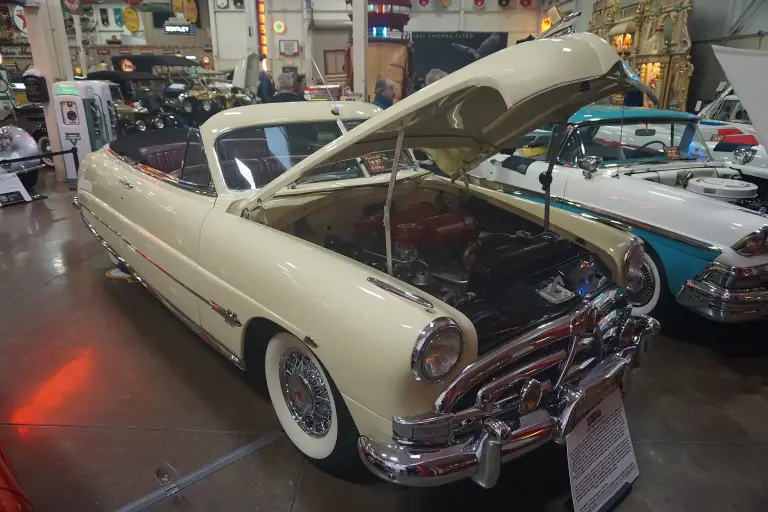
The third-generation Commodore was introduced for the 1948 model year and was one of the first brand-new postwar American designs. Its step-down body combined a low centre of gravity, better handling than contemporary cars and a distinctive low-slung shape, and it set the engineering direction Hudson followed into the 1950s.
Design and features
- Fluid-Cushioned Clutch: an oil-filled wet clutch with cork inserts that engaged smoothly and lubricated itself.
- Double-Safe Hydraulics: a separate mechanical braking system backing up the hydraulic brakes from the same pedal.
- Forward-hinged hood: opened from the windscreen end, with the release lever by the steering column.
- Drive-Master: a 1942 semi-automatic option offering clutchless or fully automatic gear changes.
- Sleeper Kit: a dealer accessory that made a double bed in the trunk of a sedan.
Hudson Commodore versions
- Series 12 (1941–1942): the six-cylinder junior Commodore on the 121-inch wheelbase.
- Series 14 (1941–1942): the straight-eight junior model, same wheelbase.
- Custom Series 15: the eight-cylinder coupe on the 121-inch wheelbase.
- Custom Series 17: the long 128-inch sedan, the top of the range.
- Commodore Eight station wagon: Hudson’s first wagon, about 100 made.
- Body styles: sedans, coupes and convertibles across the three generations.
The Commodore’s step-down chassis was developed into the Hornet, and the cheaper Pacemaker sat below the Commodore in the early 1950s range. More Hudson models are in the Hudson collection.
Video: Rare 1950 Hudson Commodore at Crusin’ Grand
Video on YouTube.
Sources
- Hudson Commodore, English Wikipedia: all facts on the three generations